As of Saturday morning, the Pentagon’s website was still listing 14 service members killed.
“It is truly disgusting and disheartening to lower the count of our service members who gave their life for this country,” said Tanya Stamos, a Navy veteran and the founder of Operation R.J.S., a nonprofit in honor of her father, Richard James Stamos, also a veteran, that provides free telehealth counseling and support.
She continued: “As a Navy combat veteran myself, I find it a slap in the face that it is so easy to disregard my brothers and sisters in arms who raised their hand and gave an oath to protect and serve foreign and domestic, all for the government who is choosing to wipe their names from history.”
The brother of Dominic Ascioti, 36, is in the military and has been deployed to the Middle East during the war.
Mr. Ascioti said the change in the count by the Pentagon was either “gross incompetence” or “a deliberate attempt to mislead or mischaracterize reality.”
He said it reminded him of how Russia hides the number of its dead from its war on Ukraine.
“As families we need, to the best of the government’s ability, some transparency,” said Mr. Ascioti, who added that he opposed the war. “We want to know what’s happening with our family, and we want to know what happened to our family if something happened.”
The criticism of the Pentagon over its accounting of American casualties in the war has extended to the halls of Congress. On Thursday, a group of Democratic senators sent a letter to Defense Secretary Pete Hegseth requesting a “comprehensive accounting” of the number of service members killed or wounded.
In the week before the recent attacks that killed three soldiers in Jordan, there were three other strikes by Iran that left dozens injured. These casualties were not immediately disclosed by the Pentagon, raising questions about whether the government was meeting its obligation to inform the country about the number of service members who had been either wounded or killed.
President Donald Trump bombed at the White House Correspondents’ Dinner Friday night. He knew he was bombing, too, and he even tried to meta-joke his way out of it.
But no. Even the president’s jokes about his bad jokes fell flat, and he was widely ridiculed for the comedy routine afterward.
Members of the media mocked the leader’s dismal performance on live TV and all across the internet. In some other countries, that’s a criminal offense. But in the US, it’s the norm, so maybe Trump’s speech unwittingly underscored the theme of the dinner: America’s robust First Amendment protections.
In
a rambling hour-long speech, Trump insulted journalists by name,
repurposed old nicknames for political opponents, made a strange number
of fat jokes that weren’t funny at all, and sounded mad at his unnamed
writers for giving him weak material to work with. “Does anyone
understand this stuff?” he said at one point, and the answer was
generally no.
Some of Trump’s remarks were “vicious,” as press secretary Karoline Leavitt promised. But more than anything, the speech was just… boring.
And boring is one thing Trump never, ever wants to be. He claimed to be singlehandedly keeping the news business afloat, commenting, “When I’m gone, you’re all going to be broke.”
“Nobody gives a damn about anybody else,” he said, and proceeded to count how many stories on The New York Times front page are about him.
Attendees were mostly silent while Trump delivered lines better suited to a MAGA rally than a black-tie dinner.
Trump’s low energy led more than one TV executive to muse that the president had stumbled upon a new technique against the media: Tank the ratings with a snoozefest.
”The other day, a senator I knew got a text, a great guy, from his wife, and she said, ‘When you get home, I wanna have you immediately come up the stairs and make love to me.’ And he said, ‘I can’t do both.’ You know what that you know? In other words, can’t go up the stairs and make love.”
“I think… Does anybody get that? Well, I thought that was actually pretty good. That was actually the only thing I thought was good in this whole fricking stupid speech that they wrote. That was the only good one, and that went down with not exactly great laughter. No, think. You know, in other words, you can’t go up the stairs and make love, two different.”
Measles cases in the U.S. have surpassed last year’s totals to reach a new 35-year high, and we’re only in July.
The Centers for Disease Control and Prevention announced Friday that there have been 2,318 measles cases in 2026 so far, more than the 2,289 cases reported in 2025 and many more than the 283 cases reported in 2024. The last time the numbers were this high was in 1991, and the past 18 months have seen more measles cases than the last 25 years combined.
The vast majority of infected people—93 percent—were unvaccinated, according to the CDC. The number is expected to only grow higher, as new outbreaks have been reported in Wyoming, Delaware, and Arizona. It doesn’t help that the CDC hasn’t had a permanent director for most of President Trump’s second term, and Secretary of Health and Human Services Robert F. Kennedy Jr., who is skeptical of all vaccines, has a history of dismissing measles, even though it can be fatal.
In 2000, the U.S. had declared measles eradicated in the country, but the Pan American Health Organization will review that status later this year. Meanwhile, Kennedy’s HHS isn’t openly supporting vaccination, with the secretary suggesting that vitamin A is an effective treatment for measles.
Jack, 50, scouts an app for deals at her local supermarket before she buys groceries. When she reaches the store, she looks in the weekly circular for coupons she might have missed. If shelf prices look too high, she tries to find lower prices someplace else.
“The apples went up here, the ones I eat, so now I’m not going to get them here,” Jack said as she pushed a cart into a Stop & Shop near her home in Lexington, Massachusetts.
With a conflict in the Middle East creating more price pressures, the cost of filling refrigerators, freezers and pantries has made affordability a central issue in the fall midterm elections.
Residents of four urban areas where food inflation has exceeded the national average shared how steadily rising prices are changing the way they shop. They described hunting for discounts, switching to store brands and feeling grateful for food banks. Some are buying less meat and skipping nonessentials like cookies. Others are buying less food overall.
And Marcia Greenwood (USA TODAY) adds:
In 2025, nearly one in five adults ages 18 to 64 — almost 20% — paid for groceries with savings, and nearly one in 20 — more than 5% — bought them with cash from a payday advance loan.
Those are two of the findings of a survey by the Urban Institute, a Washington, D.C.–based nonpartisan think tank that conducts economic and social policy research.
[. . .]
New Bureau of Labor Statistics data show that food costs have gone up over the past year.
According to its July 14 report, food-at-home costs rose 2.7% over the 12 months ending in June.
Over that same period:
- The cost of fruits and vegetables rose 5.3%
- The cost of nonalcoholic beverages increased 2.9%
- The cost of meats, poultry, fish and eggs was up 2.6%
- The cost of cereal and bakery products rose 2.4%
- The cost of dairy and related products increased 0.4%
Chump doesn't care. Tami Luhby (CNN) reports:
A growing number of Amazon and gig economy workers earn so little that they rely on public assistance to put food on the table and obtain health coverage, a Government Accountability Office study released Wednesday found.
The report is yet another example of the affordability crisis affecting many in the United States, where even some employed Americans need government help to pay for basic needs like food and healthcare.
The number of Amazon employees receiving food stamps and Medicaid in September nearly tripled since the GAO’s previous report in 2020, according to Vermont Sen. Bernie Sanders, who requested both analyses. Nearly 12,350 Amazon staffers were enrolled in food stamps and nearly 11,350 were covered by Medicaid in the states GAO examined.
Meanwhile, rideshare and food delivery companies are now among the top employers of recipients in the two safety net programs in several states, which was not the case five years earlier. Those companies include Uber, Lyft, DoorDash, Grubhub and Instacart.
This is the Chump economy. And the addition to SNAP enrollment comes as Chump's cuts to SNAP are really registering. People are going hungry in this country -- that includes children. And it's thanks to Chump's 'Big Beautiful Bill' which gutted the safety net while giving millionaires and billionaires huge tax breaks. Aliss Higham (NEWSWEEK) notes:
Wholesome eating is a central part of the Trump administration's efforts to Make America Healthy Again. But a landmark nutrition education program for recipients of federal food assistance and other low-income people will cease to exist within weeks after President Trump eliminated it last summer when he signed a massive Republican spending and tax bill.
For decades, the Supplemental Nutrition Assistance Program Nutrition Education and Obesity Prevention Grant Program, known as SNAP-Ed, has funded programs such as community cooking classes, farmers markets in low-income neighborhoods, school nutrition lessons and more in every U.S. state. The program is a "pillar of the public health infrastructure in the US," according to a report published in the Journal of Nutrition Education and Behavior.
The decision to end SNAP-Ed at a time of rising food prices and the Trump administration's push for healthy eating has mystified nutrition advocates and public health experts alike.
"It doesn't make sense when we have an administration [promoting] the Make America Healthy Again efforts that are focused on decreasing consumption of ultra-processed foods and wanting to encourage people to eat more fruits and vegetables," said Tashara Leak, a professor of nutritional sciences at Cornell University, "to then get rid of the largest federally funded nutrition education program that helps to achieve those goals."
Donald Trump Jr., who once called Andrew Tate a friend and publicly defended him against previous criminal allegations, has said nothing about the arrests. Neither has his younger brother Barron Trump, who had also been friendly with Andrew. Candace Owens, a conservative commentator who backed both brothers on her popular show, has also stayed silent.
Privately, people close to Donald Jr. have played down his relationship with the Tates; one person said he had not spoken with anyone in the administration about their arrests.
Asked by The Times about his retweeting of Tristan Tate on Saturday, Roger Stone, a prominent Republican operative, said he did so before the news of their arrests. And Paolo Zampolli, a special envoy for Mr. Trump who had hosted the Tates at a party in Washington two days before the arrests, said he hadn’t realized the extent of the allegations against them.
“I didn’t know they were arrest material,” Mr. Zampolli said in an interview.
On Thursday, federal marshals in Miami took the Tates into custody. In addition to the charges they face in the U.K., the brothers remain embroiled in grave human-trafficking and minor-exploitation proceedings in Romania and investigations in Florida about new allegations.
In the days since their arrest, their attorney Joseph McBride — who has also represented Jan. 6 defendants — has insisted the arrest is political persecution, and he has been amplifying supportive commentary online from media figures with close ties to the Trump administration. MAGA influencer and white nationalist Nick Fuentes wrote that it would be a “national humiliation” if Trump agreed to extradite the brothers to Britain over what he called “trumped up ‘Me Too’ charges.” Other far-right influencers reportedly joined in, but to no avail.
Trump’s refusal to intervene in the Tates’ extradition fight is a much-delayed correction. For years, the brothers were treated by the MAGA ecosystem not as alleged traffickers facing serious criminal scrutiny, but as useful avatars of male grievance and anti-feminist rebellion. That bargain is now boomeranging in the direction of a different Trump: Barron.
The key to understanding how the Tate brothers rose to such political heights — and why their collapse now threatens to drag the president’s youngest son into a potentially damaging congressional spotlight — can be found in the conservative media ecosystem that laundered Andrew Tate into a right-wing icon.
When mainstream platforms like YouTube, Meta and TikTok finally moved to deplatform the Tate brothers in 2022, the right-wing media apparatus stepped in to grant Tate a second — and far more dangerous — life. Tucker Carlson first gave Tate a platform on Fox News back in 2022 and later hosted a long, sympathetic interview. Elon Musk reinstated Tate’s X account, restoring his reach to over 11 million followers while repeatedly tweeting defenses that hand-waved sex trafficking allegations as political distractions. The late Charlie Kirk chimed in on behalf of Tate: “What he says is so powerful. Our society is configured towards collapsing the American man.” MAGA podcaster Candace Owens dedicated hours of airtime to declaring the Tates’ innocence while launching vicious smear campaigns against their victims.
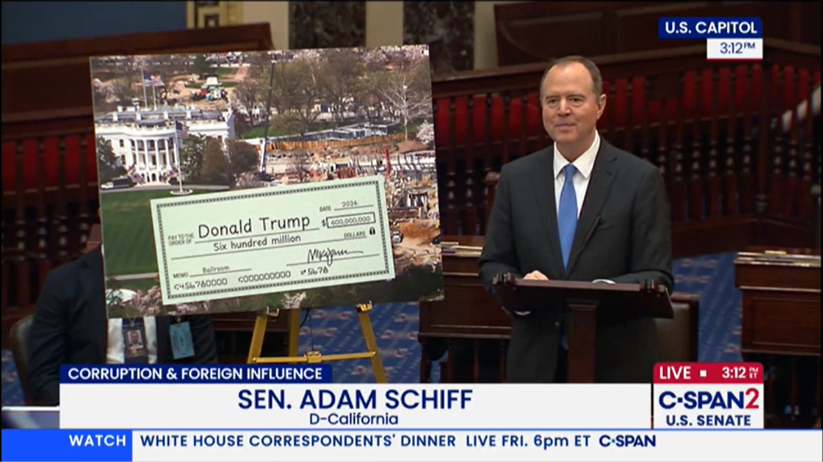
Washington, D.C. — Today,U.S. Senator Adam Schiff (D-Calif.) broke down just some of the ways President Donald Trump has used the presidency to enrich himself and his family in a speech titled: “The Cost of Corruption: Top 10 Ways Trump Has Profited off the Presidency.”
In his speech, Schiff highlighted schemes including the new overseas licensing of the Trump name announced in his second term, Trump’s settlements with media and tech companies and law firms, the Amazon-produced Melania Trump documentary, the White House ballroom project, the Air Force One airplane gifted byQatar, the president’s $TRUMP memecoin, stablecoin reserves and involvement with World Liberty Financial, and money Trump is extorting from the taxpayer through his so-called settlement with the IRS, which has netted him blanket tax immunity deal worth at least $100 million (and billions in income out of reach of IRS audit), as well as the attempted creation of a $1.7 billion slush fund.
Watch his full speech HERE. Download remarks HERE.
Key Excerpts:
On the need to root out corruption for an economy that works for all:
But it is even more crucial to root out corruption for another reason, and that is because the cost of corruption is an economy that does not meet the basic needs of the American people, an economy that does not produce housing that average families can afford, or a college education that young people can obtain without mortgaging their future, or quality healthcare that is accessible, or groceries that don’t break the family budget.
When the president is fixated only on his family’s personal wealth, on the money he can make by abusing the power of his position, on his own vanity projects, gilding the White House, gilding statues and gilding a ballroom, he has very little time or inclination to address the problems facing ordinary Americans. They are mere afterthought, and the country suffers.
On the effect of corruption in media companies getting less scrutiny after settling with Trump:
So, what’s the cost of that corruption to you? Well, if you’re a worker in the entertainment industry, it just might cost you your job, because a merger was approved on a corrupt basis and without considering job losses in the industry wasn’t made to benefit you.
If you’re a consumer, you’ll be paying more for your streaming service and have fewer choices, because this deal wasn’t approved with consumers in mind — it was approved to make money for the president.
On the president’s memecoin:
[…] The president invents a by-definition worthless asset, profits while hundreds of thousands of Americans lose their savings buying it, breaks bread with the people his government is investigating for defrauding investors, even as his administration puts an end to the alleged fraudster’s potential prosecution.
The cost of corruption here: hundreds of millions of dollars go to Trump, hundreds of thousands of Americans lose the value of their purchases — about $2 billion in total — and fraudsters get a pass to commit other frauds on the American people. More money for Trump, more fraud for you. This is the cost of corruption.
On what Trump’s ballroom donations pay for:
[…] Hundreds of millions in taxpayer funding that could go to building new hospitals in your community. Or building new schools, or keeping the ones near you open — go to a ballroom instead. Hundreds of daycare centers that could have received funding so you don’t have to pay so much for childcare, or so there is even childcare in your area.
But instead of building roads or bridges, hospitals or healthcare clinics or childcare, the president is building a gaudy gold tollbooth in place of the East Wing. And federal contracts are going to the biggest donors, not the best competitors, and that could cost you billions more in taxes.
On the crooked deals for fraudsters:
The cost of this corruption? Crooked deals to benefit convicted fraudsters. U.S. foreign policy for sale to the highest gulf bidder. Less time, attention and resources of the country focused on bringing down your costs, improving your quality of life, bringing back prosperity to America.
On what the Founders understood:
[…] The founders understood that once you accept the first gift, the second becomes easier and the third, and soon you’re not making decisions based on what’s right for the country, you’re making them based on who’s been generous to you. As president.
My colleagues, the White House has become a marketplace and the presidency a crooked family business. Every one of these transactions, the dozens we know about and the many more we surely don’t, raises profound questions about the influence of foreign governments and the buying and selling of American policy, American justice, and American democracy itself.
Read the transcript of his remarks below:
Mr. President,
More than a year and a half ago, when Donald Trump placed his hand on a Bible and took the oath of office for the second time, he swore to preserve, protect, and defend the Constitution.
In the time since, he has failed to live up to that basic promise. Instead, he has focused laser-like on a very different priority — to preserve, protect, and expand his family’s wealth.
The payments to the president and his family have been massive. The self-dealing and profiteering have been absolutely breathtaking in their scope.
And you don’t have to take my word for it. Two weeks ago, the president filed his annual financial disclosure — signed under penalty of law. It shows more than $2.3 billion dollars in income last year alone. $2.3 billion made by the president in the last year alone. Wow.
That is three and a half times what he reported the year before. So, either he’s just become a much better businessman since he became president, or he is corruptly using his office to enrich himself. The same can be said for much of the rest of his family.
Exposing this corruption is the first necessary step to stopping it. This is important in its own right — public servants should not be enriching themselves at public expense.
But it is even more crucial to root out corruption for another reason, and that is because the cost of corruption is an economy that does not meet the basic needs of the American people, an economy that does not produce housing that average families can afford, or a college education that young people can obtain without mortgaging their future, or quality healthcare that is accessible, or groceries that don’t break the family budget.
When the president is fixated only on his family’s personal wealth, on the money he can make by abusing the power of his position, on his own vanity projects, gilding the White House, gilding statues and gilding a ballroom, he has very little time or inclination to address the problems facing ordinary Americans. They are mere afterthought, and the country suffers.
That is the true cost of corruption.
So today, I’m going to walk you through the top ten ways this president has turned the Oval Office into a personal revenue stream. The settlements he’s collected. The gifts he’s pocketed.
The money he and his family have extracted from anyone with the misfortune of needing something from this government. And the pet causes he has extorted money to fund. Bear in mind, every number I am about to give you is either taken from his own financial filing, or from public reporting.
And because the president seems to enjoy ratings and rankings, we’ll count them down – from number ten all the way to number one — of the top ten most corrupt self-enrichment schemes of the president.
And by the time we reach number one, we will have tallied billions of dollars for him, for his family, for his personal whims — and nothing for you. That is the cost of corruption.
Let’s start small. And by small, I mean $23 million.
Since his re-election, the Trump family has made at least $23 million dollars licensing the Trump name overseas. A hotel in Oman. Towers in India. Golf courses on the outskirts of Riyadh and Doha.
These are just a few of the more than twenty overseas projects the Trump Organization is now pursuing – many of them requiring the cooperation of foreign governments. And here’s the thing about needing help from foreign governments when you happen to be the President of the United States —
Those governments are going to want something in return. They’re going to want you to treat them very, very favorably in return.
These countries all want something from the United States of America — U.S. military protection, U.S. nuclear power plants, U.S. technologies, U.S. AI chips, you name it. They want something from this country. And these countries are not investing in the Trump family projects out of the goodness of their hearts. They want payback, and much to the detriment of Americans’ national security interests, they are getting it.
Let’s look at just one example, this one from Southeast Asia. The administration agreed to lower its threatened tariffs on Vietnam — but not until after the Trump Organization broke ground on a $1.5 billion Trump golf complex outside of Hanoi. A golf complex that Vietnamese officials fast-tracked – by ignoring their own rules.
This kind of overt pay-to-play is playing out in country after country after country.
What is the cost of this corruption? Well, our national security suffers when the president sells advanced chips to a gulf nation, not because it’s in our interest to do so, not because our own AI companies don’t need the chips to compete, but because the president or his family got a payoff. Our country suffers when the president makes national security decisions for financial reasons that benefit not the country, but himself.
Did the president just approve nuclear power plants in Saudi Arabia because it’s a good idea? Or because the Saudis have been phenomenally generous to the Trump family business, to the president and his sons, and to his son-in-law Jared Kushner in particular, in whom they invested a cool $2 billion.
Will American troops, our sons and daughters, be more at risk of deployment to the Middle East, with more endless wars, or because of a nuclear arms race that we helped get started in the region — not because helping the Saudis go nuclear was good for us — but because the Saudis wanted payback for their investment in Donald Trump’s family? That is the cost of corruption.
Number nine brings us to perhaps one of the most frivolous media lawsuits to ever see the inside of a courtroom. Following a 60 Minutes interview with Vice President Kamala Harris during that presidential campaign, Trump sued CBS, alleging, believe it or not, “election interference.”
His claim?
That CBS edited the interview to make Harris sound better.
Let me remind everyone – most long-form television interviews are edited. That’s how television works. But in Trump’s reality, editing is election interference if he doesn’t like the edits.
CBS acknowledged the suit was frivolous. The president had no right to sue because he doesn’t like how an interview with someone else is edited. It’s absurd. The studio has a first amendment right to make those decisions for itself.
Nevertheless, CBS agreed to pay off the president — $16 million. Why? Not because they thought they would lose the litigation — they knew Trump’s claim would never be successful. No, CBS agreed to pay off the president because its parent, Paramount Studios, wanted to merge with Skydance in a deal worth $8 billion dollars. What was a $16 million dollar payoff compared to an $8 billion dollar deal?
And it wasn’t just the $16 million dollar payoff. Skydance also committed to paying another $20 million in advertising and public service announcements favored by the president. Final tally: $36 million, that the president was able to extort because he could leverage his power to kill the merger deal — into a personal payoff.
So, what’s the cost of that corruption to you? Well, if you’re a worker in the entertainment industry, it just might cost you your job, because a merger was approved on a corrupt basis and without considering job losses in the industry wasn’t made to benefit you.
If you’re a consumer, you’ll be paying more for your streaming service and have fewer choices, because this deal wasn’t approved with consumers in mind — it was approved to make money for the president.
This particular brand of corruption — suing media companies to extort them for payoffs — goes beyond anything the president did in first term. This president doesn’t just complain about the press – calling them “fake news” or “enemies of the people.”
No, no. That was the stuff of Trump 1.0.
In Trump 2.0, he sues them into submission. Uses the leverage he has over their business deals and mergers. And pockets the proceeds. More money for him, fewer jobs for you, and more money out of your pocket when you want to stream your favorite shows. This is the cost of corruption.
Number eight is a three-for-one. Twitter. YouTube. Meta. Sixty million dollars, combined.
Trump got suspended from these platforms for conduct related to the attack he incited on the Capitol. He sued. And one by one, the companies paid up. To him personally, and to his pet projects, like the golden ballroom.
Twitter – now Elon Musk’s X – settled for $10 million. A case a district judge had already thrown out and that an appeals court was openly skeptical of. They paid anyway.
And the president’s response?
He went on television to complain it was not enough, it was too low – that he “was looking to get much more money than that.”
YouTube settled for $25 million. And in a flourish of creative accounting, $22 million of it was routed straight to the White House golden ballroom project.
More on that ballroom in a minute.
But Meta – parent company to Facebook and Instagram – they also settled for $25 million.
And just to sweeten the pot, they kicked in an additional million to Trump’s inaugural fund.
So, let’s recap just this item. The president sues these platforms over their refusal to amplify his false claims about the election and his incitement of insurrection. Using the leverage he now has over them as president, to help or to hurt their businesses, he extorts them to the tune of $60 million dollars.
It is a disinformation loyalty program – except the rewards go to the president, and the rest of us get more false claims, more false information, more social harms from an unregulated social media, and potentially, more incitement of violence around our elections. This is the cost of that corruption.
For number 7, we move back to the family business.
You may have seen the trailers.
Amazon struck a $40 million deal with First Lady Melania Trump for a documentary about her life before and during her time in the White House.
Reports indicate that Melania’s team shopped the project to several studios and executives – many of whom had attended Trump’s inauguration – before Amazon closed the deal.
And Amazon, separately, contributed another $1 million to Trump’s inaugural fund.
Of the $40 million though, the First Lady personally received $28 million.
The big-time theatrical run of this film brought in only $16 million at the box office – landing it at a sweet #68 on the 2026 releases, behind “Bunny!!,” behind “Guru,” and behind “Mobile Suit Gundam Hathaway: The Sorcery of Nymph Circe.”
Bear in mind the Melania movie was so bad, that one reviewer at Variety said that if you saw the film on a plane, you would still walk out. But Amazon paid the Trump family $40 million for it. Why?
Because Amazon has huge government contracts at stake, worth billions of dollars. What is a $40 million payment for Melania, when you want a federal cloud computing contract worth a hundred times that much? Worth billions.
So – while families across this country are wrestling with the skyrocketing price of groceries, the First Lady is collecting $28 million for a documentary about….herself.
But more important, we end up paying Amazon billions in government contracts when Amazon may — or may not — be the best deal for the American taxpayer. When the amount of the contract may — or may not — be competitive with other companies, when Amazon may — or may not — be the best competitor in the bidding process.
We may never know if taxpayesr are getting ripped off, and whether the true cost of the Melania film was a bad deal for the country costing taxpayers billions of dollars on cloud computing that we didn’t need to spend.
This kind of corrupt contracting — where taxpayer funds are wasted because of a backroom deal or a kickback — is common in developing countries, but it hasn’t been common here, not until now. And that is the cost of corruption.
Just 24 hours before taking the oath of office, Donald Trump launched a memecoin called $TRUMP. A memecoin is, a kind of a “joke” digital currency. But Trump still saw the opportunity for personal profit – about $635 million worth.
And the people on the other side of that trade? More than 810,000 of them have lost a combined two billion dollars. That’s 810,000 people that bought this memecoin, this Trump memecoin, mainly the president’s own supporters, lost money so the president could make hundreds of millions of dollars.
But even that is not the end of the story. It gets worse.
Trump hosted a private dinner for the top holders of his memecoin. Investors were told they had a two-and-a-half-week window to buy enough $TRUMP to earn a seat. He created a public auction, where what was being auctioned off was access to the president – buy Trump’s memecoin and you get to dine with the president. Where? At his own private club in Virginia.
And among the guests?
A crypto billionaire who’d been charged by the SEC with fraud, in a case in which Trump’s SEC just coincidentally asked a judge to hit pause on the matter just weeks before the meme coin dinner.
And this March, the case was dropped entirely — dismissed with prejudice, never to be brought again — with the company paying a mere $10 million penalty while admitting nothing. This, for a crypto billionaire who had poured some $75 million into Trump family crypto ventures.
So, to recap this item, the president invents a by-definition worthless asset, profits while hundreds of thousands of Americans lose their savings buying it, breaks bread with the people his government is investigating for defrauding investors, even as his administration puts an end to the alleged fraudster’s potential prosecution.
The cost of corruption here: hundreds of millions of dollars go to Trump, hundreds of thousands of Americans lose the value of their purchases — about $2 billion in total — and fraudsters get a pass to commit other frauds on the American people. More money for Trump, more fraud for you. This is the cost of corruption.
Number five is one of the most audacious schemes in presidential history: the gold-plated, gilded, and gaudy White House ballroom. The president has solicited ever-larger donations for this pet project – which now has a whopping price tag of $600 million.
A $600 million monument to his vanity, built for him by people who need something from the government. And paid for by you, the taxpayer. Because far from the president’s promise that no tax dollars would be used for his golden ballroom, he’s making you pay an estimated $300 million of your tax dollars towards this project. Promises made, promises broken, and the taxpayer left holding the bag.
Now – I have sought answers from the White House on this ballroom. Asking who are the private donors, and how much they have given, and what business do they have before the federal government. Their response?
Not surprisingly, no response. Not willing to say. Not willing to be transparent. Wanting to keep it hidden from the American people.
But we know there are at least 37 donors. Among them, Amazon and Apple and Google and Meta and Microsoft and Coinbase and Tether and Caterpillar and Lockheed Martin and T-Mobile. And more.
Of these corporate donors, two-thirds have been awarded federal contracts over the last five years – contracts worth $279 billion. And fourteen of them are either facing, or have had suspended, federal actions for violations of the law.
So let’s get this straight – companies under federal investigation, many of them, write a check for the president’s ballroom, and their legal troubles go away, or their contracts multiply. Or in some cases, both.
Trump even told these donors they’d be the first guests welcomed into the finished ballroom – “if I still like you at that time, which I’m sure I will.”
Translation? Keep paying, and I’ll keep liking you.
The cost of this corruption: Hundreds of millions in taxpayer funding that could go to building new hospitals in your community. Or building new schools, or keeping the ones near you open — go to a ballroom instead. Hundreds of daycare centers that could have received funding so you don’t have to pay so much for childcare, or so there is even childcare in your area.
But instead of building roads or bridges, hospitals or healthcare clinics or childcare, the president is building a gaudy gold tollbooth in place of the East Wing. And federal contracts are going to the biggest donors, not the best competitors, and that could cost you billions more in taxes.
Number four is the gift that keeps on taking.
A $400 million luxury jet, “gifted” by the government of Qatar, to serve as Air Force One through the end of Trump’s term.
And then?
Transferred to Trump’s own museum foundation. His to keep! He took his maiden flight aboard it just a few weeks ago.
And while the president insists the plane is “free,” outfitting it to serve as Air Force One could cost American taxpayers up to one billion dollars in security upgrades.
A billion dollars. For this “free” jet. That he gets to keep. Paid for by you, the taxpayer, and his generous friends, the Qataris.
And let’s not pretend there’s nothing expected in return. Trump himself volunteered that the United States provides security for Qatar – and “will continue to.”
He also explained that only a “stupid person” turns down a “free very expensive airplane.” Only a stupid person would turn it down. How could he refuse?
So, a foreign government hands the president a $400 million jet. We pay a billion in taxes to make it usable. He keeps it when he leaves office. And if you think that’s corrupt, he thinks you’re the stupid one.
That is not a gift to America. It’s a gift to Donald Trump – paid for by the American taxpayer, courtesy of a foreign government that now holds a great deal of leverage over the president.
The same foreign government whose wealth fund is invested in developing the Doha Trump International Golf Club – complete with luxury villas and 18 holes of world-class golf.
The cost of this corruption: American foreign policy our national security interests in the region now skewed towards a country that gives the president exorbitant gifts or develops real estate deals with his family.
That is not putting America first, but putting it last, well behind his family and personal interests in a plane and golf courses.
At three –– the numbers have turned even more staggering.
After a barrage of executive orders targeting the legal profession, nine wealthy law firms struck deals with the administration – pledging nearly one billion dollars in “pro bono services” to make those threats go away. Threats to disfavor their clients, threats to take their security clearances away so they couldn’t represent other clients, threats to look unfavorably on the mergers their clients want, government contracts or lucrative deals favored by their clients.
Now this money didn’t land directly in the president’s bank account. This is value he extracted – nearly a billion dollars in legal work, redirected to causes he favors, surrendered by law firms who were afraid of what he might do to them if they refused.
And who negotiated these deals? Reportedly, Boris Epshteyn – the president’s personal lawyer. Not a government official. A private citizen, allegedly shaking down America’s largest law firms on the administration’s behalf.
Nine hundred and forty million dollars, extracted under threat. And all too easily complied with by firms that were unwilling to take a stand. It is a modern protection racket.
What is the cost of this corruption: well, law firms are silenced from representing clients whose interests may be averse to the president. That might be you one day. Businesses unable to get counsel because these law firms are too scared of crossing a vindictive president. That business may be your business one day.
And the law firms that stood their ground and defied the president, they risk losing business in a corruption of the economy that only favors firms willing to capitulate to the president. It is Putin-style economics. And it doesn’t work any better here than it does in Russia.
We are now in the top two.
World Liberty Financial. The Trump family cash cow.
A firm in which the Trump family holds an ownership interest of around 75 percent.
The sale of these governance tokens has earned the family well over a billion dollars. A single deal tied to a state-backed fund in the United Arab Emirates funneled $500 million into this venture. A single deal, made by a wealthy sheik who is also head of that country’s intelligence service. What could go wrong? And in return, they just got American made advanced AI chips, just like they wanted. Coincidence? I don’t think so. If you do, I have a ballroom I’d like to sell you.
But the scheme doesn’t stop here.
Because the Trump family is also entitled to the interest earned on the reserves backing their stablecoin – this income is ongoing, grows by the day, and is pegged to the U.S. dollar itself. Unlike the memecoin, this is real money.
More than $1.5 billion. And counting.
Over a billion and a half dollars, flowing to the president’s family, through a financial instrument his family controls, launched while he sits in the Oval Office.
Not a side business. Not a blind trust.
The President of the United States, using the power and prestige of his office to drive money into a venture he owns – and from which he profits every single day.
And consider what one of the family’s business partners got in return. The world’s largest crypto exchange, Binance, helped turn World Liberty’s stablecoin from a small venture into one of the largest in the world — first by settling a $2 billion investment from an Abu Dhabi state fund in the Trump coin, then by building it into the exchange’s own trading systems.
And for that Trump family earns interest on every dollar.
And the founder of Binance, what did he get out of it? He’d been convicted of money-laundering crimes and was facing the consequences. Until, last October, when the president pardoned him. A foreign-funded boost to the family business, repaid with a presidential pardon.
The cost of this corruption? Crooked deals to benefit convicted fraudsters. U.S. foreign policy for sale to the highest gulf bidder. Less time, attention and resources of the country focused on bringing down your costs, improving your quality of life, bringing back prosperity to America.
Which takes us, ladies and gentlemen, to number one. The crown jewel.
The president his IRS settlement and the $1.7 billion slush fund. So, here’s the scheme and you have to give the president credit for its audacity. The president sues the IRS an agency run by one of his employees, one of his appointees, and represented by the Department of Justice, also run by one of his appointees. His lawyers bring the suit, and his lawyers defend the suit. He is functionally suing himself.
And he, not surprisingly, settles with himself for a staggering amount. He gets an IRS get out of jail free card, he faces no audit or investigations for any prior tax fraud or underpayment that he, his kids, his businesses, or his associates have ever made or participated in — a deal estimated to be worth up to $100 million dollars for the Trump family, personally.
It is a sham settlement, castigated by a federal judge as based on a suit brought wholly for an improper purpose and a settlement that was the product of the worst form of collusion and self-dealing. But that is just the start. The $100 million tax get out of free card only a start.
The settlement also purports to give the president control over $1.776 billion in taxpayer money which he can use as a personal slush fund to compensate his friends and allies who claimed that they were wronged. Included among the aggrieved — people who violently attacked law enforcement officers on January 6th.
Now these people who attacked police officers on January 6. They already got pardoned by the president, on his first day. But that wasn’t enough, for them or the president. They want to be paid for their acts of insurrection, and the president is willing to pay them with your tax dollars. Imagine, your tax dollars going to pay cop beaters.
And besides the morally repugnant nature of that slush fund and its beneficiaries, it comes at a huge cost. He wants nearly two billion of your money your tax dollars to fund this cop beater program. Not to serve the public. But as a pot of money, he controls – to pay out to the people loyal to him. Willing to use violence for him.
Congress and the courts have compelled Trump’s acting attorney general to back off the fund for now, but not the president. He still wants to make the payoffs to his cronies and enablers, and the administration is looking for other ways to loot the treasury for the same purpose, using other funds of the Department of Justice.
Taxpayer money, converted into a personal patronage for the president.
There is a word for governments that take public money and hand it to their friends.
And it is not “republic.”
The cost of this corruption: incalculable. Besides misappropriating billions of your money, it is also rewarding people seeking to overturn a free and fair election. If it succeeds in encouraging others to do so in the next election, the cost to you just may be our whole democracy.
So, let’s add it up.
Overseas licensing: $23 million
Media lawsuits: $36 million
Big Tech settlements: $60 million
Amazon and Melania: $40 million
The memecoin: $635 million
The White House ballroom: $600 million
The Qatari jet: $400 million
Big Law: $940 million
World Liberty Financial: $1.5 billion and counting
The IRS giveaway and slush fund: $1.7 billion and $100 million
For a grand total of 6 billion dollars. And that fellow Americans is just the top ten.
That doesn’t include the Trump wine sold at the Coast Guard exchanges. It doesn’t include Don Jr.’s executive branch club. It doesn’t include the Trump resort in Qatar or the Trump hotel in Belgrade. It doesn’t include Don Jr.’s 2.6 million in a drone company that just got, coincidentally, landed an army contract. And it doesn’t even include all the stock trades of the president.
The president’s own filing shows 3,642 trades in just the first three months of the year. 58 trades every single market day. Up to three quarters of a billion dollars worth of trades. Think about that. The man who’s supposed to be running the country, instead he’s running a trading desk.
And what a trader he is. He bought Nvidia stock on January 6th of this year, and one week later, his commerce department approved Nvidia chip sales to China, a $50 billion opportunity for the company. He bought more Nvidia in February. A week later, Nvidia announced a blockbuster deal with Meta.
What are the odds, trade after trade, perfectly timed two decisions only his government knew were coming?
And these are only the deals that we know about.
No one put this historic level of corruption in perspective better than the Vice President, J.D. Vance, who recently told a crowd that if Watergate took place today, it would be a 12-hour story.
Think about that for a moment. If the president broke into the Democratic Party headquarters, bugged the place, used hush money to cover it up, used the CIA to thwart the FBI’s investigation of it. Lied to the country about it. J.D. Vance says that would be a mere blip on the screen for them today.
He is telling us, the Vice President is telling us, that the corruption of the Trump regime, his regime, is so pervasive, they have so successfully normalized it, that Nixon’s behavior would seem quaint. Congratulations, JD. You’ve made the most egregious corruption commonplace. Well done. You should be so very proud.
After Watergate, Congress passed a host of reforms to constrain a future corrupt president. They included limits on campaign finance, safeguards to wall off presidential misuse of the Justice Department, New oversight mechanisms for the intelligence community. Offices of Inspector General to root out fraud and much more.
It now falls on us in this generation to usher in a whole new set of reforms to address a far broader range of lawlessness and corruption.
During the first Trump administration, I introduced the Protecting Our Democracy Act, a package of reforms meant to address the many violations of law and norms by the president at that time. We have reintroduced it in the Senate, but as the list of laws and guardrails shattered multiplies, the need for corrective action must multiply with it.
Just this week, I have introduced three additional bills meant to attack conflicts of interest, keep convicted fraudsters out of the government and tighten our laws against the bribery of public officials. In the weeks and months to come, we must propose the best laws that we can, meant to constrain the worst impulses of human nature.
But we must be mindful of this truth as well. And that is, no set of laws, no matter how well conceived, no Constitution, no matter how brilliantly constructed, can protect our lives, our liberty, our prosperity if elected officials are unwilling to live up to their oaths or to accept the truth or to put their country over their party. None of it will be enough.
We must also return prosperity to America. We must make it possible when people are working hard they can earn a good living for themselves and their families. When people see the lives that their parents had as better, all too many are willing to entertain and put their fate in the hands of any demagogue who promises that they alone can fix it.
Our democracy will not be on solid ground until our economy is working again for all Americans.
When the founders gathered in Philadelphia in the sweltering summer of 1787, they debated a great many things. But one fear united them across every divide, the fear of corruption. They had just thrown off a king. They had risked everything, their lives, their fortunes, their honor, to build something new.
A republic, a government of laws, not men. And they knew with a clarity born of hard experience that a republic would not long endure if leaders used public power for private gain. That’s why they wrote a constitution of checks and balances. One that set the ambition of one branch of government against the other. And included provisions meant to address the personal weaknesses and failings of a president, any president.
Because they understood human nature. They understood those in power would be tempted to enrich themselves. They understood that foreign governments would try to buy our leaders with gifts and payments and favors. They imagined something like what we are witnessing today.
But what they may not have imagined, what they may have exceeded even their worst fears, was a president so brazen, so shameless, so relentless, and so creative in the pursuit of personal profit. And a Congress so feckless, so loath to confront him, so lacking an ambition for its own power and institution, so willing to let him profit at the public expense, with payout after payout after payout.
In 1785, Benjamin Franklin was serving as our ambassador to France. The King of France gave him a gift, a snuffbox encrusted with diamonds, a gesture of diplomatic friendship. In Paris, such gifts were routine, business as usual. But back home in America, it sparked a controversy. Franklin had to ask Congress for permission to keep it, and the Congress, then under the Articles of Confederation, granted it.
But the concern that a leader less scrupulous than Franklin would be tempted, would be compromised, lingered. So, when delegates gathered in Philadelphia two years later to write our Constitution, they remembered the snuffbox. The first draft said nothing about foreign gifts or emoluments. The final draft did, because they remembered the snuffbox.
Edmund Randolph, one of the Constitution’s framers, later explained it this way. This restriction was provided to prevent corruption. A box was presented to our ambassador by the king of our allies. It was thought proper in order to exclude corruption and foreign influence to prohibit anyone in office from receiving or holding any emoluments from foreign states.
They wrote it into the Constitution because of a snuff box.
Imagine. And now we have a president accepting a $400 million jet? Can you imagine what the founders would have thought of that?
We have a president earning more than a billion dollars from a cryptocurrency company, his family controls funded in large part by foreign interests. The founders understood that once you accept the first gift, the second becomes easier and the third, and soon you’re not making decisions based on what’s right for the country, you’re making them based on who’s been generous to you. As president.
My colleagues, the White House has become a marketplace and the presidency a crooked family business. Every one of these transactions, the dozens we know about and the many more we surely don’t, raises profound questions about the influence of foreign governments and the buying and selling of American policy, American justice, and American democracy itself.
Every single day this continues. Our democracy is weakened. Our institutions are compromised. The office of the presidency is degraded. And the costs come out of your pocket. Out of your pocket.
But here’s the thing. The founders and their warning to us about corruption also gave us the tools to fight it. They gave us a free press to investigate and expose it. They gave us a separation of powers so that no branch could become too powerful. We have those powers in this body. In this body to stop it. If only we will use them.
And they gave us above all A government of the people. The ultimate authority. The final word. And it will take all of us demanding something better. Voting for something better. Refusing to accept that this is normal or inevitable or just the way things are. A 12-hour story.
Our story is not 12 hours long. But 250 years old. It is the story of a country that began as an improbable experiment, where people believed that we had sufficient virtue to be self-governing, that we did not need to be ruled by a despot, a country where what’s right matters, where the truth matters, and where decency, basic decency matters.
That is the story of the birth of this country. And that can be the story of its future if we are willing to fight for it.
Mr. President, I yield back.
###
-
-
-
-
Talking Again With Gabriel Zucman18 hours ago
-
-
-
Convicts of a feather flock together22 hours ago
-
-
-
-
MOTOR CITY23 hours ago
-
Chump makes a slip and the truth comes out23 hours ago
-
Spicy Garlic Shrimp in the Kitchen23 hours ago
-
-
-
-
Idiot of the Week1 day ago
-
-
-
-


