Tuesday, September 29, 2015. Chaos and violence continue, Barack gives another speech, the prostitution rings in Iraq finally get some press attention, and much more.
These are the words, the words are these,
death lingering, stunk,
Flies swarming everyone
Over the whole summit peak
Flesh quivering in the heat
This was something else again
I fear it cannot be explained
The words that make, the words that make
murder
What if I take my problem to the United Nations?
-- "
The Words That Maketh Murder," written by
PJ Harvey, first appears on her album LET ENGLAND SHAKE
Yesterday, US President Barack Obama insisted before the United Nations, "Even as our economy is growing and our troops have largely returned
from Iraq and Afghanistan, we see in our debates about America’s role in
the world a notion of strength that is defined by opposition to old
enemies, perceived adversaries, a rising China, or a resurgent Russia; a
revolutionary Iran, or an Islam that is incompatible with peace."
The economy's growing (at a snail's pace) and "our troops have largely returned from Iraq and Afghanistan"?
Not quite what he ran on in 2008, is it?
Back then, the Cult of St Barack gathered to hear him thunder, "We want to end the war!"
They might have puzzled over -- maybe even booed? -- a statement like, "We want to largely end the war!"
He further insisted:
In Iraq, the United States learned the hard lesson that even hundreds of
thousands of brave, effective troops, trillions of dollars from our
Treasury, cannot by itself impose stability on a foreign land. Unless
we work with other nations under the mantle of international norms and
principles and law that offer legitimacy to our efforts, we will not
succeed. And unless we work together to defeat the ideas that drive
different communities in a country like Iraq into conflict, any order
that our militaries can impose will be temporary.
What international norm or principle is Barack exhibiting when he drops bombs daily on Iraq?
What hard lesson taught him that would work?
Because it hasn't worked for over a year now.
Operation Inherent Failure.
Robert Burns (AP) sums it up, "A summer of stalemate in the effort to reclaim the Iraqi provincial
capital of Ramadi, despite U.S.-backed Iraqi troops vastly outnumbering
Islamic State fighters, calls into question not only Iraq's ability to
win a test of wills over key territory but also the future direction of
Washington's approach to defeating the extremist group."
Not only is Barack's plan or 'plan' a failure but its exhausted patience within Iraq.
Al Mada reports that Shi'ite political parties are nervous about the US' military role in Iraq and plan to ask Haider about it (if and) when he finally appears before Parliament. MP Mohammad al-Karbouli serves on Parliament's Defense Committee and states that the popular crowd (Shi'ite militias) insist that there should be no foreign troops on Iraqi soil.
Confronted with strong opposition, will Haider fold or dance like the puppet he is for the White House?
Zayd Alisa (Open Democracy) offers this:
One year after Haider Al Abadi took over
the premiership and the US commenced airstrikes against ISIL or ISIS (Islamic
State in Iraq and Levant, previously known as Al Qaeda in Iraq - AIQ), Iraq is
grappling with not only an increasingly menacing existential threat posed by
ISIL, but also an intensifying wave of protests. Erupting in Basra—Iraq’s major
port and above all where the overwhelming majority of Iraq’s oil exports stems
from—the protests swiftly swept through southern provinces, eventually reaching
the capital Baghdad.
The demonstrations were initially sparked
by a brutal heat wave, which has been exacerbated by an indefensible chronic
shortage in the electricity supply and by almost non-existent public services. They
have dramatically expanded, however, forcefully calling for an all-out war on
corruption and swift political reform.
These protests have sent shock waves across
the Shia political blocs, largely because they are severely undermining
their
credibility and legitimacy with their Shia powerbase. The three biggest
Shia
political blocs, which have persistently been at the heart of all
Shia-led
governments since the US-led invasion in 2003, are the State of the Law
(SoL),
which is led by the Dawa party, and from which comes not only the
incumbent prime minister, Abadi, but also his predecessors Nouri Al
Maliki and Ibrahim Al Jaafari;
Islamic Supreme Council (ISC) led by Ammar Al Hakim; and the Sadrist
Al-Ahrar
bloc.
Challenges to Haider go beyond the Parliament.
Zaid Sabah and Caroline Alexander (Bloomberg News) report:
A Shiite militia that refuses even to identify its leader is emerging
as one of the greatest threats to the Iraqi administration it’s meant
to be backing.
Kataib Hezbollah has thousands of fighters deployed
against the jihadists of Islamic State. While the Iranian-backed group
has played a key role in helping Prime Minister Haidar al-Abadi stem the
militants’ advance, it’s now joining forces with other Shiite militias
to oppose the premier’s push to enact a measure that could limit its own
power, and Tehran’s influence.
At the heart of the dispute is the
National Guard Law, legislation meant to bring all pro-government armed
groups under a unified command. The measure is backed by the U.S. as
the only way to halt the breakup of OPEC’s second-biggest oil producer.
And yet
All Iraq News quotes MP Jasim Mohammed Jaafar (Iraqi National Alliance) insisting that the National Guard bill "will be endorsed by the Iraqi Parliament after the vacation of Eid Adha."
Of course, one MP after another has insisted for over a year now that this bill was on the verge of passing.
Barack himself's been pushing it publicly since June of 2014.
Maybe he should have made his (military) support conditional? No passage of the bill, no US war planes?
Haider's been busy in the US of late.
His Tweeter feed is little more than glorified selfies.
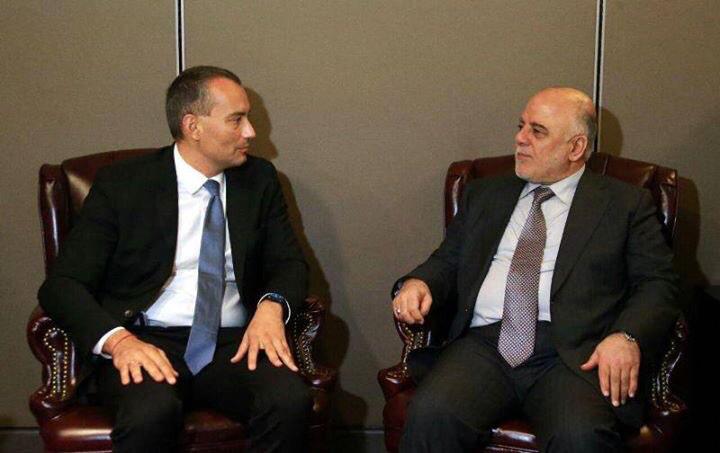
Mladenov?
The failure as head of UNAMI is now over the peace process?
Well I guess that's one way to rig the effort and ensure no progress.
Mohammed Shafiq (Alsumaria) reports that Foreign Minister Ibrahim al-Jaafari also addressed the United Nations Monday insisting that it needed to help Iraq with its crises.
Which I guess is his way of insisting that the new deal with Russia was necessary.
CBS and AP note:
Iraq will begin sharing "security and intelligence" information with
Russia, Syria and Iran to help combat the advances of the Islamic State
of Iraq and Syria (ISIS,) the Iraqi military announced Sunday.
A
statement issued by the Iraqi Joint Operations Command said the
countries will "help and cooperate in collecting information about the
terrorist Daesh group," using the Arabic acronym for ISIS.
On CNN (see video on page), they argue
the aspect of the goals of the US versus Russia with regards to Syria
(the US government wants Syrian President Bashar al-Assad replaced --
that has been the goal since the days of Bully Boy Bush).
But another aspect is how can Iraq share intelligence with Russia?
The US is sharing intel with Iraq which Iraq will then pass on to Russia?
I have no problem with intel being shared but I'm not the person in the
White House who has demonized Russia and Russian President Vladimir
Putin.
Barack created the 'great enemy' Putin -- as we noted in real time.
Putin was a minor player -- a fading one -- until the President of the
United States repeatedly elevated him at the end of Barack's first term
by verbally attacking him.
That was Barack's decision and the world lives with the consequences.
So it's worth noting now that the chain of intel will go something like
this: US government shares with Iraq which then shares with Russia.
Jason Ditz (Antiwar.com) offers this take:
Yesterday’s announcement that Iraq is going to engage in intelligence
sharing with Russia and Syria has been met negatively by Pentagon
officials, who say that it “complicates” the US war and dramatically weakens America’s own intelligence gathering abilities.
This problem appears to be largely a function of US annoyance at the
information sharing, which means the Pentagon intends to limit
intelligence sharing with Iraq, seemingly out of spite, and will
subsequently get less intelligence from Iraq in return.
Ditz seems a little self-righteous and ignorant in the above.
I have no problem with intel sharing.
But I do grasp that the US might not want to share intel with someone they're picking a fight with.
I'm confused as to why that's such a mystery to Jason Ditz.
Violence continues in Iraq. Monday? Alsumaria reports a
Baghdad car bombing left 3 people dead and seven more injured and
Khalidiya mortar and rockets attack killed 1 sixteen-year-old girl and left two children and two adults injured. Iraq Times adds that a
45-year-old man was shot dead (three shots to the chest) in front of his Basra home by militia members and a
Basra tribal clash left 3 people dead and a fourth injured.
In other news,
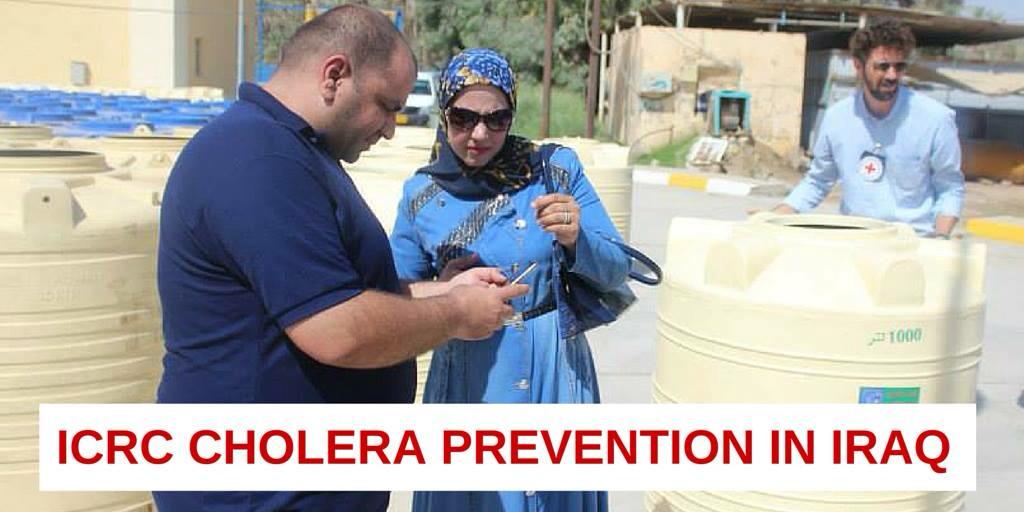
Alsumaria notes that the Ministry of Health states there are now 401 confirmed cholera cases in Iraq.
All Iraq News adds that 14 confirmed cases are in Diwaniya Province.
On cholera, we'll note this Tweet:
For years, we've noted the sex trade in Iraq. Few have.
Off Our Backs did (the feminist publication ceased publication shortly after). Today, CNN's Arwa Damon Tweets:
The New Yorker report is by Rania Abouzeid and here's an excerpt:
In 2012, Iraq passed its first law
specifically against human trafficking, but the law is routinely
ignored, and sexual crimes, including rape and forced prostitution, are
common, women’s-rights groups say. Statistics are hard to come by, but
in 2011, according to the latest Ministry of Planning report, a survey
found that more than nine per cent of respondents between the ages of
fifteen and fifty-four said they had been subjected to sexual violence.
The real number is likely much higher, given the shame attached to
reporting such crimes in a society where a family’s honor is often tied
to the chastity of its women. The victims of these crimes are often
considered outcasts and can be killed for “dishonoring” their family or
their community.
Since
2006, Layla, a rape victim and former prostitute, has been secretly
mapping Iraq’s underworld of sex trafficking and prostitution. Through
her network of contacts in the sex trade, she gathers information about
who is selling whom and for how much, where the victims are from, and
where they are prostituted and trafficked. She passes the information,
through intermediaries, to Iraqi authorities, who usually fail to act on
it. Still, her work has helped to convict several pimps, including some
who kidnapped children. That Saturday night, I accompanied Layla and
Mohammad on a tour of some of the places that she investigates, on the
condition that I change her name, minimize details that might identify
her, and not name her intermediaries.
The
work is extremely dangerous. The pimps whom Layla encounters are women,
but behind them is a tangled hierarchy of armed men: corrupt police,
militias that profit from the sex trade, and militias that brutally
oppose it. On the morning of July 13, 2014, the bullet-ridden bodies of
twenty-eight women and five men were retrieved from two apartments, said
to be brothels, in a building complex in Zayouna, a neighborhood in
eastern Baghdad. I saw the bodies a few hours later, at the city morgue,
laid out on the floor. Morgue workers blamed the religious militias,
singling out the pro-Iranian Asa’ib Ahl al-Haq, one of the many armed
outfits proliferating in Iraq. Other groups of suspected prostitutes
have been found shot dead, but the Zayouna incident was the largest
killing in recent years, and it prompted at least fifteen neighborhood
pimps whom Layla knew to flee with their girls to Iraqi Kurdistan. Layla
often visits apartments like the ones in Zayouna, posing as a retired
pimp. As a cover, she sells the madams abayas that are intricately
embroidered with colored crystals and diamantés; they serve to identify
women as pimps, rather than prostitutes, at night clubs.
I should probably do a correction.
Off Our Backs did report on the issue.
In fairness, AFP also frequently mentioned "prostitutes."
Whenever a woman died and someone accused her of having been a prostitute -- excuse me, whenever a woman was murdered and someone accused her of having been a prostitute -- an anonymous neighbor or a vindictive police officer -- AFP was happy to report this allegation as fact -- despite having no proof and knowing what a slur the charge was in Iraq.
Now AFP was never interested in reporting on prostitute rings or pimps or anything like that.
But let a woman be murdered and AFP was happy to stamp her with "prostitute" -- in a "she had it coming" kind of way.
Lastly,
Isaiah's
The World Today Just Nuts "
Col Bernie Sanders" went up last night.
iraq
bloomberg news
caroline alexander
 Brett McGurk
 discussing reform initiatives.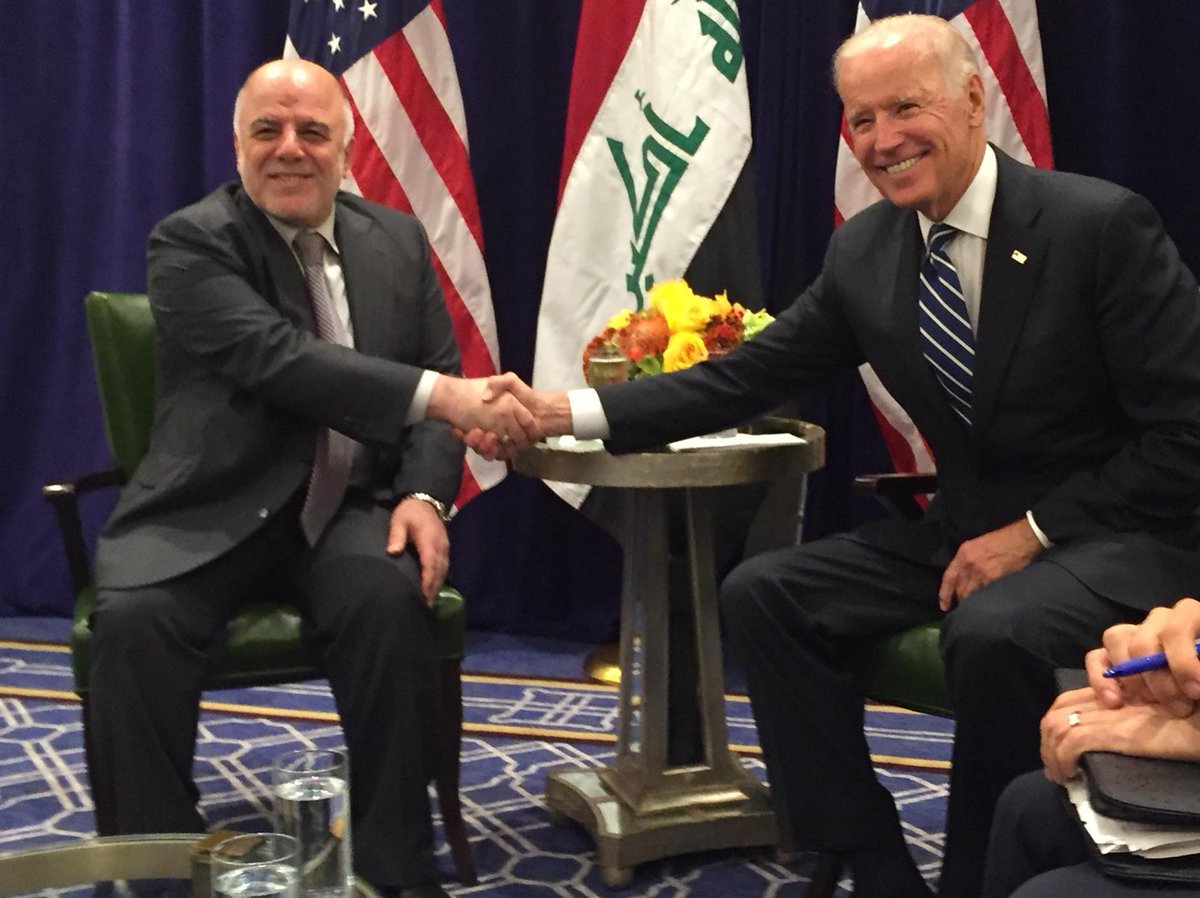
 Sam Morris


 Haider Al-Abadi
 Patrick Youssef
 Arwa Damon