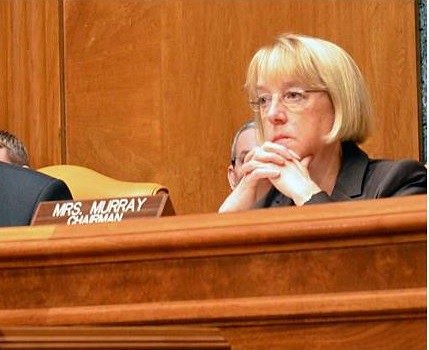
Senator Patty Murray never stops fighting for veterans. Her office notes:
As Trump Administration Undermines Financial Protections, Senators Murray, Cantwell Demand CFPB Uphold its Duty to Shield U.S. Troops from Predatory Lending & Financial Fraud
Aug 17 2018
WASHINGTON, D.C. – In an effort to protect U.S. military
members and their families from abusive financial practices, U.S.
Senators Maria Cantwell (D-WA), Patty Murray (D-WA), and every
Democratic member of the U.S. Senate demanded that the Trump
Administration uphold its duty under the Military Lending Act (MLA) to
protect servicemembers and their families from predatory lending and
financial fraud through the Consumer Financial Protection Bureau (CFPB).
“The CFBP should not be abandoning its duty to protect our servicemembers and their families, and we seek your commitment that you utilize all of the authorities available to the CFPB to ensure that servicemembers and their families continue to receive all of their MLA protections,” the senators wrote to CFPB interim director Mick Mulvaney.
The MLA was passed in 2006 with bipartisan support to help safeguard active-duty military members and their families from financial fraud, predatory loans, and interest rate gouging. The law caps the annual interest rate for an extension of consumer credit to a servicemember or his or her dependents at 36 percent.
This week, however, the New York Times reported that: “The Trump administration is planning to suspend routine examinations of lenders for violations of the Military Lending Act… Mick Mulvaney, the interim director of the Consumer Financial Protection Bureau, intends to scrap the use of so-called supervisory examinations of lenders, arguing that such proactive oversight is not explicitly laid out in the legislation, the main consumer measure protecting active-duty service members, according to a two-page draft of the change.” And NPR reports that the Trump administration is also taking aim at financial protections for the military by proposing to ease restrictions on “gap insurance” that could open up servicemembers to getting cheated by predatory practices when they purchase cars.
“For generations, Americans have set partisanship aside and have made every effort to provide servicemembers and their families with all the resources and protections they deserve,” the senators continued. “We ask no less of you and, as such, seek your commitment that you will continue the CFPB’s tradition of ensuring that servicemembers and their families receive all of their MLA protections by utilizing all of the authorities available to the CFPB.”
In 2011, Senate Democrats created the Office of Servicemember Affairs at the CFPB to serve as an independent watchdog to protect military personnel from financial abuses. The office focuses on the unique consumer financial challenges affecting servicemembers and their families. It empowers servicemembers through financial education and works with CFPB examiners to ensure that all consumer protections are made available to servicemembers, while also monitoring complaints submitted by consumers to the CFPB, and coordinating with other federal and state agencies on military consumer protection measures.
The office has handled more than 90,000 consumer complaints from servicemembers and their families and taken action to help return hundreds of millions into the pockets of servicemembers affected by harmful practices.
In addition to Senators Cantwell and Murray, the letter to Mulvaney was also signed by U.S. Senators Jack Reed (D-RI), Sherrod Brown (D-OH), Bill Nelson (D-FL), Joe Donnelly (D-IN), Jon Tester (D-MT), Chuck Schumer (D-NY), Mark Warner (D-VA), Dick Durbin (D-IL), Chris Van Hollen (D-MD), Tim Kaine (D-VA), Jeanne Shaheen (D-NH), Bob Casey (D-PA), Doug Jones (D-AL), Mazie Hirono (D-HI), Robert Menendez (D-NJ), Kirsten Gillibrand (D-NY), Richard Blumenthal (D-CT), Heidi Heitkamp (D-ND), Tammy Baldwin (D-WI), Elizabeth Warren (D-MA), Bernie Sanders (I-VT), Jeff Merkley (D-OR), Catherine Cortez Masto (D-NV), Tammy Duckworth (D-IL), Brian Schatz (D-HI), Michael Bennet (D-CO), Debbie Stabenow (D-MI), Sheldon Whitehouse (D-RI), Cory Booker (D-NJ), Angus King (I-ME), Christopher Coons (D-DE), Martin Heinrich (D-NM), Maggie Hassan (D-NH), Gary Peters (D-MI), Joe Manchin (D-WV), Ed Markey (D-MA), Tom Udall (D-NM), Tom Carper (D-DE), Claire McCaskill (D-MO), Patrick Leahy (D-VT), Chris Murphy (D-CT), Ron Wyden (D-OR), Tina Smith (D-MN), Ben Cardin (D-MD), Dianne Feinstein (D-CA), Amy Klobuchar (D-MN), and Kamala Harris (D-CA).
The full text of the letter can be found HERE and below.
Dear Director Mulvaney:
We write regarding reports that the Consumer Financial Protection Bureau (CFPB) will no longer protect servicemembers and their families by including the Military Lending Act (MLA) as part of the CFPB’s routine lender examinations due to a purported lack of authority. These reports are puzzling because the CFPB already possesses the authority to enforce the MLA and examine many types of lenders for the purposes of “detecting and assessing risks to consumers and to markets for consumer financial products and services.” The CFPB should not be abandoning its duty to protect our servicemembers and their families, and we seek your commitment that you will utilize all of the authorities available to the CFPB to ensure that servicemembers and their families continue to receive all of their MLA protections.
By enacting the MLA, Congress sent a clear bipartisan message that high-cost lending is a clear risk to military consumers that must be addressed to also protect military readiness. Indeed, among its provisions, the MLA caps the annual interest rate for an extension of consumer credit to a servicemember or his or her dependents at 36%. CFPB examinations and the CFPB’s Office of Servicemember Affairs have been critical components of ensuring the detection and prevention of risks to military consumers. Such examinations serve as the early warning system for MLA deficiencies so that they do not snowball into costly losses for servicemembers and avoidable litigation costs and penalties for lenders.
Given your senior role at the Office of Management and Budget, we are sure you are aware that the MLA also helps the Department of Defense (DOD) to save taxpayer funds based on the following DOD justification for its MLA rule:
“Losing qualified Service members due to personal issues, such as financial instability, causes loss of mission capability and drives significant replacement costs. The Department estimates that each separation costs the Department $58,250. Losing an experienced mid-grade noncommissioned officer (NCO), who may be in a leadership position or key technical position, may be considerably more expensive in terms of replacement costs and in terms of the degradation of mission effectiveness resulting from a loss of personal reliability for deployment and availability for duty.”
Needlessly stopping MLA examinations altogether and choosing instead to rely on reports of MLA violations after they occurred is further perplexing given that the CFPB is already conducting lender examinations of credit products that are also subject to the MLA. Such a policy decision would be both inefficient and irresponsible to require a CFPB examiner to ignore as part of his or her examination risks to military consumers who are protected by the MLA. In addition, for our servicemembers, especially those who are deployed overseas facing hostile fire, it is unreasonable to place the burden of detecting and reporting MLA abuses on servicemembers, especially when they should be given every opportunity to focus squarely on their missions.
What the CFPB is reported to be contemplating is equivalent to forcing our armed forces to stop using radar, sonar, and other early warning technologies and instead react to threats as they occur. No one would force our armed forces to do so, and the CFPB should not similarly force any of its examiners to turn a blind eye. For generations, Americans have set partisanship aside and have made every effort to provide servicemembers and their families with all the resources and protections they deserve. We ask no less of you and, as such, seek your commitment that you will continue the CFPB’s tradition of ensuring that servicemembers and their families receive all of their MLA protections by utilizing all of the authorities available to the CFPB. We request that you respond with your commitment no later than Monday, August 20.
Sincerely,
“The CFBP should not be abandoning its duty to protect our servicemembers and their families, and we seek your commitment that you utilize all of the authorities available to the CFPB to ensure that servicemembers and their families continue to receive all of their MLA protections,” the senators wrote to CFPB interim director Mick Mulvaney.
The MLA was passed in 2006 with bipartisan support to help safeguard active-duty military members and their families from financial fraud, predatory loans, and interest rate gouging. The law caps the annual interest rate for an extension of consumer credit to a servicemember or his or her dependents at 36 percent.
This week, however, the New York Times reported that: “The Trump administration is planning to suspend routine examinations of lenders for violations of the Military Lending Act… Mick Mulvaney, the interim director of the Consumer Financial Protection Bureau, intends to scrap the use of so-called supervisory examinations of lenders, arguing that such proactive oversight is not explicitly laid out in the legislation, the main consumer measure protecting active-duty service members, according to a two-page draft of the change.” And NPR reports that the Trump administration is also taking aim at financial protections for the military by proposing to ease restrictions on “gap insurance” that could open up servicemembers to getting cheated by predatory practices when they purchase cars.
“For generations, Americans have set partisanship aside and have made every effort to provide servicemembers and their families with all the resources and protections they deserve,” the senators continued. “We ask no less of you and, as such, seek your commitment that you will continue the CFPB’s tradition of ensuring that servicemembers and their families receive all of their MLA protections by utilizing all of the authorities available to the CFPB.”
In 2011, Senate Democrats created the Office of Servicemember Affairs at the CFPB to serve as an independent watchdog to protect military personnel from financial abuses. The office focuses on the unique consumer financial challenges affecting servicemembers and their families. It empowers servicemembers through financial education and works with CFPB examiners to ensure that all consumer protections are made available to servicemembers, while also monitoring complaints submitted by consumers to the CFPB, and coordinating with other federal and state agencies on military consumer protection measures.
The office has handled more than 90,000 consumer complaints from servicemembers and their families and taken action to help return hundreds of millions into the pockets of servicemembers affected by harmful practices.
In addition to Senators Cantwell and Murray, the letter to Mulvaney was also signed by U.S. Senators Jack Reed (D-RI), Sherrod Brown (D-OH), Bill Nelson (D-FL), Joe Donnelly (D-IN), Jon Tester (D-MT), Chuck Schumer (D-NY), Mark Warner (D-VA), Dick Durbin (D-IL), Chris Van Hollen (D-MD), Tim Kaine (D-VA), Jeanne Shaheen (D-NH), Bob Casey (D-PA), Doug Jones (D-AL), Mazie Hirono (D-HI), Robert Menendez (D-NJ), Kirsten Gillibrand (D-NY), Richard Blumenthal (D-CT), Heidi Heitkamp (D-ND), Tammy Baldwin (D-WI), Elizabeth Warren (D-MA), Bernie Sanders (I-VT), Jeff Merkley (D-OR), Catherine Cortez Masto (D-NV), Tammy Duckworth (D-IL), Brian Schatz (D-HI), Michael Bennet (D-CO), Debbie Stabenow (D-MI), Sheldon Whitehouse (D-RI), Cory Booker (D-NJ), Angus King (I-ME), Christopher Coons (D-DE), Martin Heinrich (D-NM), Maggie Hassan (D-NH), Gary Peters (D-MI), Joe Manchin (D-WV), Ed Markey (D-MA), Tom Udall (D-NM), Tom Carper (D-DE), Claire McCaskill (D-MO), Patrick Leahy (D-VT), Chris Murphy (D-CT), Ron Wyden (D-OR), Tina Smith (D-MN), Ben Cardin (D-MD), Dianne Feinstein (D-CA), Amy Klobuchar (D-MN), and Kamala Harris (D-CA).
The full text of the letter can be found HERE and below.
Dear Director Mulvaney:
We write regarding reports that the Consumer Financial Protection Bureau (CFPB) will no longer protect servicemembers and their families by including the Military Lending Act (MLA) as part of the CFPB’s routine lender examinations due to a purported lack of authority. These reports are puzzling because the CFPB already possesses the authority to enforce the MLA and examine many types of lenders for the purposes of “detecting and assessing risks to consumers and to markets for consumer financial products and services.” The CFPB should not be abandoning its duty to protect our servicemembers and their families, and we seek your commitment that you will utilize all of the authorities available to the CFPB to ensure that servicemembers and their families continue to receive all of their MLA protections.
By enacting the MLA, Congress sent a clear bipartisan message that high-cost lending is a clear risk to military consumers that must be addressed to also protect military readiness. Indeed, among its provisions, the MLA caps the annual interest rate for an extension of consumer credit to a servicemember or his or her dependents at 36%. CFPB examinations and the CFPB’s Office of Servicemember Affairs have been critical components of ensuring the detection and prevention of risks to military consumers. Such examinations serve as the early warning system for MLA deficiencies so that they do not snowball into costly losses for servicemembers and avoidable litigation costs and penalties for lenders.
Given your senior role at the Office of Management and Budget, we are sure you are aware that the MLA also helps the Department of Defense (DOD) to save taxpayer funds based on the following DOD justification for its MLA rule:
“Losing qualified Service members due to personal issues, such as financial instability, causes loss of mission capability and drives significant replacement costs. The Department estimates that each separation costs the Department $58,250. Losing an experienced mid-grade noncommissioned officer (NCO), who may be in a leadership position or key technical position, may be considerably more expensive in terms of replacement costs and in terms of the degradation of mission effectiveness resulting from a loss of personal reliability for deployment and availability for duty.”
Needlessly stopping MLA examinations altogether and choosing instead to rely on reports of MLA violations after they occurred is further perplexing given that the CFPB is already conducting lender examinations of credit products that are also subject to the MLA. Such a policy decision would be both inefficient and irresponsible to require a CFPB examiner to ignore as part of his or her examination risks to military consumers who are protected by the MLA. In addition, for our servicemembers, especially those who are deployed overseas facing hostile fire, it is unreasonable to place the burden of detecting and reporting MLA abuses on servicemembers, especially when they should be given every opportunity to focus squarely on their missions.
What the CFPB is reported to be contemplating is equivalent to forcing our armed forces to stop using radar, sonar, and other early warning technologies and instead react to threats as they occur. No one would force our armed forces to do so, and the CFPB should not similarly force any of its examiners to turn a blind eye. For generations, Americans have set partisanship aside and have made every effort to provide servicemembers and their families with all the resources and protections they deserve. We ask no less of you and, as such, seek your commitment that you will continue the CFPB’s tradition of ensuring that servicemembers and their families receive all of their MLA protections by utilizing all of the authorities available to the CFPB. We request that you respond with your commitment no later than Monday, August 20.
Sincerely,

