Greetings fellow Bioneers!
Over the past two years, we’ve heard a common refrain: Our “system” is broken. Our culture, healthcare, public policy, environment, and political structure all need fixing. It’s a daunting thought, and an even more daunting undertaking—and it’s what Bioneers Gar Alperovitz, author and former state department official, and Rupa Marya, Associate Professor of Medicine working at the intersection of medicine and social justice, have set out to do. This week, we take a look at the work Alperovitz, Marya, and their organizations are doing to create the solutions we need for a more just and equitable future.
|
|
The Big Question: Dynastic Wealth
Wealth statistics within the United States paint an alarming picture of the country's economic reality. Perhaps the most frightening is this: The top 1% holds more wealth than the bottom 90%. This stark contrast has a lot to do with—you guessed it—taxes. Or, rather, the lack thereof. And it didn't happen overnight; this imbalance has been decades in the making. But there are ways to break up the concentration of money at the top. Implementing what type of tax on obscenely wealthy families could help dissolve this stark wealth inequality over time? (Read to the bottom of the email to find the answer.)
|
|
Wise Words
“I used to think that the top environmental problems were biodiversity loss, ecosystem collapse and climate change. I thought that thirty years of good science could address these problems. I was wrong. The top environmental problems are selfishness, greed and apathy, and to deal with these we need a cultural and spiritual transformation. And we scientists don’t know how to do that.”
—Gus Speth, environmental lawyer and Senior Fellow and co-chair of the Next System Project at the Democracy Collaborative
|
|
|
Video to Watch: The Path of Liberation through Medicine
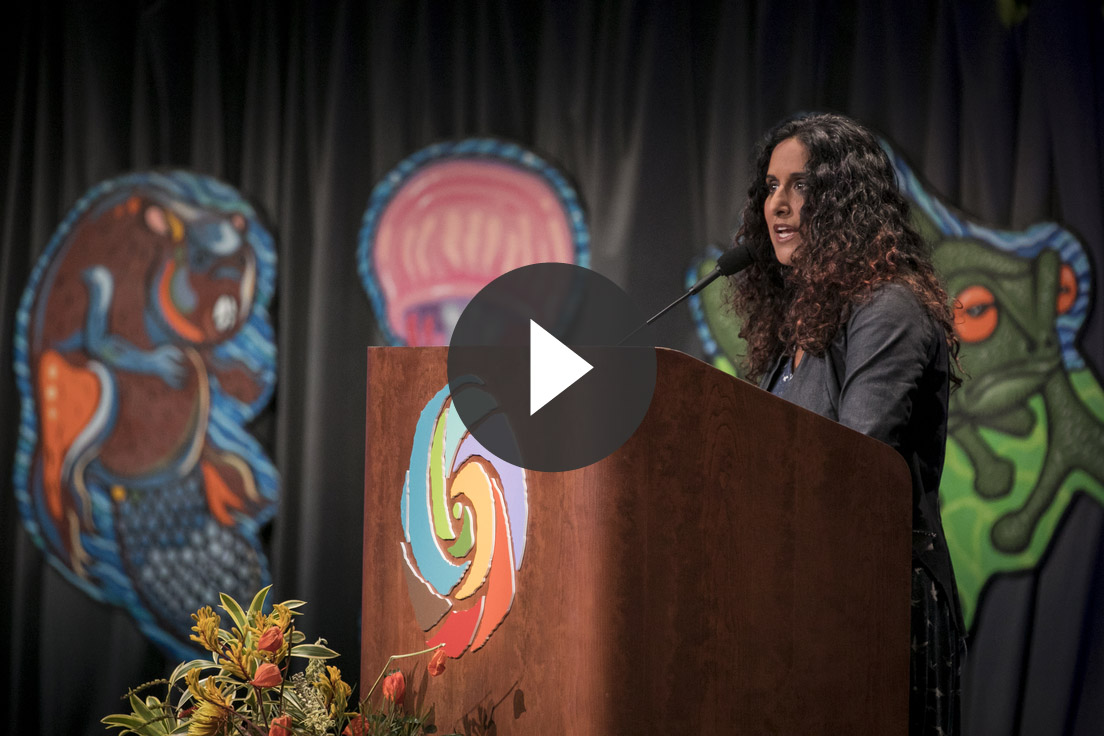
Health visionary Dr. Rupa Marya, Associate Professor of Medicine at UC San Francisco and Faculty Director of the Do No Harm Coalition, urges us to radically re-envision and expand our concept of medicine to encompass and address the health impacts of poverty, racism and environmental toxicity. Watch the video here. |
|
Don’t Miss: 2018 Conference Media Online and DVDs on Sale Now
Experience Bioneers 2018 all over again (or for the first time!) in two ways:
Purchase our Bioneers 2018 DVD set. A celebration of the genius of nature and human ingenuity, this set of keynote talks and performances highlights social and scientific innovators with practical and visionary solutions to the world’s most pressing environmental and social challenges. Get yours here.- Watch all 2018 keynote videos, and find some bonus content, when you visit this page.
|
|
This Week on Bioneers Radio & Podcast
Climate disruption is harmful to your health. Dr. Linda Rudolph and Dr. Barbara Sattler are showing how our success or failure as a civilization may well hinge on how ingenious, nimble and socially just our public health systems can become in restoring the ecosystem health on which all health depends. And doing the right thing is good for our health.
Subscribe to the Bioneers podcast now: iTunes | Stitcher | SoundCloud | YouTube |
|
Help Bioneers Continue This Important Work
Exciting news! An anonymous donor has offered to match all donations to Bioneers, dollar for dollar, up to $100,000 before the end of the year! We're 14% there! Support Bioneers now with Venmo or Paypal by giving to donate@bioneers.org or click the button below: |
|
Person to Know: Gar Alperovitz
Over the past 10 years, Gar Alperovitz has played a central role in creating the quiet revolution of on-the-ground models and experiments of economic democracy. He co-founded The Democracy Collaborative in 2000, followed by the Next System Project, of which he’s co-chair. He has operated on the frontlines of real world politics, running political campaigns, House and Senate staffs, and policy planning in the state department and has a distinguished career as a historian, political economist, and author. In this excerpt from his 2018 Bioneers keynote address, titled “Why We Need a Next System,” Alperovitz discusses his work with the Next System Project and a breakthrough model for community-based political-economic development.
I want you to think about design. What is the nature of the design that you would actually want to live in? Who would own things? Where would the power come from? Would it be an expansionary system? Corporations have to expand. They’ve got to keep reporting more profits, and that has environmental implications for big corporations. So what is the nature of the design? What would it look like in the ideal? How do we get from here to there?
That’s the nature of this program we call the Next System Project. At one level, we have a major debate going on amongst theorists and academics and activists on the design of different systems. But if you want to actually change the system, get it out of the abstraction of the academics. There is a lot there that can be built on and worked on.
One way to start is with projects. We’ve worked a lot on the Evergreen Cooperatives Project in Cleveland, Ohio. This is in a very poor neighborhood — 40,000 people, mostly black, the average unemployment is 20%, family income averages $20,000 a year. In the middle of that neighborhood is the Cleveland Clinic, Case Western Reserve University, and University hospitals. All three of those institutions have a lot of taxpayer dollars in them — Medicare, Medicaid, education money. They buy a lot of things just to exist, and they can’t move. They are so-called “anchored” because there is a huge investment of capital in those buildings and facilities. This is a technical term these days — anchor institutions.
One of the designs that we’ve developed is using the purchasing power of these big institutions and focusing it on this community to establish a community-wide nonprofit corporation to benefit and reflect the community’s interest as a whole. What is interesting about it is that it begins with the principle of community — not corporation, not state socialism — but local community, and it has attached to it another idea: worker ownership. That is a systemic design in miniature. Read more here. |
|
Create Change: Do No Harm Coalition
According to data from the FBI, police in the United States take hundreds of lives each year — more than police in any other developed country in the world. While there are a variety of factors contributing to this crisis, as outlined here by Vox, one thing is undeniable: The health effects of this violence on our communities are more vast than many realize. In order to help the public conceptualize this problem and take action, the Do No Harm Coalition’s group of UCSF and Santa Clara University health researchers (including Rupa Marya, above) is investigating the health effects of law enforcement violence on communities—from the ICE and FBI to local police. In order to understand the full effects of this violence in a way that could help shift policy, Do No Harm Coalition put together a 20-minute survey in English and Spanish. Want to help? Take the survey now. |
|
What We’re Tracking:
These women have dedicated their lives to environmental activism—and they often face serious threats of violence by those trying to silence them. (Sarah Hurtes via Harper’s Bazaar)
The recently released U.N. annual report card on climate change may have offered a few glimpses of hope, but it also found that the world as a whole is alarmingly behind on cutting emissions. (Eric Holthaus via Grist)
- In this interview from October, political dissident and author Noam Chomsky highlights the ways in which conservatives are failing us all in regards to climate change, and why we need to take immediate action to save the planet and humanity. (Noam Chomsky via Democracy Now!)
|
|
The Big Question, Answered: Dynastic Wealth
|
|
| Do you know people who might enjoy reading this? Please share it with them! |
|
|
|