At today's US State Dept press briefing, spokesperson Jeff Rathke attempted to spin Tony's failures by insisting that "we certainly value Tony Blair's contributions." Pressed to cite contributions, even spin machine Rathke faltered.
Last week, US President Barack Obama made a fool of himself publicly by attempting to minimize the fall of Ramadi to the Islamic State with Barack insisting this was not a loss. In those footsteps follow Rathke who praises Blair's so-called "contributions" while being unable to cite any and insisting that the state of not succeeding is something other than "failure."
Some elements of the current storm may be human-made. This exchange took place during today's State Dept press briefing.
QUESTION: All right. I have two questions. One is about Ramadi. There are reports about Iraqi special forces retreating from the city because they received instructions from someone close to former Prime Minister Maliki or Maliki himself. Are you aware of those reports?
MR RATHKE: I’m not familiar with those reports. I don’t have any comment on that.
Nouri's long been said to be plotting -- and he always will until he's in his grave. He wants to come back. He has leaders loyal to him still in the ranks of the Iraqi military. Is that why the militia is so much more effective than the Iraqi military?
It's a question worth pondering -- unless you're the US State Dept.
On the fall of Ramadi,
Araw Damon and Hamdi Alkhshali (CNN -- link is text and video) offer an insider's account -- one Iraqi solider -- of what happened on the ground.
The administration continues their attempt to spin failure as success with regard to the Iraqi forces. Today, it was the US State Dept's turn.
QUESTION: Iraq. Can we go to Iraq?
MR RATHKE: Yes.
QUESTION: Okay. Very quickly, can you just sort out all this
confusing statements coming from every which way on the role of the
Iraqi army, how they conducted themselves during the fall of Ramadi, and
so on? Today another person from the Pentagon saying that basically
they cut and run. There are statements that are really contrary to that.
Just walk us through what is the U.S. position. Is the Iraqi army or
the Iraqi Security Forces worthy of all the support, and both material
and training and all these things, that they are getting if they – every
time there is a confrontation with ISIS, they just fall back?
MR RATHKE: Well, I think we talked about this a bit yesterday as well. Let me just start --
QUESTION: The story just will not go away.
MR RATHKE: Let me just start, though, with the situation on
the ground. We are encouraged by reports that Iraqi forces have begun to
consolidate and reorganize and counterattack on ISIL around Ramadi. We
also welcome the news from Prime Minister al-Abadi on the
counteroffensive, and we’ll continue to offer support to our Iraqi
partners as they work to push ISIL out of their country.
Now, as for a battlefield assessment, you can talk with the Iraqi
Government. We, of course, from our part in the coalition, are
supporting the Iraqi Government with airstrikes in conjunction with them
on targets, ISIL targets in Anbar and in other parts of Iraq. Now, the
question that you’ve asked about the – we’ve always said that our
strategy in Iraq, which is a – on the one hand it has a military
component, also has non-military components. But the strategy, the
military strategy relies on a well-equipped and well-trained partner on
the ground. So we are, of course, helping to provide them with the
capabilities they need and the support so that they can win this fight,
and we’re supporting them to that end.
That would have been the perfect opportunity to ask Rathke to illuminate the world on what exactly the administration has been doing to help with regards to the "non-military components" of the so-called Iraq 'strategy'?
It was June of 2014, after all, when Barack publicly declared that only a "political solution" could solve Iraq's crises.
And yet the US has done nothing with regards to that.
They've offered no leadership, they've offered no encouragement.
They've refused to open the diplomatic toolbox and use the carrot and stick method where you say to Haider al-Abadi, "You want more weapons? Okay, bring the Sunnis into the government as full partners."
You may or may not remember but the benchmarks that Bully Boy Bush's White House set in 2007 included an end to de-Ba'athification. Nouri al-Maliki promised to do that but never did. Not in his first term and not in his second term.
Sometimes he gave lip service on the issue but he never did a damn thing.
Haider's really good a lip service.
But he's also failed to follow up.
Though they avoided that issue, at least the press didn't rush to swallow Rathke's spin.
QUESTION: But the United States has been training an Iraqi
armed forces for the past 12 years at least – 12 years, not at least –
for the past 12 years, spending a lot of money and a lot of training and
so on. But looking back, even when there was the Awakening and so on,
it was really the American forces that did whatever fighting there was.
So there is no record of this army that you have trained and spent so
much time and effort at, standing up and doing what it’s supposed to do.
Why do you think that is?
MR RATHKE: Well, I think if you look at quite a few places in
Iraq, you see where Iraqi forces have been successful in pushing back
and in pushing ISIL out of territory that they previously controlled.
There are certainly areas where ISIL has made gains in recent days.
Ramadi is, of course, one we’ve talked about, as well as Palmyra, in
Syria. But if you compare this to nine months ago, when ISIL was on the
offensive in many places in Iraq, we also see places where they’ve been
forced to retreat; they’ve lost areas that they used to dominate from
Babil to Diyala, also Nineveh and Kirkuk province. So ISIL has been
defeated at Mosul Dam, at Mount Sinjar, also in Tikrit. So there are – I
think there have been a lot of areas – populated areas where ISIL had
been in control and has been pushed back.
QUESTION: Sorry to belabor the point, but even the examples
that you cited – Tikrit, Babil, and the north and so on – it was either
the Peshmerga or the popular committees, the Shia militias and so on in
Tikrit and other places. There is no – I mean there’s no stark example
that says this national Iraqi army has stood its ground, is there?
MR RATHKE: Well, again, we take a view of that, Said. We – if
you look at those areas and others where the Iraqi forces have pushed
ISIL back, we see a much different picture, and we see the Iraqi forces
committed to defending the country.
QUESTION: You haven’t seen that the counteroffensive has
actually begun yet, have you? You said something to that effect earlier,
but they’re still regrouping. They haven’t actually started going back
into Ramadi, have they?
MR RATHKE: Well, for a battlefield analysis, I’d refer you to
my colleagues at the Pentagon or to the Iraqi authorities --
And we'll stop him there to note all he does is give battlefield analysis.
He's not talking diplomacy, he's not talking State Dept efforts.
Like so many other idiots currently serving in the State Dept, he has confused his department with the DoD.
We'll note this Tweet:
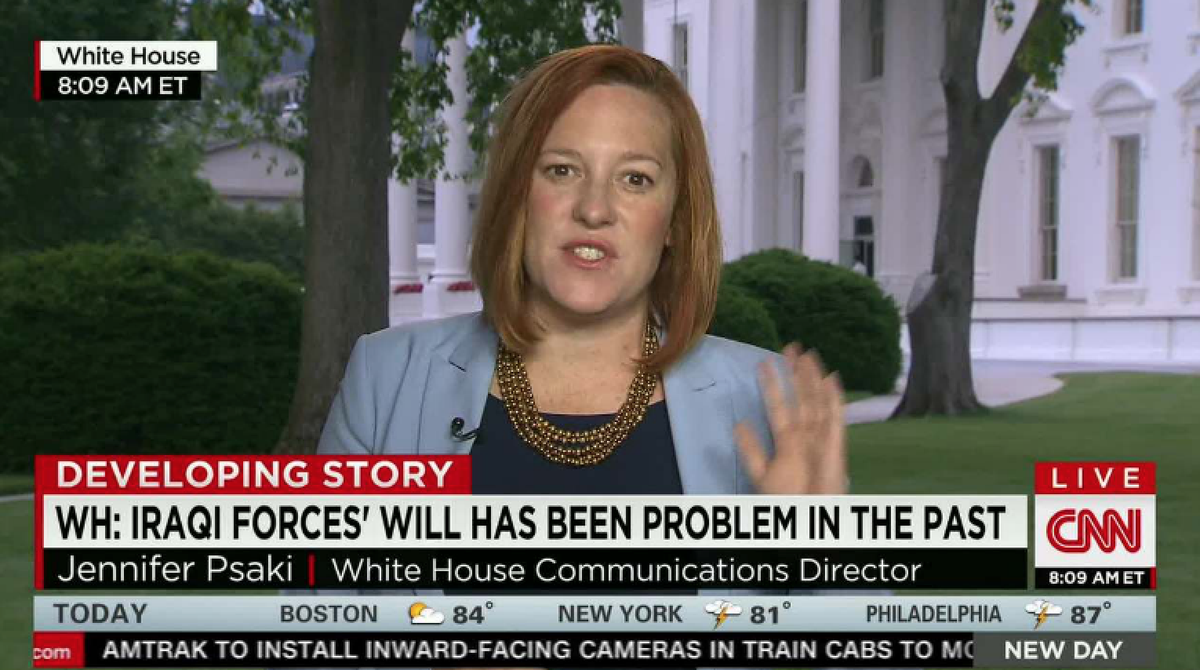
Jen Psaki was a State Dept spokesperson until recently.
We've called her out and we've also noted that she didn't rely on spin the way so many others did. Victoria Nuland was a non-stop lying machine. Until her Urkaine phone call exposed what trash she was, we stood pretty much alone here on the left in condemning her. All the faux left had to know what she 'worked for Barack' (she was supposed to be working for the American people) and they didn't want to know anything else -- didn't want to know that Icky Vicky had been Dick Cheney's advisor and a cheerleader for the Iraq War and married to a neocon -- in fact married into the most prominent neocon family.
We called her out repeatedly.
We didn't have to call out Psaki as much.
But if Rathke's looking for a role model in his efforts as spokesperson, he should aspire to Psaki's efforts.
As for the Ramadi effort?
Jason Ditz (Antiwar.com) points out, "One day into their much-hyped offensive against the ISIS-held city of
Ramadi, Iraqi troops and their allies have stalled almost immediately,
with reports that the troops
entered the grounds of the university, but were unable to retake it."
In other news,
AFP notes, "State TV said the paramilitaries had renamed the campaign 'Labeyk Ya Iraq' (At Your Service Iraq) Wednesday. A spokesman for the paramilitary groups, known as Hashid Shaabi, said both names had 'the same meaning'." The issue came up today and Rathke demonstrated how ineffectual the State Dept truly is.
QUESTION: -- Roz asked you about the name of the operation, which is --
MR RATHKE: Yes.
QUESTION: -- “Labaik Ya Hussein,” which is really a call on
the prophet’s grandson, who was also saintly among the Sunnis but it has
– in this particular case, it has sectarian connotation. Do you have
any reaction to that? The Pentagon stood against it.
MR RATHKE: Well, I think I was asked about this yesterday, and I gave a response. So I don’t have anything beyond what I said yesterday.
QUESTION: They changed the name today.
MR RATHKE: Well, yes, I’m aware of those reports. But Said’s question was our point of view about the name.
QUESTION: Do you have reaction to them changing the name?
MR RATHKE: Well, I’m aware of the report. We’ve said that
anything that heightens tension is something we would be concerned
about. But that was – yes, Roz.
QUESTION: So you don’t --
QUESTION: Let’s --
QUESTION: You don’t have any reaction?
MR RATHKE: Well, I think, again, this announcement yesterday
if – it was my understanding it wasn’t an official announcement about
this name.
QUESTION: Right.
MR RATHKE: So I think there’s been a clarification of that.
QUESTION: The new one, or whatever --
MR RATHKE: Yeah.
QUESTION: I mean, does it matter to you guys?
MR RATHKE: Well, what we’ve always said in our support for
Prime Minister Abadi is the central element of our strategy and his
strategy is to govern Iraq in a way that is nonsectarian and that brings
Iraq together. And so it’s consistent with that, that we would want to
see – avoid anything that would raise sectarian tensions.
Moqtada al-Sadr, Shi'ite cleric and movement leader, slammed the original name as divisive and destructive but the US State Dept can't figure out where it stands?
Let's not forget that they and others in the administration were quick to slam a YouTube clip -- that they lied and called a "film" -- and to declare it destructive. But when they need to speak up about the actions -- life and death -- of a group of militias (thugs), they fall silent?
As Leela Jacinto noted, "Naming an operation by saber-rattling Shiite militias into the disgruntled Iraqi Sunni heartlands 'Labalik ya Hussein' is like waving a red rag at a bull. And this bull, I fear, could charge straight into ISIS's arms."
QUESTION: Well, let’s set aside whatever it is the Shia
militia are calling this counteroffensive. Let’s talk about their
behavior. Both the Secretary and General Allen have in recent months
condemned their behavior once they liberated certain parts of Iraq,
basically engaging in sectarian violence and alleged human rights
violations. Sine you stressed from the podium yesterday that these
militia are acting on orders from Baghdad, has this Administration made
it very clear to Abadi’s government that human rights violations by
these militia will not be tolerated and should be actively discouraged
from the very beginning?
MR RATHKE: Well, our point of view on this hasn’t changed. We
believe that Iraqi forces have to make concerted efforts to protect
local populations and property and to secure the human rights of all
Iraqi citizens, indeed, as guaranteed by the Iraqi constitution and as
the Prime Minister himself and other Iraqi leaders have pledged. So our
point of view on that remains the same, and we talk regularly with our
Iraqi counterparts about those issues.
QUESTION: But I’m asking whether there’s a particular emphasis
given that there are so many people who are trying to get out of Ramadi
and who basically are being told that unless they have family in
Baghdad that they’re not going to be allowed to leave Anbar province and
cross over Bzebiz Bridge – I knew I was going to get that wrong – to
try to get to Baghdad and to try to get to safety, in part because
they’re afraid of potential repercussions by these militia.
MR RATHKE: Well, again, our point of view on this is as I just
stated it. We believe that Iraqi forces have to make every effort to
protect local populations and to protect the human rights of Iraqi
citizens.
Yes.
QUESTION: So what happens if they – if such violations do
happen? What can the U.S. do to make certain that those responsible are
held accountable?
MR RATHKE: I’m not going to speculate about things that
haven’t – you’re talking about things that could happen in the future.
I’m not going to speculate about that. But the – this is an important,
important issue and one in which we remain in contact with our Iraqi
counterparts.
Go ahead.
Nothing.
The White House can do nothing.
And it has done nothing.
When Tikrit was over run with militias and War Crimes took place, where was the US State Dept?
Making excuses.
Always making excuses.
Never pressing for reform.
Never calling out abuse.
Never calling out crimes.
Even the DoD was calling out the abuses. Even Barack's special envoy John Allen was calling them 'unhelpful.'
But the State Dept stands for nothing.
They have a mission statement, they just don't follow it:
Department Mission Statement
The Department's mission is to shape and sustain a peaceful,
prosperous, just, and democratic world and foster conditions for
stability and progress for the benefit of the American people and people
everywhere. This mission is shared with the USAID, ensuring we have a
common path forward in partnership as we invest in the shared security
and prosperity that will ultimately better prepare us for the challenges
of tomorrow.
--From the FY 2014 Agency Financial Report,
released November 2014
Hillary Clinton spent four years as Secretary of State trotting around the globe and smiling for cheesy photos of easy and meaningless photo ops.
John Kerry can't even accomplish that.
A functioning administration would be using the State Dept for diplomacy.
A functioning Congress would be demanding the State Dept testify as to what exactly their role is in Iraq.
And every member of Congress would cut off Brett McGurk or whomever when they began talking about military actions.
They would say, "You are not in the Defense Dept. We're asking you to testify about your department's efforts."
Instead, they let McGurk babble on about what DoD is doing.
Yet when they ask him a question about DoD, he begs off, insisting he's not with the Defense Dept so he can't answer.
This after building his testimony solely around the actions of the DoD.
John Kerry should be called before the Congress to defend his Dept and justify their non-action.
As for Ramadi and refugees,
Tim Arango (New York Times) reports: