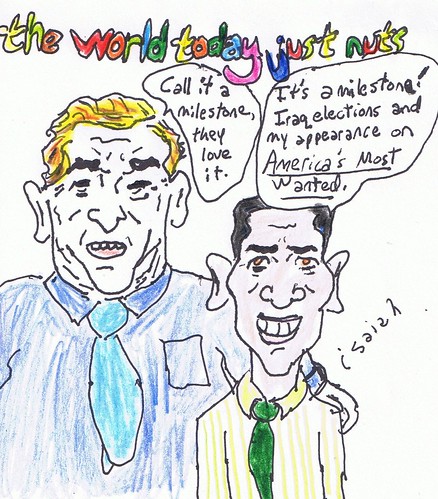
Friday, March 5, 2010. Chaos and violence continue, campaigning for elections continue, birth defects are on the rise, Gordon Brown appears before the Iraq Inquiry, we are not your sin eaters, and more.
This morning on the second hour of
The Diane Rehm Show (NPR), Susan Page (
USA Today) guest hosted for Diane and she spoke with the panelists Tom Gjelten (NPR), Susan Glasser (
Foreign Policy) and David E. Sanger (
New York Times).
Susan Page: Well Iraqis -- most Iraqis who are going to vote, go to the polls on Sunday, the first national election in five years. David Sanger, what seats are up?
David Sanger: Well an amazing number of candidates are up. Uh there are going to be 6127 candidates for 325 seats. So you could see a fair number of people who come in with one, two and even three votes if they, you know, get Moms and spouses to vote for them. You'll also see uh about 50,000 polling places. And I guess they must have all read those books about uh how Lyndon Johnson conducted polls in Texas in the 40s and 50s because not only are they writing this on special paper and numbering the ballots but the ballots then go into clear plastic boxes so that it gets a little bit harder to fiddle with. That said, the ingenuity of Iraqis with fiddling with uh ballots now may be as good as Americans have had at various points in our history. Uh, I think what you need to think about for this election are two things. First is it could be a long time before we see a serious result. When this happened in 2005, it took about five months to put the government together. Here it may not take as long but it could be a few months. And the second big question is: Does anything come up out of this that gets in the way of the American withdrawal strategy? And that is all linked to the divisions of Sunni and Shia, the levels of violence and so forth. For President [Barack] Obama who has already said that he's not out to make a Jeffersonian democracy and either Afghanistan or Iraq the big question is can he just stay on schedule.
Susan Page: Well what do you think, Susan, will he be able to stay on schedule with the withdrawal of US troops over the next two years or do you think that's in some peril?
Susan Glasser: Uh, well, you know, if I had a crystal ball for this one, we-we could all go home. But I do think that the election will be an intersting indicator. And what comes after it, as David mentioned, of just how riven is the political space in Iraq right now. There have certainly been some uh disturbing signs in the weeks leading up to the election that this is a highly polarized, highly sectarian environment going into the elections. Uhm, you know, there are signs of levels of divisions between Sunni and Shia that have probably reached their highest level of the last two years in the context of this campaign. So will renewed violence break out? What does it do to the potential unraveling of political space in Iraq? How much is the current prime minister, Nouri al-Maliki -- what is he willing to do to hold onto power over the next few weeks and months?
Susan Page: Tom, is there someone the US hopes emerges as the new leader of Iraq?
Tom Gjelten: No, I-I think what the United States hopes is simply stability. Uh, as David said, I think the, you know the prospect of divisions following this election is so unnerving that the United States would basically settle for any candidate that's able to keep the country more or less, uh, uh, on track and stable. I mean there seem to be -- You know, the good news is that all sectors of the Iraqi political spectrum are-are represented in this election. The bad news is that all sectors of the Iraqi political spectrum are represented in this election including some very violent, anti-American militia members. Moqtada al-Sadr who's responsible for a lot of the attacks even though he's currently living in Iraq, we think. His-his party is well represented. We've got an alleged former death squad leader who's represented. We have Sunni religious groups represented, Sunni secular groups, Shia religious groups, Shia secular groups. So everybody is represented but what that also does is it really is a recipe for what Susan and David are talking about, the kind of, the warring factions in the aftermath.
Susan Page: But I wonder if, to look on the bright side maybe, a second democratic election in five years, since the fall of the Saddam Hussein regime, does it indicate democracy or an Iraqi form of democracy is really taking root? Or do you think that goes too far, David?
David Sanger: It represents an Iraqi form of democracy. We've had other moments in Iraqi history, including in the 1950s, when there were similar forms of democracy and they didn't last. I mean, Iraq is a place that, at various moments, has gravitated towards strong-man leaders and that could well happen again.
Echoing that thought are
Ernesto Londono and Leila Fadel (Washington Post) who explain, "After the ballots are cast and counted, voters will have provided the first conclusive evidence of what kind of democracy is likely to take root in the heart of the Middle East -- if one does at all."
Charles Levinson (Wall St. Journal) reports, "Iraq's leading candidates made final appeals to voters and an influential anti-U.S. cleric unveiled a unqiue election-day strategy, on the final day of campaigning for Sunday's national polls." Iraqi refugees will vote in the US, Jordan, Syria, Turkey, Egypt, the UAE, Lebanon, Iran, Canada, England, Denmark, Australia, Germany, Austria, Sweden and the Netherlands. And in Iraq,
Jane Arraf (Christian Science Monitor) looks at the approximately 3 million young, first-time voters in Iraq who express frustration and note that their lives have been plagued by violence, unemployment and lack of basic services. The Iraq War started in March 2003 and that's seven years ago. 20-year-old Iraqis were 13 when this illegal war started. Arraf reports, "This should be an exciting threshold to a new future for young people. But a broad range of interviews reveal that for this generation, born into a decade of trade sanctions and raised in war, there is an overriding sense of frustration, fears about security, and the struggle to find their place in a country still emerging from conflict." Among the first time voters is Nada Hatem Farhan and
Jane Arraf examines what the elections mean to her and her life: Not much at all. She's like to be an attorney or journalist but instead states she must become a teacher which is about it in terms of 'respectability' for women in her area -- but that's if she's able to go college. There is a push for her to get married to her cousin as soon as she finishes high school.
At Inside Iraq, an Iraqi correspondent for McClatchy Newspapers notes that all the candidates are decrying foreign influence and foreign money in the process but that those who serve in Parliament refused to address the situation before the elections. The correspondent observes:
The parties that are ruling Iraqi now are the same, two were established in Iran, and that we can find an explanation because Saddam was hunting the opposition down and killing their beloved ones so they had to find a safe place to live and seek change, but what me and my fellow citizens cannot comprehend is why these parties still receiving money and show allegiance to Iran or other countries and then criticize the foreign support.
And the most important part, these parties didn't mind an invasion and called it a liberation in 2003, later they called it occupation and interference, and they keep forgetting that it is the foreign interference and invasion that brought the democracy to the country, so why Iraqis need to oppose foreign funds, when everything was and still coming from outside.
In other deveopments,
Layla Anwar (An Arab Woman Blues) expresses her anger very clearly today over Zeinab Khadum Allwan (we covered her in
Wednesday's snapshot) but she's confused George W. Bush with "Western feminists" and we won't play dumb, Layla, just because we respect you. Rage and scream and do so against "Western feminists" if you want but don't expect us to play dumb with you.
First off, there's nothing about a burqa in Zeinab's story as told by the BBC -- nor is she 'modestly' dressed. She's dressed in tennis gear, so why Layla wants to use shame of the human body and how the West has allegedly torn off the 'mystique' of the female form (that would be "the other" for all educated in feminist theory, that which is cloaked, that which is hidden) to try to score points is actually a mystery.
Let me be really clear before I go further, I've noted this before online. I've posed nude. I have no hang ups about being naked and anytime someone wants to play the shame game re: nudity, it's never going to work with me. So call that A and B. C, George W. Bush is not and never was the face of feminism. If the Iraq War was sometimes sold as 'liberation' for Iraqi women, that came from Bush and his supporters in the media. Western feminists, as a group, opposed the Iraq War. We won't be your sin eater on this, Layla. You're angry and you have every right to be. You can lash out at whatever grouping you want including Western feminists. But I'm not of the Chickie-baby-boom-boom 'school' who's confused a push-up bra and a party schedule with feminism nor do I stand still while hit with a two-by-four.
Feminists in the West have got to learn to fight back and that includes saying, "I understand your anger but your facts are wrong." And, Layla, your facts are wrong. No feminist in the US or England or Canada has hailed the Iraq War as a success for female liberation nor would they. What we have repeatedly noted in the West was that Iraq had a more progressive policy regarding women than any other country in the region and that the invasion actually set the rights of women backwards. In fact,
Rebecca was just writing about that last night, before you posted your attack on Western feminists today:
it's women's history month and the recent history for iraqi women isn't a good 1. they were better off before the invasion. they had rights. they were not required to hide themselves away. iraq was a secular state.
why is it that women are always the 1s to suffer in any society?
it could be us in the united states to lose our rights. it's not as if we have an equal rights amendment in the constitution. even if we did, before the 2003 invasion, iraqis could point to their own constitution and show how women's rights were in it.
the true story of women's history appears to be that every day we have to struggle and fight and that's largely just to remain in the same spot. forget getting ahead.
You can be angry, you can lash out any group you want to. But we're not going to play stupid here when you attack feminism and attack it with distortions. As for "you" have to watch? I watched.
I watched and wrote about it on Wednesday. Two days later you show up? Welcome to the party, Layla, food's all gone but pour yourself a drink.
Layla's angry, she has every right to be. Her country's been destroyed. There's no band-aid for it. And while we'll understand that, I do not play the game where we're Western feminists so we turn the other cheek while some one attacks us with lies. (
Ava and I wrote a piece calling out the refusal to fight back in November of last year.) Had second wave leaders stood up in real time, a lot of lies and distortions wouldn't have taken hold in the last decades. Layla's angry. It's a deep anger and it's completely understandable. And she can lash out if she wants at whomever she wants. But if that lashing out includes a distortion of feminism or feminists, I'm not going to play. I'm not your sin eater. You need to grow up and take accountability for your own actions and that includes knowing who your enemies are. I already raised my children, I'm not going to baby any grown up at this late date.
Chair John Chilcot: It has been borne in on this Inquiry from the outset that the coalition's decision to take military action led directly or most often, indirectly to the loss of lives of many people, servicemen and women in our and the Multi-National Forces, the Iraqi security forces, and many civilians, men, women and children, in Iraq. Still more have been affected by those losses and by other consequences of the action. Given all that experience, I should like to ask right at the outset whether you believe the decision to take military action in March 2003 was indeed right.
Gordon Brown: It was the right decision and it was for the right reasons. But I do want, at the outset, to pay my respects to all the soldiers and members of our armed forces who served with great entourage and distinction in Iraq for the loss of life and the sacrifices that they have made, and my thoughts are with their families. Next week, we will dedicate at the national arboretum a memorial to the 179 servicemen and women who died in Iraq and I think the thoughts and prayers of us are with all the families today.
Sentences two and three might have taken some of the sting out of sentence one were it not for the fact that those assembled had already seen Gordon Brown strut into the room, glad handing and beaming as if he was going to a christening,
You walked into the party
Like you were walking onto a yacht
Your had strategically dipped below one eye
Your scarf it was apricot
You had one eye in the mirror
As you watched yourself gavotte
And all the girls dreamed
That they'd be your partner
They'd be your partner and . . .
You're so vain
You probably think this song is about you
You're so vain
I bet you think this song is about you
Don't you, don't you?
BE THE FILMMAKER TO CREATE THE FIRST AND ONLY VIDEO
FOR CARLY SIMON'S CLASSIC ROCK SONG "YOU'RE SO VAIN"
IN ASSOCIATION WITH AOL MUSIC'S SPINNER.COM
THE GRAND PRIZE WINNER WILL HAVE THEIR VIDEO PREMIERED AT THE 2010 TRIBECA FILM FESTIVAL, FEATURED ON AOL AND MEET CARLY SIMON IN-PERSON
Los Angeles, California. Thirty seven Decembers ago, pop songstress Carly Simon tore up the record charts with her single "You're So Vain." The song captured the number-one slot on both the Billboard Hot 100 and the Adult Contemporary charts, and to this day remains one of the most popular classic rock songs of all time.
Perhaps more than any other track in pop music, the song's central mystery captivated the public. Ironically, even with all this speculation,
the song has never had a music video to accompany it.
To coincide with her critically-acclaimed latest release, NEVER BEEN GONE, fans and filmmakers are invited to submit a music video to accompany the newly recorded version of "You're So Vain." If you'd like to add elements of the original 1972 version of the song feel free, but your video has to incorporate at least some of the 2010 recording, making the most of the new footage that can be downloaded here.
Carly will screen and judge all of the entries herself. The winning video will be featured on AOL Music's Spinner.com and screened at this years' Tribeca Film Festival in April, where the winner will also have the opportunity meet Carly Simon.
To help fans and filmmakers out, Carly has created a template of optional tools which can be utilized in the creation of the video including recently shot green screen footage, stills, video blogs and more all of which can be found and downloaded HERE.
You can submit your video from February 8th 2010 through April 15st 2010.
You don't have to include Gordon Brown in your video; however, if you're Sarah Brown, you certainly should consider doing so.
Ann Treneman (Times of London) offers a textual sketch of Gordo in repose:
The Prime Minister yesterday was particularly stunning and I mean that in the same way that Brazilian tree frogs are stunning. He entered the first session with one of his awful smiles and immediately began to explain the Iraq conflict as a "paradigm" in a "post Cold War world", which occasionally came out as "postcode war world". Members of the public began to fall asleep almost immediately and, after the first coffee break, two people never returned, early victims of Browning.
His strategy was brilliantly simple -- attack early, attack often and never stop talking. He revealed straight away -- and not in response to any question -- that he had never turned down any request for funds from the military for Iraq -- ever. Full stop.
Gordon also quickly became Susan Megur's oil painting "The Two Sides of Ones Self."
Gerald Warner (Telegraph of London) explains that in his first ten minutes, Gordon made it sound like he was in the loop but, after that, he pulled a blank whenever asked about key moments, key decisions and key events. Apparently, when the gang wanted fish & chips, they sent Gordo on a snack run and took care of business before he could get return.
While Gordon testified or testi-lied inside,
Stop The War Coalition was present outside. The
Telegraph of London reports the protestors included an activist wearing a Gordon Brown and holding a giant check, stained with blood, indicating 8.5 billion pounds were spent on the Iraq War by England. The organization's John Rees is quoted stating, "Gordon Brown was the paymaster for this most unpopular of wars and was the second most powerful man in the Government. He has cleverly avoided the political stigma Tony Blair attracted but he bears the same responsibility and should be held to account by this inquiry."
Committee Member Roderic Lyne: So you and other Cabinet ministers, except, of course, for the Foreign Secretary and the Prime Minister, were not aware that the Attorney General's position had been equivocal only two weeks beforehand in his document of 7 March and had been indeed directly opposed to the position he took in Cabinet up to about 11 February? You were completely unaware of this and you were unaware also that the Foreign Office's legal advisers, specialists in international law, did not agree with the position that the Attorney General presented to Cabinet?
Gordon Brown: I think there had been some press coverage about the Foreign Office. I may be wrong on that, but I think there may have been some press coverage.
Committee Member Roderic Lyne: The Foreign Secretary referred to some press coverage.
Gordon Brown: Look, the question that came before us was the advice of the Attorney General that this was lawful or not? The Attorney General gave unequivocal advice to the Cabinet. I think he has been along to the committee to explain the basis on which he gave that advice. I have heard him now give his evidence to the Committee, but he had a straightforward question to answer. It wasn't a simple question, but it was a straightforward question, "Was it lawful or was it not?" and he gave an unequivocal answer.
Committee Member Roderic Lyne: You don't think the Cabinet needed to know whether this was based on a robust position or a slightly controversial position?
Gordon Brown: I think, in retropsect, people as historians of this matter, will look at it very carefully and look at what happened and what was said between different people at different times and what were the first drafts, the second drafts and the third drafts. But the issue for us was very clear. I mean, we are a Cabinet making a decision. Did the Attorney General, who is our legal officer responsible for giving us legal advice on these matters, have a position on this that was unequivocal, and his position on this was unequivocal. He cited, as I have already done, the United Nations resolutions that led to us believe that Saddam Hussein had failed to comply with international law. He cited 1441 and the importance of the final opportunity for Saddam Hussein. All these things were said and it laid the basis on which we could make a decision, but it wasn't the reason that we made the decisions. He gave us the necessary means to make a decision, but it wasn't sufficient in itself.
"How can we trust a man who still believes that this illegal war and all the horror it has caused was right?" said the Liberal Democrat Leader.
Commenting on Gordon Brown's appearance at the Iraq inquiry, Nick Clegg said:
"This was the day Gorodn Brown finally had to come clean and admit that he believes the Iraq war was right.
"We now know we were betrayed by Gordon Brown and we were betrayed by the Labour Party.
"How can we trust a man who still believes that this illegal war and all the horror it has caused was right?
"When the Liberal Democrats were the only party to oppose this immoral invasion we didn't just speak for us, we spoke for the nation."
At the Guardian, Chris Ames explains that
Brown indicated weeks ago that he would be arguing "the convention of collective cabinet responsiblity, which requires cabinet ministers to back policies that they do not agree with" and he concludes that the policy "is not just a licence to lie, but a requirement to do so." It also doesn't speak well to Brown's alleged leadership -- and his leadership is already in question in England just due to the economic disaster. But on top of that, Gordon wants to argue that we must all back policies even if we don't agree with them -- does not show leadership when he served under Blair and doesn't show leadership now that he's prime minister. It shows a disdain for an open process, for differening opinions and for the law itself.
Committee Member Roderic Lyne: If you had known that his position had been equivocal only ten days previously in formal advice presented to the Prime Minister, would it have changed your view?
Gordon Brown: I don't think it would have changed my view, because unless he was prepared to say that his unequivocal advice was that this was not lawful, then the otehr arguments that I thought were important played into place, and that was what I have already talked to you about [. . .]
It wouldn't have mattered said Gordon. Strange because before that exchange (page 51 of the transcript), he told Lyne, "No, and I think that -- look, I'm not a lawyer, I'm not an international lawyer." Which he isn't. So it's amazing that he wants to declare that if he'd been told that Peter Goldsmith, Attorney General, had just changed his mind in a matter of days on the legality of the war, it would not have changed his mind or even bothered him. Apparently, it's not just that he's not a lawyer, it's also that he just doesn't care too much. Again, his well rehearsed testimony did not inspire or demonstrate leadership. For Tony Blair, that wouldn't matter. But Blair's not the sitting prime minister, Brown is.
Commenting on Gordon Brown's appearance at the Chilcot inquiry, SNP Westminister Leader and Defence Spokesman Angus Robertson MP said:
"Where Blair spun, Brown ducked, but he still confirmed he was part of the inner circle that led the country into the worst foreign policy disaster in modern times.
"The Iraq inuqiry has been massively damaging for Labour. With every evidence session, the UK Government's case for war and the actions of Labour Ministers are further discredited.
"The people won't forget Labour's role in planning and executing this illegal war. The Chilcot inquiry has laid out the eivdence -- it's now up to the voters to cast their verdict at the ballot box.
"It's no wonder Brown wanted the inquiry conducted behind closed doors. He's clearly keeping a great deal hidden.
"Contradicting Sir Kevin Tebbit's claim that the MoD was operating a crisis budget, the Prime Minister insisted every request for funding was met.
"Sadly, for all of those who opposed the Iraq invasion and for the thousands who lost thier lives to it, truth of the Iraq invasion may have been forever lost to the New Labour spin machine."
As his turn before the committee, Brown remembered a note and wanted to insist that the loss of life "leaves us all sad" and "leaves me very sad indeed". He squeezed it in twice in his closing remarks because he threw it out once in his opening remarks in the first half of the day ("any loss of life is something that makes us very sad indeed") but forgot to work it in again and again, as advised, so he could demonstrate some resource.
Sian Ruddick (Great Britian's Socialist Worker) notes how two bodies heard explored war today:
A war criminal and an anti-war soldier both faced questioning this Friday. One will get off with no repercussions -- the other could be sent to prison for two years.
Gordon Brown has tried to keep his distance from the Iraq war, hoping that the legacy of mass murder will be left with Tony Blair. But Brown's hands are far from clean.
He wrote the cheques for the war, funding the destruction that rained down on Iraq.
And in the run up to the war Brown was "absolutely core" in shoring up support amongst backbenchers, insists Sally Morgan, one of Blair's key aides.
Brown says the Iraq war is all over now -- but it isn't. There are still thousands of US and British troops in the country.
And the lasting legacy of devastation and chaos created by the occupation continues to blight the lives of millions of Iraqis.
The legacy includes a country destroyed, lives lost and birth defects among other issues.
John Simpson (BBC News) reports on the birth defects stemming from the illegal war and weapons used in it (some exploded, some still not exploding) which have contaminated the country:
We went to a house where three children, all under six, were suffering from birth defects.Two boys were partially paralysed, and their sister clearly had serious brain damage.Like all the other parents we spoke to, their mother had no doubt that the American attacks were responsible.Outside, a man who had heard we were there had brought his four-year-old daughter to show us. She had six fingers on each hand, and six toes on each foot.She was also suffering from a number of other serious health problems. The father told us that the house where they still lived had been hit by an American shell during the fighting in 2004.There may well be a link with drinking-water, especially in al-Julan.After the fighting was over, the rubble from the town was bulldozed into the river bank, and most people in this area get their water from the river. Ben Leach (Telegraph of London) adds, "The level of heart defects among newborn babies in the city is now said to be 13 times higher than in Europe.Some doctors have reported they are seeing as many as two or three cases a day, mainly cardiac defects." Alex Sundby (CBS News) notes the issue
here. I believe we last noted the birth defects in the January 4th snapshot when we covered this
episode of Inside Iraq (Al Jazeera):
Jasim al-Azzawi: Dr. Jawad al-Ali, you are a physician, you are a member of the Iraq Cancer Board and you have seen the astronomical rate in cancers rise as well as defects in children. Explain to me what is going on in Basra?
Dr. Jawad al-Ali: Really, as you know, Iraq is effected by three wars, three destructive wars. The last two -- the 1991 war and the 2003 war -- where depleted uranium is used for the first time in history. The 1991 war, they used depleted uranium at the western part of Basra and also they dropped some of the uranium weapons [. . .] during the withdrawal of the Iraqi army. And also they dropped some of the depleted uranium at the eastern part of Basra where it was the only way to withdraw our army from Kuwait.
Jasim al-Azzawi: Did that cause such an astronomical rise in the cancer rates in 1991 and the 90s? And also in the 2003?
Dr. Jawad al-Ali: After three or four years, that is in 1994, I, myself, I noticed that the hospital receiving many patients with cancer. And we were surprised at that time. And we don't what was the link. But, after two years, that is 1996, one of the intelligent persons, worked with the intelligence and he's escorting one of the delegations, he told me that depleted uranium is used. And he told me this is a secret, please keep it inside your brain.
Jasim al-Azzawi: It is no longer a secret, Dr. al-Ali, let me bring in Christopher Busby. Mr. Busby, you were a witness expert in one of the British trials regarding a soldier who developed cancer immediately after returning from deployment in southern part Iraq.
Christopher Busby: In September of this year, I was asked by the coroner in the West Midlands near Birmingham to attend an inquest as an expert witness. I've become a witness on the health effects of depleted uranium. I sat on a number of government committees including a [UK] Ministry of Defense committee and I've studied the health effects of Uranium for almost 15 years and I've closely followed these arguments about the increase in cancer in Iraq and in other areas where uranium has been used. So I was -- I was asked to give evidence as an expert witness in this case. This man, Stuart Dyson, has worked as an Ordnance Corps support soldier. So basically what he did, he cleaned up the vehicles and, as a result, he became contaminated with depleted uranium which collected on the vehicles which were used in the 2003 Gulf War and he then developed cancer at a very early age, about 38. I mean, it's very, very rare to get that cancer, colon cancer, at that age. The normal rate is about 6 in a million people. Now we know as a result of cancer research that cancer is caused by exposure to something that causes a mutation in cells. So we have to look to something that he was exposed to that caused mutations in cells.
Jasim al-Azzawi: Yes.
Christopher Busby: And really there isn't anything else but depleted uranium.
Jasim al-Azzawi: Dr. Jawad al-Ali, you were also a member of a research team in Iraq, especially in the south, and you have seen the deformities and the defects among newly born babies in Iraq. How bad is that?
Dr. Jawad al-Ali: You know, depleted uranium, it's not only a cancer inducing factor but also it might effect the chromosomes whether in the husband or the mother of a child. And many, many children are born with deformities, with loss of limbs, with a big head, with deformed legs and the rate of this -- these deformities is increasing about seven times since 1991until 2002. And also another phenomena we noticed here that families cluster -- cluster of cancer in families -- a husband and a wife are effected. And many families, I got their pictures with me. The other phenomena is the appearance of double and triple cancers. That is three cancers in one patient or two cancers in the same patient. These phenomena are very strange for us. I haven't seen it before. Because I worked in Basra for about 39 years. And I haven't seen such cases of cancer [before]. The other thing is the change of pattern of cancer as said by Dr. Busby. We have a change in the pattern that is the cancers of elderly people appearing now in a younger age group. And this is surprising. Even the breast cancer which is disease of middle and elderly ladies now appearing at the age of 20.
Due to an unexpected crimp in our permit, Camp OUT NOW will be erected on March 15th instead of the 13th -- but we will still have St. Stephen's to sleep in that weekend.
The reason we're not setting up Camp on the 13th is that the people who are running the St. Patty's Day parade won't allow us to keep Camp up during the parade. So on Sunday during the parade, we will be passing out info and making an anti-war presence --
We will gather in Lafayette Park (across from the White House) at 10am the morning of the parade.
We are still looking for donations, and you can donate here:
TV notes. NOW on PBS begins airing Friday on most PBS stations (check local listings):