Wednesday, September 07, 2011

Iraq snapshot

Wednesday, September 7, 2011.  Chaos and violence continue, more talk of the US extending the military presence in Iraq beyond 2011, Iraq gets good news with regards to phosphates, the KRG prime minister states Nouri's acting like a dicator, as does a member of the Iraqi Parliament, and more.
 
Thomas E. Ricks used to be a journalist.  Then he became a COINista and went to work for a think tank and tried to continue passing himself off as journalist.  Overseas, they were the first to catch on to the charade.  Campuses in this country have caught in even if some outlets haven't.  Today Tommy turns in a piece so shoddy it's difficult to believe he was ever a journalist.  His blog is "Best Defense" and we're not linking because he's engaged with his usual circle jerk (including CIA contractor Juan Cole) and we don't need any diseases from Tommy's whoring.  With the help of a guardrail, he mounts his high horse to declare (his now standard) "Suppose we gave a war in Iraq and nobody here cared?"  You mean yourself, Thomas?   This is only the second time he's written about Iraq since July 27th.   We'll come back to Tommy.
 
Today Eric Schmitt and Steven Lee Myers (New York Times) cover the news Fox broke yesterday but forget to give credit to those who broke that news.  They do point out that keeping 3,000 troops in Iraq after December 31st could cause problems:

It also reflected the tension between Mr. Obama's promise to bring all American forces home and the widely held view among commanders that Iraq is not yet able to provide for its own security. And it reflected the mounting pressures to reduce the costs of fighting in Iraq and Afghanistan, both wars that have become increasingly unpopular as the 10th anniversary of the attacks of Sept. 11, 2001, approaches.

Felecia Sonmez (Washington Post) notes Fox News broke the story and that the Chair of the Senate Intelligence Committee, Senator Dianne Feinstein, states she will do her part to block any effort to drop the number of US troops to 3,000. She expresses her belief that the US needs to remain in Iraq to ensure what she sees as gains. Mackenzie Weinger (POLITICO) notes that Fox News broke the story and notes, "The other proposal, presented at the Pentagon recently by the senior U.S. commander in Iraq Gen. Lloyd Austin, would keep 14,000 to 18,000 troops there." David S. Cloud (Los Angeles Times) observes, "As the deadline nears, some senior U.S. and Iraqi officials warn that Iraq's army and police, despite billions of dollars in aid from Washington and its allies, will be unable to contain sectarian violence or prevent neighboring Iran from expanding its operations if U.S. forces are drawn down too far."
Back to Thomas E. Ricks, when not pushing his sins off on others, he reveals just what a dullard he is.  Does no one read?  We gave Fox News credit for breaking the story about one option the White House has.  One.  But we also noted in yesterday's snapshot:
 
On the issue Fox News reported on and that Norah O'Donnel asked about, Lolita C. Baldor, Rebecca Santana, Lara Jakes and Robert Burns (AP) report that the White House "is reviewing a number of options" but that a request needs to be made before Barack can decide which option to go with.
 
I'm all for giving credit where it's due but Fox News was not the only one reporting and certainly Baldor, Santana, Jakes and Burns are a formidable team with a strong track record to point to.  So why is everyone ignoring their report?
 
Today Dan Murphy (Christian Science Monitor) zooms in on the Fox News report and asks, "One thing much of the media commentary has neglected so far?" The AP story.  (No, he doesn't say that, but that is the answer.)  David Jackson (USA Today) also manages to ignore the AP story.
 
Today Jakes, Burns and Baldor team up Donna Cassata and Julie Pace (AP) report that the White House is insisting they've made no decision yet with James Jeffrey  insisting that 3,000 is not a number tossed around in the "ongoing discussions in Baghdad, where both governments have been weighing whether as many as 10,000 U.S. forces should stay." The AP team also reports that "Iraqi officials" were taken aback by the 3,000 number (apparently they missed AP's report yesterday as well).  Sunlen Miller (ABC News) reports Senators Lindsey Graham, Joe Lieberman, John McCain decried the 3,000 to 4,000 number from the Senate floor saying it was too low. In addition, John T. Bennett (The Hill) reports Senate Armed Services Committee Chair Carl Levin states he's "not concerned" by leaving 3,000 US troops in Iraq while the House Armed Services Chair Buck McKeon states "more American troops must remain in Iraq to preserve what he sees as U.S. victory there."  Reuters offers Senator Carl Levin's statements at greater length, "I don't think it's appropriate for us to be pressing the Iraqis to be asking us for troops. We ought to consider a request . . . But for us to be sending a message that 'you need us,' is the wrong message, I believe." Kevin Baron (Stars and Stripes) notes that conservative and centrist think tanks are also in a tizzy feeling the number would be too small.  Howard LaFranchi (Christian Science Monitor) adds, "US military commanders, led by Gen. Lloyd Austin III, the senior commander in Iraq, are proposing that up to 18,000 US troops remain in Iraq after the year-end pull-out date."  MJ Lee (POLITICO) quotes US Secretary of Defense Leon Panetta stating, "No decision has been made. [. . .] They have indicated a desire, obviously, for our trainers to be there, and obviously, that would probably be at the core of whatever negotiations take place."  Greg Jaffe and Annie Gowen (Washington Post) remind that numbers isn't the only issue, there is also what remaining troops will be doing in Iraq.  Their lede is worth noting:
 
This much is clear: There will likely be some kind of U.S. military presence in Iraq after 2012.
 
James Kitfield (National Journal) adds, "The Iraqis had indicated that they might have been willing to accept 10,000 residual U.S. forces, a senior U.S. military official with extensive experience in Iraq told National Journal."  Whatever the number, they're supposed to be 'trainers.'  Jason Ditz (Antiwar.com) observes, "Spinning the continued US presence as a (mostly) training mission should please Prime Minister Maliki, who has repeatedly insisted he doesn't need parliamentary approval to keep US trainers in the nation.  Parliament was deeply divided over the prospect of a continued occupation, and such a vote was expected to be difficult."  In addition, yesterday Julian E. Barnes, Adam Entous and Siobhan Gorman (Wall St. Journal) reported the US military "commanders and intelligence officers" are advocating "for greater authority to conduct covert operations" within Iraq allegedly "to thrwart Iranian influence" and that if the White House signs off on the request, "the authorization for the covert activity in Iraq likely would take the form of a classified presidential 'finding'." How many troops would be left behind for cover operations?  That information would, of course, be "classified" and not released to the public.
 
Staying on the topic but moving over to what's said from Iraq, Al Mada reports that KRG President Massoud Barzani is stating that civil war is likely if US troops withdraw from Iraq at the end of this year. Barzani was speaking yesterday at a conference in Erbil and stressing the KRG position that US forces remain needed in Iraq. He further stated that this was the opinion of all political blocs in Iraq and discussed away from the microphones; however, for public consumption, few are willing to speak honestly. Bazani noted the issue of the Constitution's Article 140 which calls for the resolving on the Kirkuk issue. By end of 2007, a census and referendum were supposed to have taken place to determine the fate of the oil-rich and disputed Kirkuk. However, Nouri al-Maliki refused to follow the Constitution and, all these years later, no referendum has been held, no census taken. He also called out Nouri al-Maliki's refusal to follow the Erbil Agreement.

Background, following the March 7, 2010 parliamentary elections, Iraq entered Political Stalemate I -- a nine month period where nothing was accomplished. The blocs met in Erbil at the start of November 2010 to hammer out an agreement, the Erbil Agreement, which provided the various political blocs with at least one win each. For example, State of Law came in second but their leader Nouri al-Maliki was allowed to retain the position of prime minister. Once the Erbil Agreement was agreed to, Parliament held a session and began moving forward. Iraqiya came in first in the March 2010 elections and at the session of Parliament, a number of their members walked out when it became obvious to them that the Erbil Agreement was tossed into the trash by Nouri once he was named prime minister-designate. Those Iraqiya members were not mistaken about what was happening. By the end of December 2010, Iraq had entered Political Stalemate II as a result of Nouri's inability to follow the Erbil Agreement. September 25th, it will be nine months since the start of Political Stalemate II. Again, the first political stalemate lasted nine months.

In the speech, Barzani raised the issue of the recent draft oil law that Nouri's Cabinet is proposing. Barzani called it out stating that it disregards the Constitution and said that Nouri is behaving like a dictator.  It's an observation others are making as well.  Aswat al-Iraq quotes Iraqiya MP Khalid Abdullah al-Alwani stating that "the present government, headed by Premier Nouri al-Maliki, is similar to a dictatorship, with one ruler and one party, without real partnership, just in name. There are no consulations in government affairs and non-implementation of Arbil agreement."


And speaking of violence and destruction, Tony Hayward's back in the news. Graeme Wearden (Guardian) reports:

Tony Hayward has sealed a deal to exploit the oil fields of Iraq's Kurdistan region, landing the former BP boss an expected windfall of around £14m.

Hayward's return to the oil industry was finalised on Wednesday as his new investment vehicle, called Vallares, agreed a merger with Genel Energy International of Turkey. The deal will deliver an estimated £176m windfall for Hayward and his fellow backers of Vallares, including Nat Rothschild.


Iraqis need to be asking how these deals were made and who made the decision that Iraqi lives and Iraqi water ways were so unimportant that the man who oversaw the BP Gulf Disaster was just waived on in.  Agustino Fontevecchia (Forbes) observes, "Hayward will be once again at the helm of an oil and gas company after the disastrous accident in the Gulf of Mexico in the summer of 2010, when the Deepwater Horizon drilling rig exploded, killing 11 and producing one of the worst natural disasters ever in the region. Hayward, who was replaced by BP's current CEO Bob Dudley, was blamed by many for not doing enough on time to ameliorate the problems."


In other news, citing Iraq's Foreign Minister Hoshyar Zebari, the Associated Press reports that Iraq and Kuwait are no longer in conflict over Kuwait's proposed port. Fang Yang (Xinhua) reports, "Iraq may close its main border point with Kuwait to put pressure on its neighboring country to change the location of its controversial huge port on the joint navigation channel to the Gulf, an official newspaper reported Wednesday." Yang cites Iraq's Minister of Transportation Hadi al-Amri as the official. Al Sabaah is the newspaper in question and it runs a very brief item which notes that if the port goes through, Kuwait will no longer need to send items through Iraq and that this would harm Iraq's economy.  Zebari apparently didn't read Parliament in on the 'resolved' issue. They're planning to address what Dar Addustour calls "the crisis" and that includes rumors that Iraqi MPs have been paid off by Kuwaiti officials.

 
In other news, David Blair (Financial Times of London) reports that it's been discovered Iraq has "the second biggest phosphate reserves in the world, after Morocco."  In 2010, the Guardian explained, "Phosphorous is an essential nutrient for plant growth, along with nitrogen and potassium. It is a key component in DNA and plays an essential role in plant energy metabolism. Without it, crops would fail, causing the human food chain to collapse.
Phosphate production is predicted to peak around 2030 as the global population expands to a predicted 9.1 billion people by 2050. And unlike oil, where there are renewable energy alternatives to fossil fuels, there is no substitute for phosphorus, according to the US Geological Survey."
 
Yesterday there were many Iraq issues to address and the biggest one was the issue of the various scenarios for keeping US troops in Iraq beyond the 2011 deadline.  So we really weren't too interested in this column by Bill Keller.  It could wait and waiting would allow us to see if Greg Mitchell had anything to offer.
 
He had nothing and that's far more depressing than anything in Bill Keller's column.  Bill Keller was a columnist for the New York Times in the lead up to the illegal war.  He made the decision to disgrace his reputation, such as it was, by becoming a War Hawk. Though Chris Hedges would be savaged by the paper for a speech he gave against the war, being for it cost you nothing.  This was demonstrated when the pro-war Bill Keller was promoted from opinion columnist to executive-editor four months after the start of the Iraq War.
 
Jill Abramson is now executive editor of the paper, the first woman to hold that post.  Bill Keller has returned to being a columnist.  It's a weird step-down and I can't think of, for example, any former editors of the Washington Post doing anything similar, but to each their own.  This year, Keller was seen, rightly or wrongly, as using his position as executive-editor (that he still held at that time) to grab onto a column at the front of The New York Times Sunday Magazine (he was seen as doing that within the paper -- the minor criticism of those columns from outside the paper were nothing compared to the internal criticism). He's now a columnist for the paper and not the magazine as a result.
 
As a columnist these days, his genius is for tossing out ideas.  He fails to develop these -- whether it be his column on Twitter or the one yesterday -- and they're poorly written.  But they do attract a flurry of media attention suggesting that he remains an ideas person if not a writer.  Joe Coscarelli (New York Magazine) wrote a strong critique of Keller's Monday column and noted the column weighed in at "nearly 3,500 words."  (It has not gone unnoted by Times reporters that Keller is allowed a word count that they could only dream of, even for breaking news. Nor that, as executive-editor, Keller failed to champion long pieces and instead insisted that "Middle America" dictated the paper print more short pieces.)  And along came The Nation's Greg Mitchell.
 
Keller wrote a column of nearly 3,500 words.  Monday, Greg wrote a 'critique' that ran over 1,600 with the promise that he'd return to the topic today.  Over 1600 words.  And he was going to return to the topic today.  (He failed to keep that promise. No surprise.)
 
And yet where's The Nation's coverage of the White House scenarios for keeping US troops in Iraq?  When I spoke to a friend with the magazine this morning -- close to this afternoon -- I was asked, "What scenarios?"  It was in the news yesterday (see yesterday's snapshot) and it's covered in today's papers.  Do they not read at The Nation these days?
 
Having (falsely) sold Barack as anti-war, you'd think The Nation would be on top of efforts to extend the US military presence in Iraq beyond 2011.  Apparently, it's more important that they pretend the world stopped (or at least world problems did) when Bush left office. And that's a bit of Greg Mitchell's problem.
 
If you're going to take on Bill Keller's column -- for nearly 1700 words -- you should have something worth saying.  Mitchell accuses Keller of, basically, serving up reheated mashed potatoes that were cooked several days ago which, for the record, is what Greg Mitchell himself does.
 
I don't know Bill Keller's motives for writing the column.  I will not forget his war cheerleading before the start of the war.  I won't excuse it.  Nothing in the column suggests he's taken accountablity for it.  The topic most likely was chosen because he knew it would garner attention (again, ideas he can come up with, execution is Bill's problem).
 
If I were going to hold Bill Keller accountable for his actions, I don't know that I'd rely on Judith Miller.  Her pre-war reporting is before Keller's executive-editor.  Where in Greg Mitchell's nearly 1700 words is that noted?  Greg can't shut up about Judith Miller.  That field's been plowed several times over.  Time to rotate the crops, Greg.
 
Greg Mitchell has never had objectivity and he's also lacked sense.  No where is that more clear than in his attack on Bill Keller for the paper's backing Judith Miller when erstwhile federal prosecutor Patrick Fitzgerald was investigating the outing of CIA agent Valerie Plame.  The paper was correct to defend Miller.  It would be correct to defend any journalist who refused to name sources. And a case that can't be made without compelling reporters to testify about sources is a case that was weak to begin with.  (See the current witchhunt efforts to force James Risen to testify about his source or sources.)  Keller's decision to defend Miller was controversial because Judith Miller was controversial.  In terms of principals, it was the right thing to do and Keller deserves applause for his decision there.
 
But Greg Mitchell's beyond the thought required for that.  He's not much of a thinker -- he struggles with comprehension, as we've noted at Third.  And when he's caught in factual errors, he changes them without noting he's altered them.  So it's not surprising to read the 1700 words and hear Greg whine endlessly about the coverage of Colin Powell's speech to the UN and the WMD coverage ahead of the war and all the other things that the paper did . . . when Keller wasn't executive-editor.
 
It's a bit hard, I guess, to do the real criticism necessary.  The real criticism would be calling out the Iraq reporting under Keller.  That would be the Burnsie & Dexy Green Zone frolics.  By the time Keller becomes executive-editor, the Iraq War has started.  His era's problem is not pre-war coverage, it is the stenography that kept the Iraq War going. His problem is 'reporting' that appeared many, many days after it should have. Why does a report on a November 15, 2004 battle appear on the front page of the November 21, 2004 edition of the New York Times?  Why the delay?  Unless the paper's allowed the military to vet the copy before they published it.
 
 
Dexter Filkins is another Judith Miller because, if you buy into the argument that Miller got us into Iraq, or helped to get us into Iraq, it's Dexter Filkins and his lik that keep us there. He wants to reflect on his time in Iraq but not in any meaningful way.  For instance, he doesn't want to talk about the limited realities he does see (from the Green Zone) or, for that matter, that his movements are limited. The ultimate embed has promoted the myth that Iraq was a place where he could move freely in article after article. (And the Times has mainly relied on stringers, Iraqis, to explore the areas outside the Green Zone.)
Truth in advertising (because we won't call it "reporting") would have meant a lot more Americans would have grapsed earlier what the reality was.
 
Bill Keller should be pushed on the issue of the use of white phosphorus used on the residents of Falluja and how Dexter didn't report on it.  Bill Keller should especially have to explain how  Abeer Qasim Hamza was repeatedly nameless in the paper?  Ellen Knickmeyer (Washington Post) filed a major report when the news broke that the military's story -- ran with no questioning or skepticism by the New York Times -- from months prior was false, that 'insurgents' had not attacked a family home, that it was US soldiers and that they gang-raped  14-year-old Iraqi Abeer Qassim Hamza al-Janabi, murdered her, murdered her five-year-old sister Hadeel Qassim Hamza and both of her parents Wassim Hamza Raheem and Fakhriya Taha Muhasen.  And Ellen Knickmeyer named the victims.  The New York Times rendered them invisible over and over again. To read the New York Times coverage was to wonder if the "14-year-old girl" who was raped and killed by US soldiers had a name.  She didn't in one report after another.  She didn't during the court martials, she didn't have a name.
 
Ask Bill Keller how that happened?  Ask him how the paper 'reported' ahead of the Article 32 hearing?  Because what the paper did was present the defense case.  Before the defense did.  A defense that military law expert Eugene Fidell would state, after it was presented at the Article 32 hearing, "This is not a defense known to the law."  But days before, the paper had a 'report' that argued just what the defense did.  How did that happen?
 
Ask Bill Keller why Dexter Filkins did campus appearances in 2006 claiming that he wasn't allowed to print what was really happening in Iraq?
 
There are many things regarding the Iraq coverage during Bill Keller's reign as executive-editor to complain about (there are many things to praise as well: Sabrina Tavernise, Damien Cave, Alissa J. Rubin, Tim Arango, etc.).  I'm not really sure why he's expected to forever answer for the coverage by other people before he was executive-editor.  One reason may be that, as usual, Greg Mitchell's unable to do the work required to launch anything but a critique that's been gone over and over and over by every outlet except the New York Times.  By the way, while The Nation remains silent over the talk of extensions, long, long ago Elisabeth Bumiller was reporting on that for the New York Times.  Don't expect Greg Mitchell to ever note that either.


The Iraq War beyond 2011?

Al Mada reports that KRG President Massoud Barzani is stating that civil war is likely if US troops withdraw from Iraq at the end of this year. Barzani was speaking yesterday at a conference in Erbil and stressing the KRG position that US forces remain needed in Iraq. He further stated that this was the opinion of all political blocs in Iraq and discussed away from the microphones; however, for public consumption, few are willing to speak honestly. Bazani noted the issue of the Constitution's Article 140 which calls for the resolving on the Kirkuk issue. By end of 2007, a census and referendum were supposed to have taken place to determine the fate of the oil-rich and disputed Kirkuk. However, Nouri al-Maliki refused to follow the Constitution and, all these years later, no referendum has been held, no census taken. He also called out Nouri al-Maliki's refusal to follow the Erbil Agreement.

Background, following the March 7, 2010 parliamentary elections, Iraq entered Political Stalemate I -- a nine month period where nothing was accomplished. The blocs met in Erbil at the start of November 2010 to hammer out an agreement, the Erbil Agreement, which provided the various political blocs with at least one win each. For example, State of Law came in second but their leader Nouri al-Maliki was allowed to retain the position of prime minister. Once the Erbil Agreement was agreed to, Parliament held a session and began moving forward. Iraqiya came in first in the March 2010 elections and at the session of Parliament, a number of their members walked out when it became obvious to them that the Erbil Agreement was tossed into the trash by Nouri once he was named prime minister-designate. Those Iraqiya members were not mistaken about what was happening. By the end of December 2010, Iraq had entered Political Stalemate II as a result of Nouri's inability to follow the Erbil Agreement. September 25th, it will be nine months since the start of Political Stalemate II. Again, the first political stalemate lasted nine months.

In the speech, Barzani raised the issue of the recent draft oil law that Nouri's Cabinet is proposing. Barzani called it out stating that it disregards the Constitution and said that Nouri is behaving like a dictator.

Yesterday came news of various scenarios the White House was entertaining to keep US troops in Iraq beyond 2011. Fox News reported on one scenario that would keep approximately 3,000 troops in Iraq. Eric Schmitt and Steven Lee Myers (New York Times) forget to give credit for who broke that news but note:

It also reflected the tension between Mr. Obama’s promise to bring all American forces home and the widely held view among commanders that Iraq is not yet able to provide for its own security. And it reflected the mounting pressures to reduce the costs of fighting in Iraq and Afghanistan, both wars that have become increasingly unpopular as the 10th anniversary of the attacks of Sept. 11, 2001, approaches.

Felecia Sonmez (Washington Post) notes Fox News broke the story and that the Chair of the Senate Intelligence Committee, Senator Dianne Feinstein, states she will do her part to block any effort to drop the number of US troops to 3,000. She expresses her belief that the US needs to remain in Iraq to ensure what she sees as gains. Mackenzie Weinger (POLITICO) notes that Fox News broke the story and notes, "The other proposal, presented at the Pentagon recently by the senior U.S. commander in Iraq Gen. Lloyd Austin, would keep 14,000 to 18,000 troops there." David S. Cloud (Los Angeles Times) observes, "As the deadline nears, some senior U.S. and Iraqi officials warn that Iraq's army and police, despite billions of dollars in aid from Washington and its allies, will be unable to contain sectarian violence or prevent neighboring Iran from expanding its operations if U.S. forces are drawn down too far."

No, it doesn't appear the Iraq War ends December 31, 2011. Take that up with the liars who spent the last three years telling you it did.


The e-mail address for this site is common_ills@yahoo.com.


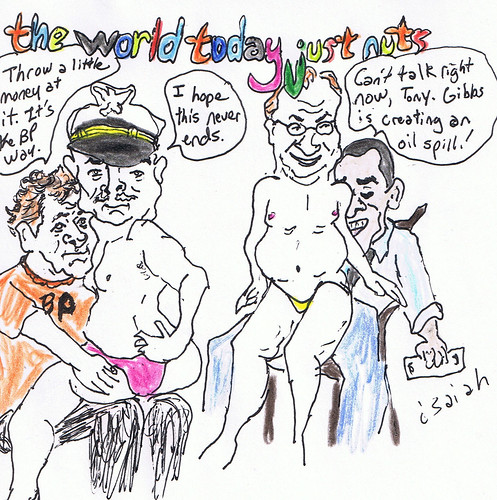
Look who's back in the oil business

Working It For BP


Above is Isaiah's "Working It For BP" from June 6, 2010 and that's BP's Tony Hayward joining Barack in a lap dance. Tony Hayward's back in the news. No, not for a raid in Russia. Graeme Wearden (Guardian) reports:

Tony Hayward has sealed a deal to exploit the oil fields of Iraq's Kurdistan region, landing the former BP boss an expected windfall of around £14m.

Hayward's return to the oil industry was finalised on Wednesday as his new investment vehicle, called Vallares, agreed a merger with Genel Energy International of Turkey. The deal will deliver an estimated £176m windfall for Hayward and his fellow backers of Vallares, including Nat Rothschild.


Iraqis need to be asking how these deals were made and who made the decision that Iraqi lives and Iraqi water ways were so unimportant that the man who oversaw the BP Gulf Disaster was just waived on in.


In other news, citing Iraq's Foreign Minister Hoshyar Zebari, the Associated Press reports that Iraq and Kuwait are no longer in conflict over Kuwait's proposed port. Fang Yang (Xinhua) reports, "Iraq may close its main border point with Kuwait to put pressure on its neighboring country to change the location of its controversial huge port on the joint navigation channel to the Gulf, an official newspaper reported Wednesday." Yang cites Iraq's Minister of Transportation Hadi al-Amri as the official. Al Sabaah is the newspaper in question and it runs a very brief item which notes that if the port goes through, Kuwait will no longer need to send items through Iraq and that this would harm Iraq's economy. I can't get Al Sabbah back up right now -- I lost this entry completely and am having to recreate it. This is the link for Al Sabbah. The article was the first one on the right hand side below the main photo (photos, they change). We'll link to the article in the snapshot. Zebari apparently didn't read Parliament in on the 'resolved' issue. They're planning to address what Dar Addustour calls "the crisis" and that includes rumors that Iraqi MPs have been paid off by Kuwaiti officials.


The following community sites updated last night and this morning:


Ann, Betty, Ruth and Mike have updated. Blogger's not reading those. Swiping from Stan's site:

It's a Blogger/Blogspot issue. We'll close with this on the Libyan War from Lizzie Phelan (Pravda via Information Clearing House):

The war on Libya has not only been a war that has vindicated NATO's claim to the most powerful military force on earth, capable of imposing its will through sheer aggression wherever it sees fit, but it has also been a war that has reasserted the western mainstream media's power to not just fabricate events but to create.

The first media victory was when it got away with claiming that Gaddafi's government was attacking it's own citizens in Tripoli from the air, a claim which formed part of the pretext for NATO's intervention and also served to create panic and anger amongst the city's residents. No one was held to account when later Russian intelligence satellites and visits from independent observers to the areas alleged to have been targeted, revealed no evidence that such attacks had taken place.

One of the most powerful lies was churned out by none other than British Foreign Secretary William Hague who claimed in the first days of the crisis that Gaddafi had fled to Venezuela. The Libyan government admitted repeatedly that their media was wholly incompetent and unable to provide alternative information at the time, with the result that the people of Libya like the rest of the world believed the claims that were being made. In this instance the result was to create a sense even amongst his traditional support base that they had been abandoned and betrayed. Of course Mr Hague made no apology for such irresponsible remarks when soon after Gaddafi showed his face in the streets of Tripoli.

More recently, the BBC has yet to apologise for using blatantly fake footage from a demonstration in India claiming it was in Tripoli's Green Square, as part of their evidence that the city had fallen.

The e-mail address for this site is common_ills@yahoo.com.


Tuesday, September 06, 2011

Iraq snapshot

Tuesday, September 6, 2011.  Chaos and violence continue, Norah O'Donnell presses the White House to go on the record about Iraq, politics remains murky in Iraq, a new cable reveals Blackwater guards didn't really leave Iraq, and more.
 
Danny Schechter (ZNet) notes US President Barack Obama is set to deliver another speech, this one on Thursday and supposedly focusing on jobs:
 
Attention, collapsing Economy: you finally have the big man's attention. Nearly 70 organizations are pressing the President to take strong action.
Please give him a break. He's been busy tending Empire business -- waging GWOT warfare on IraqAfghanistanLibyaYemenPakistanSomalia et. al . . .
Call it the greatest "long war" in American history: an unending and unbelievably expensive intervention justified as necessary to keep us safe.
 
But the Iraq War made no one safe.  Iraqis aren't safe, and we'll get to that later in the snapshot, but neither is "the west." The former head of British intelligence, MI5, Eliza Manningham-Buller just said so in a recent speech.
 
Eliza Manningham-Buller:  War was declared on a rogue state, an easier target than an elusive terrorist group based mainly at that stage in the difficult terrain of the Afghanistan-Pakistan border.  And, in my view, whatever the merits of putting an end to Saddam Hussein, the war was also a distraction from the pursuit of al Qaeda. It increased the terror threat by convincing more people that Osama bin Laden's claim that Islam was under attack was correct. It provided an arena for the jihad for which he had called so that many of his supporters including British citizens traveled to Iraq to attack western forces. It also showed very clearly that foreign and domestic policies are intertwined, actions overseas have an impact at home and our involvement in Iraq spurred some young British Muslims to turn to terror.
 
BBC News has video here and notes, "She was speaking during her first 2011 Reith Lecture, which will be broadcast on BBC Radio 4 on Tuesday 6 September 2011 at 09:00 BST and repeated on Saturday 10 September at 22:15 BST. You can also listen via the BBC iPlayer or download the programme podcast."  In the US, Richard Cohen (New York Daily News) observes:
 

This is a melancholy season in Washington, much talk about the decline of America and how our vaunted system has broken down. I won't quibble. But the most consequential breakdown of our system is exemplified by waging an unnecessary war and then - history, brace yourself - the reelection of the incompetents who had done it. Is it possible that for all the treacly talk about "the fallen" and all our salutes to the troops, we care so little about them that we casually gave second terms to the very people who wasted their lives?
This lack of accountability is not limited to our ill-conceived military adventures. After all, the financial system collapsed, but afterward there were no metaphorical hangings. People of modest means, suckers fooled into thinking a home of their own was a gift of citizenship, lost it all, but the guys at the top had a couple of bad years and then got the bonuses they were accustomed to. We are a get-over-it nation, always moving on.
Still, Iraq was different. Lives, not homes, were lost - and the Middle East was thrown up into the air.


And the Iraq War continues.  Over the weekend,  Aswat al-Iraq quoted from a statement by Humam Hammoudi, "head of the Iraqi Parliamentary Foreign Relations Commission," which says of the issue of a US withdrawal: "we are waiting the PrimeMinister to present a new agreement following the U.S. forces withdrawal for the training cadres." Al Mada reports today that Iraqi Gen Anwar Hamad Amin has released a statement stating that Iraq will need "years" to be able to secure their own air space and that, post-2011, they will continue to need US air support.  But the big news happens because of Fox News.
 
Today, they reported, "The Obama administration has decided to drop the number of U.S. troops in Iraq at the end of the year down to 3,000, marking a major downgrade in force strength, multiple sources familiar with the inner workings and decisions on U.S. troop movements in Iraq told Fox News."  They reported that US Secretary of Defense Leon Panetta had agred to it and they quoted Panetta denying that any decision had been made.  Some rushed to slam Fox News.  Why?  Today Norah O'Donnell, CBS News, raised the issue of Iraq.
 
Norah O'Donnell:  And can I turn to Afghanistan and ask whether the President has received a recommendation from Secretary Panetta to reduce the number of troop levels to about 3,000 by year's end?
 
Jay Carney: I think you mean Iraq.
 
Norah O'Donnell: Excuse me, Iraq.  Thank you.  I misspoke.
 
Jay Carney:  No.  And the process has -- as you know, we are operating under a status of forces agreement with the Iraqi government that was signed by the previous administration to draw down our forces.  We are in negotiations, consultations with the Iraqi government about what our relationship with Iraq will look like going forward.  We want a normal, productive, healthy relationship with Iraq going forward.  We have said in the past that if the security component of that relationship -- if the Iraqi government makes a request of us, we will certainly consider it.  That request has not been made.  No decisions have been made.  And so we are operating as of now under the existing agreements.
 
 
Norah O'Donnell: I understand those negotiations are underway.  But the question specifically, though, is has Secretary Panetta delivered a recommendation to the President --
 
Jay Carney:  No, I think what I -- This is contingent upon what our relationship looks like with Iraq, and that component of it depends on our negotiations with the Iraqi government.
 
Wendell Goler: Will budgetary concerns be a part of the President's decision about how many troops to leave in Iraq?
 
Jay Carney: The President has I think made abundantly clear for a long time now that he will end and has ended our efforts in Iraq, our combat efforts, responsibly.  We have been operating on a timetable that has withdrawn over 100,000 U.S. forces since he took office in a way that has been incredibly careful and responsible, and has allowed the Iraqis to further build up their security forces and improve their capacities. And uh, the -- Wh-what our relationship looks like going forward with Iraq will depend upon our negotiations with the Iraqi government.
 
Wendell Goler: And not concerns about how much it costs?
 
Jay Carney: I think we live in a world of, uh --  where resources aren't infinite, and that -- that's the case with every consideration we make.  But the answer is we will uh-uh make decisions based on what is the best for the United States, best for our national security interests and best for having the most effective relationship with Iraq going forward.
 
Norah's with CBS News, Wendell Goler is with Fox News.  The is the most Jay Carney has spoken of the Iraq War.  A war that has no cease fire.  A war that has no peace treaty.  A war that is ongoing. A war that the White House should be asked of regularly.  Today they were forced to address it.  They should.  The State Dept is forever being asked about Iraq. Why isn't the White House?  Is Barack not the commander-in-chief?  Was an executive order signed that no one knows of?
 
If not, the White House needs to be pressed on what is going on with Iraq.Victoria Nuland, State Dept spokesperson, is a better speaker than Jay Carney to begin with.  But part of the reason she's not forever stammering and uh-uh-ing her way through Iraq issues is because she's regularly forced to address it. That includes today:
 
QUESTION: On Iraq?
 
MS. NULAND: On Iraq. Yeah.
 
QUESTION: The [Kurd] president, Masoud Barzani, has told the U.S. forces to stay in Iraq, and warning of a civil war if the American forces withdraw. What can you tell them?
 
MS. NULAND: I think our public position, our private position, hasn't changed, that our plan is to withdraw by the end of the year. Were the Iraqi Government to come forward and make a request for some continued security assistance, we would be prepared to look at it.
 
QUESTION: Do you consider this call as a request from an Iraqi leader?
 
MS. NULAND: Well, we have heard many different views from individual Iraqi leaders, but they have a government, and we need to hear a united view from the government.
 
QUESTION: There was an article, a very lengthy article, by Ayad Allawi last week basically calling for that, so that's the head of a major political Iraqi bloc. Now you have the Kurds calling for that. There are talks of some sort of behind the scene agreements between the Pentagon and the Iraqi Ministry of Defense for a rotation. And so, did you know of that?
 
MS. NULAND: I mean, it's clear that a lot of Iraqis are thinking about this and talking about it. But obviously, we couldn't get into a discussion on the basis of informal comments by individual Iraqis.
 
QUESTION: I guess the question is: Is the United States flexible enough to accept such a request when it happens?
 
MS. NULAND: Again, you're taking me into hypotheticals as to when this might happen. Our view hasn't changed, that if they have something that they would like us to do, we're prepared to look at it.
 
QUESTION: Thank you.
 
MS. NULAND: Please.
 
QUESTION: Is there any --
 
MS. NULAND: Oh, sorry. Still on Iraq?
 
QUESTION: Yeah.
 
MS. NULAND: Yeah.
 
QUESTION: Is there any possibility to make a deal with north Iraq regarding the future of the U.S. presence in Iraq instead of waiting for a request from the Iraqi Government?
 
MS. NULAND: I think we have for many years operated on the basis of a single policy with regard to a unitary Iraq. I don't see that changing.
 
On the issue Fox News reported on and that Norah O'Donnel asked about, Lolita C. Baldor, Rebecca Santana, Lara Jake and Robert Burns (AP) report that the White House "is reviewing a number of options" but that a request needs to be made before Barack can decide which option to go with.
 
As noted earlier, the Iraq War didn't make Iraq safer for Iraqis.  Lara Jakes (AP) reports on the mood of Iraqis and notes, "Security is a key indicator of Iraq's future -- it drives business investment, government policy decisions and the psyche of the war-torn nation. In interviews across Baghdad, Iraqis cited the random daily bombings and shootings that continue to kill people here. At least under Saddam, they say, they knew they could avoid being targeted by violence by simply staying quiet."  Reuters notes a Baghdad sticky bombing left two people injured and a Haditha attack on the military left 8 Iraqi service members dead with one more injured.
 
 
Yesterday Al Rafidayn reported on the political intrigue in Iraq. A healthy portion of the National Alliance is the Supreme Islamic Iraqi Council headed by Amar al-Hakim and they are calling for pressure on Nouri's government to force it to provide basic services. And there may be an effort to form a majority government -- an effort which would sidestep Nouri and his political slate (State Of Law). Iraqiya's MP Talal Zaobaie states that Iraqiya, parts of the National Alliance, the Kurdistan Alliance and Sadr's bloc can come together to form a majority government which would shut out Nouri. As the article notes, Nouri began floating a threat that they would shut others (sometimes defined as Iraqiya) out of the goverment by tossing aside what currently existed and forming a majority government. Zaobaie insists if such a move was taken, everyone would be welcome provided they weren't part of the effort which harmed advancing the ministries (naming heads to the ministries) or part of the effort interfering with ending corruption. The article notes that the Sadr bloc has already stated that the government's response to the upcoming protests will determine whether or not they (the Sadr bloc) will withdraw confidence from the government. Supposedly this potential alliance would have at least 180 members (therefore 180 votes) and they would be able to push through a measure to withdraw confidence in Nouri's government and then establish a new majority government which, the assertion is, would avoid sectarian strife.


Al Mada also picks up the story and mainly adds input from the Sadr bloc via Jawad al-Jubouri who states that the bloc will suport Nouri or anyone who pushes for a government that serves its citizens. The newspaper also notes that State of Law MP Ammar al-Shibli is declaring that this plan demonstrates that State of Law must move towards forming a majority government. Dar Addustour's coverage emphasizes that such a plan would shut out certain "leaders of their lists" (more than just Nouri) and that this appears to be an effort to punish these leaders for the failures of government. 

That was yesterday.  Today UPI reports that Moqtada al-Sar has issued a call for "resistance" over the US "temporarily closing" Baghdad International Airport and Iraq's air space August 30th. Maybe this 'brave' stand will cover up his latest cave. After much bellowing from his bloc and Moqtada himself, Reuters reports his big protest isn't even on, doesn't have a date and that he announced yesterday Nouri al-Maliki had one "last chance" to work on reforms it was supposed to have implemented long ago. Reuters reminds, "Earlier this year Sadr had given Maliki six months to accelerate reforms after protesters took to the streets across the country demanding more electricity and jobs and better government services."

Al Mada also reports on First Lady Moqtada's latest drama and notes there are conflicting views on the political feasibility of it. State of Law's Adnan al-Sarraj insists that the government does not currently have the resources to make the improvements necessary. Readers of the article leave blistering comments that might surprise the western press still so sure Moqtada is a beloved and important 'force' within Iraq. The first comment questions Moqtada's ethics and wants to know exactly what is "your salary? Has the electricity gone out in your home? Are your children sharing hell with us in Iraq or have they been scattered outside of Iraq?" The second comment starts with the premise that he and his bloc are the "scourge" in Iraq and expands from there. The third comment opens with sarcasm before pointing out that Moqtada himself is part of the government. He can take comfort that the fourth comment condemns all in government.  Dar Addustour notes that Moqtada's statement sent out yesterday is a refusal to topple Nouri's government and that Baghdad is demanding permits for any protests taking place (this Friday, the youth activists plan to return to Tahrir Square and protest).

Meanwhile Al Rafidayn reports the KRG is stating Nouri is becoming a dictator who disregards political agreements and they are calling for the withdrawal of the draft oil law his Cabinet announced they'd devised last week. The KRG states that the draft conflicts with the Constitution and other laws and they call for it to be withdrawn by the Cabinet or rejected by the Parliament. That outcry comes as Nouri is set to meet with the KRG's prime minister. Al Sabaah notes Barham Salih and Nouri have a previous scheduled meeting.
 
Yesterday W.G. Dunlop (AFP) reports on a recently leaked State Dept cable which explains that although Blackwater was banned from Iraq in 2010 as a result of the September 16, 2007 slaughter in Baghdad where they shot at and killed Iraqi civilians, the same security guards/mercenaries/contractors who had been working for Blackwater just switched over to other firms (such as DynCorp and Triple Canopy) and continued to work in Iraq. It's not noted in the cable whether or not the information was shared with the Iraqi government but it most likely wasn't due to the fact that the position of the US Embassy in Baghdad was that they needed Triple Canopy to protect their staff. Press TV discussed the latest disclosed cable with Iraqi Democrats Against Occupation's Sabah Jawad:

Press TV: Who are the Americans trying to deceive, why are they using guards who have committed crimes against the people of Iraq?

Jawad: There are two aspects regarding these Blackwater [operations]. Obviously, the Iraqi government knows about these people operating in the country despite the fact they have changed their name from Blackwater to Xe [Services]. They [Iraqi officials] should know better than allow these people to still operate in Iraq. The second thing it shows is the total mentality behind the American occupation of Iraq; they have been killing Iraqi people since 2003, and even before that, since they actually began to get involved in the affairs of Iraq and after the Iraqi invasion of Kuwait. It is total disregard for the lives of innocent people in Iraq and we have many examples that when they (Blackwater employees] are proven to have committed crimes against the Iraqi people, in fact sometimes they are treat as heroes. We have reports recently in the United States that a couple of guys who used to operate in Iraq are planning for local election and even Congress and they are boating about crimes in Iraq. There is no justice as far as American occupation of Iraq is concerned. The Americans are not subjected international or Iraqi or any law for the matter, even the US's laws. These people get away with murder and they will continue to do so until the Iraqi government does something about them and we see the back of American occupation in Iraq.


Last week, another cable garnered press attention. It addressed the Ishaqi slaughter of 2006, when US forces handcuffed a family and then shot each one dead in the head -- including children. As noted Friday, Matt Schofield reported on it at length in real time. His first report ran March 19, 2006 (Knight Ridder Newspapers, now McClatchy). Saturday Matt Schofield (McClacthy) reported more on the latest developments:


Five years after reporting on what I came to call the Ishaqi Incident, five years after it had largely been forgotten in this country, five years after sleepless nights and bouts of despondency began, I found myself thinking again of five innocent faces, their bodies covered by blankets in the back of a pickup truck in Baghdad.
It came back in an unexpected manner: through WikiLeaks. What happened March 15, 2006, in Ishaqi, Iraq, was the topic of an unclassified diplomatic cable by Philip Alston that came to light in the last few days.
Alston has one of those titles that won't quit: United Nations special rapporteur on extrajudicial, summary or arbitrary executions.
His job is much simpler: When very bad things happen, he looks into them. Sometimes those things happen in Kenya or the Congo. Sometimes in Afghanistan or Iraq. Rarely, Americans are involved.
What happened in Ishaqi, no matter whom you listen to, was very bad.
PJAK is a rebel Kurdish group engaged in an independence struggle with the Iranian government. PJAK has set up camp in northern Iraq. David Batty (Guardian) reports that Iranian military spokesperson Hamid Ahmadi has declared Iran has killed 40 PJAKs and that PJAK declared a ceasefire but Iran is rejecting it stating they want the PJAK out of certain (Iraqi) areas. And should that happen? Xinhua reports that Hamid Ahmadi stated "that after the withdrawal of PJAK, talks will be held on truce if deemed necessary" -- if PJAK withdraws from Iraqi areas, the Iranian government may or may not go for a truce, they'll decide after. Aswat al-Iraq adds that Ali Akbar Salihy, Foreign Minister of Iran, is due to visit Erbil in the KRG shortly to meet with Kurdish leaders to discuss "border attacks." In addition, Aswat al-Iraq reports that Massoud Barzani, President of the KRG, is due to visit Tehran.

As attacks take place and Iran's dispatched their military, the Iranian government traffics in fantasy. Press TV reports, "The state-funded British Broadcasting Corporation (BBC) is seeking to encourage the Party for a Free Life in Kurdistan (PJAK) terrorist group to continue militant attacks against Iraq." Back on the planet earth, Aswat al-Iraq reports on the civilian population effected, "The Kurdish local authorities of Soran Qadha, Arbil, declared that the Iranian bombings of border villages continued into today, and covered populated areas in Seedkan, north of Arbil. The shelling resulted in overall panic in the area, likely related to the death of one woman and wounding of two civilians in yesterday's bombing."

And a demonstration is planned for Wednesday in Erbil to protest the attacks on northern Iraq by both the Iranian military and the Turkish military.
 
Turning back to the US.  It's an interview that will have you rolling on the floor with laughter and it's not a skit from a Christopher Guest film.  The two are actually serious. The Progressive's Matthew Rothschild and CODEPINK's Jodi Evans.  But before we get to that.  Elaine's begged me for years to share here my first meeting with Jodi Evans and never has it been more appropriate. 
 
I know Jerry Brown.  Via his campaigns, I was aware of Jodi who worked on them.  (I mainly donated to them.)  At some point after he was elected governor, I finally was face to face with Jodi one day when I arrived for a scheduled meeting (non-governmental business, but it was scheduled) and he came out of his office to apologize that he was running late but had I met Jodi (formally I hadn't) and if I needed anything while I waited, she could get it.  So Jodi and I said our hellos and I asked for a Tab (this was the seventies).  Jodi stopped to answer a phone call.  Then she explained just how much pressure she was under.  And she certainly sounded as if she was.  And this went on for about ten to fifteen minutes before Jerry was done with his meeting at which point I went off to speak with Jerry while puzzling over his in-over-her-head assistant. 
 
And all these years later, Jodi, I'm still waiting on that Tab.
 
Elaine thinks that story encapsulates Jodi Evans -- and if you know Jodi, you'll may agree.  But now for Progressive Radio's effort at Revisionary Theatre:
 
Jodi Evans: I said to my son recently who was big in the Obama campaign, "Maybe it was good that McGovern lost." Because all of us who had come there with our hearts and souls and the vision of what that campaign stood for had to then carry it forward ourselves.  And, you know, it -- We didn't get disappointed by Obama, we-- the kind of -- I've seen a lot of his friends get depressed and really feel lost.  Instead we got empowered and it really set the trajectory for our lives.
 
Matthew Rothschild: I'm speaking with Jodi Evans, the co-founder of CODEPINK, you're listening to Progressive Radio, I'm Matt Rothschild, the editor of The Progressive magazine.  Let's talk about Obama a little bit.  My daughter, like your son, worked for the campaign, though she was just knocking on doors here in Wisconsin as was my wife for that matter.  They were both very, very disappointed in what Obama has done as you say your son was. What's your take on Obama? What happened?
 
Jodi Evans: I think he's a great, inspiring speaker.  [Giggles.]  I think it was a perfect storm of a moment.  You know, I was for Obama in the beginning because he was the anti-war candidate and was actually speaking out against the war. It wasn't until later that he decided to make Afghanistan the good war which is when I started to get pretty upset and was able to actually say to his face twice during the campaign, "There's no such thing as a good war." 
 
Jodi is highly creative.  As co-founder of CODEPINK, she determined who was "bird-dogged" and who wasn't.  She made the determination that, for example, Hillary was to be bird-dogged (stalked) by CODEPINK and she made the determination that Barack wasn't.  Despite the fact that Barack's voting record was identical to Hillary's. That had an impact.  As for her being for Barack "in the beginning because he was the anti-war candidate" -- does she mean the fall of 2002?
 
I ask because -- as Elaine and I have both long discussed online -- before he was elected to the US Senate, right after he started running for that office in fact, Elaine and I were at a pricey fundraiser for Barack and, during our face time, we raised the issue of the Iraq War -- our big issue and he was the alleged peace candidate -- only to have him declare that "we" were already in Iraq (actually, no, we were in the United States) so it no longer mattered.  It was similar to statements he'd later make to the New York Times during the 2004 DNC convention.
 
So it's a lie when Jodi says he was the anti-war candidate.  He presented himself as that and groups like CODEPINK encouraged the lie by refusing to note that if Barack truly was against the Iraq War then voting for continuing it once he was in the Senate was more disgusting than the hawks who voted for it in 2002.
 
As for "later" on Afghanistan, I don't know what the hell she's talking about.  In February 2007, he declared his intent to run for the Democratic Party's presidential nomination.  June 3, 2007 -- in a televised debate -- he  declared that, "One of the things that I think is critical, as the next president, is to make absolutely certain that we not only phase out the Iraq but we also focus on the critical battle that we have in Afghanistan and root out al Qaeda." Want to go back further?  The October 12, 2004 debate when he ran for the US senate, "It is an absolutely hopeful sign for the people of Afghanistan. As I have stated unequivocally, I have always thought that we did the right thing in Afghanistan.  My only concerns with respect to Afghanistan was that we diverted our attention from Afghanistan in terms of moving into Iraq [blah, blah, blah]."  Or how about his August 1, 2007 speech?  CNN's opening sentence in their report on that speech?  "Sen. Barack Obama says he would shift the war on terror to Afghanistan and Pakistan in a speech he delivered Wednesday."
 
So I'm confused as to when Jodi was confused about where Barack stood on Afghanistan since it was pretty much always clear and it certainly was before 2008 rolled around -- the year Jodi did her part to demonize Hillary while building up Barack.  I'm confused because I'm not a fan of let-me-lie-my-way-out-of-the-hell-I-created revisionary tactics.
 
As for Barack being a  great speaker, as Ava and I noted February 15, 2009:
 
We watched Monday in full as Barack uh-uh-uhed and spoke in that robotic manner that allows him to find more unnatural pauses than Estelle Parsons and Kim Stanley combined. "He's our Method president!" we quickly gasped while wishing we could have one president this decade capable of normal speech. If he gets any worse, he'll be Sandy Dennis.
 
 
Back to the interview.
 
Jodi Evans: I think he's a great, inspiring speaker.  [Giggles.]  I think it was a perfect storm of a moment.  You know, I was for Obama in the beginning because he was the anti-war candidate and was actually speaking out against the war. It wasn't until later that he decided to make Afghanistan the good war which is when I started to get pretty upset and was able to actually say to his face twice during the campaign, "There's no such thing as a good war." 
 
Matthew Rothschild: Well how did he respond?
 
Jodi Evans: He said, "I was thinking the Civil War."  And I said, "I really don't think you're that stupid because that was about economics really." But, you know.  [Laughs] I said, "Shame on you." So, you know, I had experiences of him when he was a senator. I made a movie called The Ground Truth which is about the wounded soldiers and took it to his office and talked to him about it because Veterans Affairs was one of the Committees he was on.  And he was -- You know, when you're in the office with him, he's super-inspiring and personal and "I'm going to do this with" and "We're going to bring these people in" and "We're going to change this." But nothing happened. So I think I kind of knew the 'nothing happens' out of the story personally.  But I also know what it's like having been inside a governor's office, what happens when you get power.  And unfortunately, watching it from the outside, I've never seen a more closed, you know, presidential community. I mean, it's all really weird.  It's never been this bad. And I don't know why that is, what they're afraid of.  It seems to be really out of a lot of fear and --
 
Matthew Rothschild:  "Closed"?  By that you mean cloistered? All of one mind set?
 
Jodi Evans:  Yes. And elite. Super elite given who he is. Even my friend Van Jones was in the White House for awhile and the stories he would tell me about how they were told to dress and behave is just not kind or relational.  I think relational is the important thing. And so you think there must be a lot of fear that creates that.  That's what cause people to be that way.  You see that in how he is around war and how he is around Wall Street. I think they're all issues that he really doesn't have a grasp of so he gives that power away to others. I've been in that situation. Jerry [Brown] did that a bit with me, he'd be like, "I don't want to deal with that," so he'd give the power away. And so, unfortunately, he's given the power away to, you know, the wrong [laughing] people as far as I'm concerned. Or the people that don't represent what he ran on. His words and actions aren't matching. And they just seem a little lost.  They can run a good campaign but they just don't know how to be president.
 
Matthew Rothschild: At least at the beginning of his presidency, it seems to me, that Obama anesthetized the peace movement. Uh, did you have that same feeling?
 
Jodi Evans: Well we've had that experience before like in 2006 when it was the peace movement that actually -- it was the anti-war, you know, push that got all those new people in and, you know, really changed the tenor of the election and then they get there and they vote for war. So you know, we've been there before. But, yes, I think it sucked the air out of anything that any organization or movement that had a wet blanket thrown on it You kind of get thrown back and you don't know what to do next and you kind of have to rethink. I mean, that doesn't happen in CODEPINK, we just kind of go, "Yeah, we're used to this," and keep going and we're usually all alone in the street for awhile and people will get back when they get their feet kind of on the ground again.
 
A.N.S.W.E.R. and World Can't Wait continued protests.  CODEPINK alternated between silent mode and cheerleader mode.  And if you've forgotten it, click here for Scott Horton's Antiwar Radio piece (transcript) on when CODEPINK supported the Afghanistan War.  Short on facts, but almost as entertaining as Corky St. Clair.