Kat: If I say, "I met him on a Monday," chances are you say, "and my heart stood still." And hopefully, we're both talking the Crystals and not the Shaun Cassidy cover. Not because I'm this huge fan of the Crystals, you understand, or this huge enemy of Shaun. I mean, one of the group's biggest hits is "He's A Rebel" and no one in the group sings on it.
No, to record that number one hit, Phil Spector relied on Darlene Love and her group of backup singers the Blossoms. Phil Spector? Oh, yeah, the crazy who is currently in the midst of serving a 19 years-to-life sentence in the California penal system. But before he went completely nuts and totally criminal, Phil was more of a minor league terrorist and producing some of the classic rock songs of the early sixties.
Not that most people would know. In part because Specter has always been so damn greedy and also due to legal issue after he shot dead Lana Clarkson in 2003. What do I mean by that?
No one did more to destroy Phil's legacy than Phil. And it was long before 2003. In 1986, on a day trip back from Mexico (in the good old days before a passport was required), I was zooming through Baja California with the gas tank groaning. So I zip into a gas station, fill up, go inside, check out the sunglasses, grab some chips and a cola, head to the register and there's a huge layout of cassette tapes. Back in 1986, cassettes were all the rage for music.
I'm running my finger along the plastic cases to make sure I don't miss a title when I find one with Phil Spector's greatest hits. It has a little white sticker on it noting it's an import from England. Of course. I grab it and plop it down on the counter with the rest of my bounty.
It had a photo montage of various artists and a title like
Phil Spector's 16 Greatest Hits. I remember the paper the credits were on was blue. Photo montage of various artists?
Yeah, Phil wasn't a singer. He was a producer and sometime songwriter. As you read this, even if you don't think you know Phil's work, most likely you do. "Uptown" by the Crystals, "Then He Kissed Me" by the Crystals, "You've Lost That Lovin Feelin" by the Righteous Brothers, -- What? Yeah, like I said, pretty much everybody knows Phil's work.
And in the 60s, he got credit for it. He was a hit making machine famous for his "Wall of Sound." Radio royalty starting in 1958 with the Teddy Bears "To Know Him Is To Love Him" -- a song he not only sang on with his group but one that he also wrote and, most importantly, produced. An exciting ride that more or less came to a screeching halt in 1966 when his production of
Tina Turner singing "River Deep - Mountain High" crashed well outside of the top 50 (in this country, in England it was a major top ten hit winning praise from the likes of George Harrison). That was pretty much it for Phil. He'd play a drug dealer in Easy Rider. He'd luck into 'producing' the Beatles'
Let It Be. George, John, Paul and Ringo had already recorded the tracks without him. Phil just sweetened them after the fact. Some argue "over-sweetened." (Pick up
Let It Be . . . Naked to listen to how they would've sounded without Phil's accents.)
That was really it. George and John both used him as co-producer for a few hits. Warner Brothers hoped his touch would put Cher back on the charts (didn't happen). John Lennon infamously let Phil actually produce him in the studio, went so far as to say he wanted Phil to treat him the way Phil had treated Ronnie Spector. Phil kept his word there. Screaming at Lennon, threatening Lennon, brandishing a gun -- it all harkened back to the days when he imprisoned Ronnie (lead singer of the Ronettes and briefly his wife) and kept a coffin for her in their mansion as a warning. (For Ronnie's story, see the book she wrote with Vince Waldron,
Be My Baby: How I Survived Mascara, Miniskirts, and Madness.) And the resulting 'album' can charitably be described as "a mess."
Phil would go on 'producing' and that harmed his reputation more than anything else. Not just because what's the point of producing Leonard Cohen, Dion or the Ramones, for example, when you're the hit making producer if you can't produce hits, but also because Phil's delusions that the best times lay ahead of him kept the hits buried. See Phil's work was on Phillies Records, a label he started with Lester Sill. He later bought out Sill. And after the crash of "River Deep - Mountain High," the always reclusive Phil became more so. As the seventies progressed, apparently when he needed some quick cash, he would license a song or two for a collection. But for the most part, he failed to ride the nostalgia wave sweeping the country (it began with the film
America Graffiti). In the 80s, this was only more true.
There were no Phillies releases. No new material -- not that most were yearning for Phil to reteam with Bob B Soxx and the Blue Jeans, for example, or the Paris Sisters -- and no attempt to work the old material in reissues. There was radio, oldies radio. But not a lot more. When I got home with that cassette, you would have thought it was Mexican weed the way everyone came over to oooh and aaaah. Several friends dubbed off copies of the cassette. You really couldn't find it in the States, not even in the imports at Tower.
1986 was also the year I bought my first CD magazine. It was near the end of the year and this thick, cheap paper thing that was more like a coin collectors guide. It was called something like
CD Digest. And it was about the titles being put out on the latest music format. CDs wouldn't begin dominating the market for another decade, but they were already making inroads among collectors. I remember the reviews being insulting and sexist (no surprise, geeks can be some of the biggest sexists) and threw the thing in the trash after reading yet another man explain how Cass Elliot, Grace Slick, Janis Joplin, Diana Ross, etc. wasn't really talented but lucked into a man who allegedly did all the work. If they're straight, that's how you know their geeks, by the way. No man who's ever actually been in bed with a woman could claim with a straight face that the man did all the work. But I digress.
CDs reigned supreme for years and years.
So much so that Phil's ego finally led to
Back to Mono. What was that? A 1991 CD boxed set containing 60 tracks plus 1963's
A Christmas Gift For You album's 13 tracks. Critics loved it. Consumers? CDs were overpriced. We knew it. And they knew we knew it. So they repeatedly assured us that the prices would go down when the CDs really started selling. It never happened. I believe I was paying $8.99 for an album on cassette in 1986 when the same title on CD was costing $13.99. And the prices just went higher and higher. Which is how Phil Spector ended up finally releasing a collection that most people couldn't afford -- four discs and listing for around forty bucks.
Did he really think young, enthusiastic music buyers were going to discover him when they could buy his boxed set or four of the current hot albums for the same price?
Around 2001, the economy crashed (as it had at the end of the seventies) and the format changed (ibid). I stayed with CDs while Tower Records was around. After my beloved second home was closed down, I began dipping my toes into the sea of downloads. As a serious collector of many years, I know a few tricks. (I can still win any Ebay item but that's a trade secret I'll pass on only when I'm almost in the grave.) And one of the tricks music collectors know is that if it's not available here, check England and Japan -- where music is always huge.
So finding that there was no Phil Spector collection at iTunes or Amazon, I started looking around. At Amazon UK, I found I could get many of Phil's hits . . . on disc. But copyrights prevented me from downloading the same tracks from Amazon UK. Let me explain that slowly, I couldn't download the tracks but I could buy them on disc and have them shipped to me in the US. No, it made no sense at all and by that time I really wasn't buying CDs and certainly not in the mood to wait for one to make a Transatlantic voyage.
I gave up looking but, just clicking around Amazon (US), discovered that there were two collections available. I assumed I'd download the more expensive one,
The Phil Spector Collection, for $24.99, because it had the most tracks: 59. But, for a change, I didn't immediately hit the purchase button, I looked at the tracks. I love the Ronettes and am sure all their songs on the collection are wonderful, all 20 not counting Ronnie Spector's solo numbers as Veronica. But where the hell was "You've Lost That Lovin Feelin"? Or Tina's "River Deep - Mountain High"?
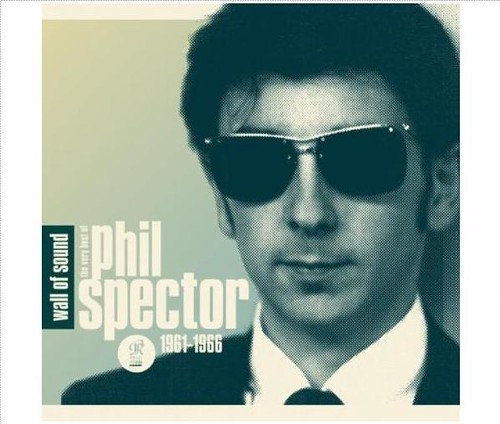
On
Wall of Sound: The Very Best of Phil Spector 1961 - 1966, 19 tracks for $9.99.
By no means does
Wall of Sound contain everything. For example, the Righteous Brothers' "Unchained Medley" (given new life via the film
Ghost) isn't on here. And none of the Paris Sisters' songs are on here which is a real shame because their "I Love How You Love Me" remains a teenage love classic, full of the push-pull, the masochistic overtones that signal the onset of adolescence. It's their in what can be seen as a wall of hushed silence surrounding the vocals, it's there in the vocal and it's there especially in the lyrics.
Much attention has rightly been focused on Phil's walls (of sound and of silence) and, since Tom Wolfe's essay back in the 60s, comparing them to mini-Wagner operas. But no one seemed to grasp -- then or since -- that operas depend on lyrics as much as music to convey the dramatic emotion (maybe the inability to grasp that has something to do with the fact that so few speak Italian in this country?). But Phil's contributions include lyrics as well. I don't mean as writer. In fact, his co-writing credits often came about as a result of blackmail ("Cynthia and Barry, I'm not recording this song you wrote unless I get co-writing credit!"). But he selected (and popularized) very plain spoken and relatable lyrics (with a few noteable exceptions such as his infamous bomb for the Crystals "He Hit Me And It Felt Like A Kiss").
Phil's ridiculous hairdo may have helped convict him in 2003, he looked insane. But what some might not have grasped was that it was Phil's attempt at an afro. He spent forever and a day pretending he was Black or that he understood the Black experience. He was a Jewish kid from the Bronx with heavy affectations. What he understood was the teen experience. That was nothing to sneeze at and why he -- a non-singer -- became more famous in the end than Chuck Berry, Fats Domino and assorted others. The teen experience insight prevented him from releasing a song like "My Ding A Ling." The Teen experience prevented him from thinking a Glen Miller hit was the perfect thing for rock and roll. Teens, he knew, were obsessed with themselves. So if you were going to go nostalgic, skip Glen Miller (who they didn't know) and slide on over to Disney with "Zip-A-Dee-Doo-Dah." When teenagers get nostalgic, it's for their childhood (something the other 60s producing genius, Brian Wilson, also understood). This teen wisdom is why, when Phil did sit down with a Cynthia Weil and Barry Mann, he could verbalize what he wanted, even if he didn't know exactly how to write it.
Cynthia Weil and Barry Mann wrote some of Spector's biggest hits including the Crystals' "Uptown" which was about as political as top forty got back then. But they weren't the only ones. Basically everyone at the Brill Building was forever auditioning for Phil. Ellie Greenwich and Jeff Barry scored with "Be My Baby" -- a huge hit for the Ronettes. Ellie and Jeff also wrote Phil's hits "Da Doo Ron Run," "Then He Kissed Me" and "Baby I Love You" -- as well as the nadir and classic "River Deep - Mountain High." But it was Barry Mann and Cynthia Weil who'd write "Walking in the Rain" -- one of Phil's great productions (and a hit for the Ronettes). And it was Barry and Cynthia who would write "You Lost That Lovin Feelin."
But they, and the acts singing the hits, often get overlooked because so great was Phil's reputation and producing talent that he truly was the star of his records. And in the seventies, this was acknowledged but fading, in the eighties more so and it continues to this day. For many, Phil Spector is nothing but the killer serving a prison sentence.
Before 2003 ever rolled around, he was one of rock pioneers whose work changed the understanding of the popular song as much as Bob Dylan and the Beatles did. Along with the songwriters mentioned, many other artists got starts and re-starts via that Wall of Sound. (I'm exempting Carole King and Gerry Goffin who did write the occasional number for Phil due to the fact that they were well established outside of Phil throughout the sixties.) Those who worked with Phil during his hey day included Russ Titelman (whose own production masterpiece is probably Steve Windwood's
Back in the High Life), Don Kirshner whose stable of writers supplied so many of Phil's early hit songs, Brooks Arthur (who went on to produce
Janis Ian's
Between The Lines) and, probably most of all, a young couple. He was a short fellow named Sonny Bono who did pretty much everything for Phil and she was
Cher who sang back up on Phil's hits from "Da Doo Ron Ron" through "You've Lost That Lovin Feelin." Sonny and Cher became Sonny & Cher -- rock's first hippies -- and then TV stars and then a divorced couple and then he became a mayor and was voted into the US Congress while she became an unstoppable music institution and an Academy Award winning actress.
And Phil? Maybe the collection will help? Maybe the fact that Sony is now in charge of the recordings will help? See, Phillies was as big as Motown. But while Berry Gordy was smart enough to work the Motown classics while he owned the label, Phil sat on his. So, for example,
China Beach viewers identify the sixties with the Motown sound and Phil's forgotten. It's one thing for the artist to be a recluse, something else to turn the art itself into a recluse.
None of the above is meant to argue for a parole hearing for Phil or to claim that he's not guilty or that he's guilty but he's a really, really sweet guy. Phil Spector killed a woman. He was found guilty by a jury of his peers of that crime. And it's not really surprising the way he used to brandish firearms or the way he used to threaten and bully women. Cher probably summed him up best of all who worked with him when, in 1998's
The First Time, she wrote:
I believe Phillip really was a genius, but there was a downside. He could be a real dick. He could be a lot of fun, but when he was in a bad mood, everyone in the studio walked on eggshells. People were in awe of him, and they did what he said.And that's why he got away with his outrageous behavior that only became more outrageous (and threatening) and why he may have come to believe he was above the law. Long before that happened, he had produced the tracks that make up
Wall of Sound and forever changed the popular song as we know it.
phil spectorthe crystalsdarlene lovecherthe beatlesjohn lennongeorge harrisonthe ronettesthe righteous brothersthe paris sisterskats kornerthe common ills