Monday, January 09, 2012

Iraqis say suffering has increased, refugees and more

Gallup has a new poll out today. It's a survey of Iraqis. Stafford Nichols explains, "The percentage of Iraqis who rate their lives poorly enough to be considered 'suffering' rose from 14% in in October 2010 to 25% in September 2011." So isn't great that NPR and others shut down their Iraq offices and went home? 'We don't really care about Iraqis,' their actions say. 'We were just here as hand maidens to the US government because if we hadn't been here to attempt to control the narrative, less friendly to the US government outlets might have gotten control of the narrative.' It's a big F.U. to the Iraqi people.

And while we're on the press distortions, we were repeatedly attacked in angry e-mails (including from some 'name' reporters in the MSM who were claiming at their outlets that violence was down and had been going down steadily) for asserting that violence wasn't going down. Iraq Body Count's analysis was noted by a number of outlets last week. I waited for the one that would emphasize this: "The number of civilian deaths in Iraq in 2011 was almost at the same level as in 2010 -- there has now been no noticeable downward trend since mid-2009. As observed in IBC's previous annual report, recent trends indicate a persistent low-level conflict in Iraq that will continue to kill civilians at a similar rate for years to come." No one ever did make that their main emphasis. It went against the lies the US military spokespersons were serving up in Iraq and at the Pentagon and trained doggies know not to bark if it displeases their masters.


Trudy Rubin (Philadelphia Inquirer) has spent the last years reporting what she saw with her focus on the truth. A strong argument could be made that her columns have documented the steps that led to the current political crisis. Her focus for some time has been on the Iraqis who helped the US as translators and have now been forgotten. Her most recent column on that topic is "Shame On US: allies betrayed." Excerpt:

Last week, I spoke on the PBS NewsHour about Iraqis who worked for our civilians and military before we left the country - and who now face death threats because we betrayed them.

I've received a slew of e-mail from Iraqi interpreters who are in hiding because Shiite militias have pledged to kill the "traitors" who aided the Americans. I've also received e-mail from U.S. military officers desperately trying to get their "terps" out of the country. And I've heard from ordinary, concerned Americans.

All ask the same question: How can we get the U.S. government to issue the visas it promised to Iraqis who risked their lives to help us?

I'm ashamed to admit that the U.S. government has abandoned these people. No one seems eager to bring more Iraqis into this country in an election year.

President Obama has failed to keep his 2007 campaign pledge to rescue these Iraqis. A group of concerned senators, mostly Democrats, including Pennsylvania's Bob Casey, has made inquiries, but gotten no answers from Secretary of Defense Leon Panetta or Secretary of Homeland Security Janet Napolitano. Nor has a peep been heard on behalf of the "terps" from Republican senators who backed our war in Iraq.

Good for Trudy Rubin. And her voice is especially needed since no one has taken up the megaphone Kenneth Bacon had as president of Refugees International (he passed away in 2009). In addition to the stories she shares in her column, she also has a blog post entitled "More Iraq visa horror stories" dealing with stories shared by a US military officer and Refugees International. Kimi Yoshino (Los Angeles Times) writes of a visit to Disneyland with a group of Iraqi refugees who were among the small number able to get into the US:

Since my husband arrived in the U.S. in 2009 after months of red tape, I've heard him remark on numerous occasions how youthful everyone looks here — and how relaxed. In Iraq, a life of fear and anxiety has taken a toll. Forty-year-old Iraqis look 10 years older. And there's an exhaustion, a sadness, that seems to permanently cloud their eyes.
That was part of the culture shock of Disneyland, so much joy all packed into one place.
"Once I entered inside, I felt like I was transferred into a whole different world of fantasy," my husband said. "Everybody's happy and everybody's nice — like it's not a real world."
The uncertainty and the violence that still grips their country is what drove them to leave, even if it meant starting over.

And Andrew Lam (New American Media) focuses on the Iraqis forced out of their country due to the violence:

Each time Uncle Sam ventures abroad he leaves an unfinished story, and nowhere is it most unfinished than the story of Iraq, where despite flowery speeches regarding freedom and sovereignty by the Obama administration, despite assurances that tyranny has been “cast aside,” the tragedy caused by the United States invasion, occupation and inevitable abandonment is on an epic proportion.

Never mind that sectarian violence continues unabated and much of the populace remains mired in poverty, and that there’s a distinct possibility that the country is on its way to becoming a failed state if the Sunnis and Shiites cannot find a way to collectively govern.

The most unfinished story, however, is the population that the war has displaced. Whether tyranny has been cast aside is questionable, but certainly cast aside are the people of Iraq. They have been displaced both internally and internationally and are now imperiled by the sin of our omission.


Stephen Lendman (OpEd News) explores journalism in Iraq and emphasizes this remark by Nouri al-Maliki's spokesperson Ali al-Dabbagh to RT News: "[Press freedom] is not protected by the government. [. . .] and you can see that there are people in the Ministry of the Interior for example, they are misusing their power against citizens and against journalists. They keep accounts and some of them have been fired."

In the US, Dar Addustour notes, Fort Lewis spokesperson Chris Ophardt has announced approximately 100 soldiers are on lockdown as a result of an "apparent theft of sensitive military equipment." Reuters reports on it here. Dar Addustour identifies the soldiers as having recently returned from Iraq, Reuters makes no mention of that.

Bonnie reminds that Isaiah's The World Today Just Nuts "Here's Nouri" went up last night. On this week's Law and Disorder Radio -- a weekly hour long program that airs Monday mornings at 9:00 a.m. EST on WBAI and around the country throughout the week, hosted by attorneys Heidi Boghosian, Michael S. Smith and Michael Ratner (Center for Constitutional Rights) -- topics explored include an update on Guantanamo by Michael Ratner on the tenth anniversary of the Guantanamo Bay prison, attorney Roger Wareham discusses the January 12th International People's Tribunal on War Crimes and Other Violations of International Law, California State University professor David Klein on the plan to build the Cornell and The Technion of Israel in NYC and CCR attorneyy Darius Charney on NYC's stop and frisk policies.


The e-mail address for this site is common_ills@yahoo.com.


wbai
law and disorder radio
michael s. smith
heidi boghosian
michael ratner


Sunday, January 08, 2012

Isaiah's The World Today Just Nuts "Here's Nouri"

Here's Nouri


Isaiah's latest The World Today Just Nuts "Here's Nouri." Nouri whines, "Wah! They made me go after Tareq al-Hashemi!" In the background, Moqtada al-Sadr utters a disapproving, "Nouri!" And Isaiah notes, yes, it is nod to I Love Lucy but he's not comfortable calling the cartoon I Love Nouri due to possible misinterpretations. Isaiah archives his comics at The World Today Just Nuts. Isaiah archives his comics at The World Today Just Nuts.


Link


And the war drags on . . .

On today's Face The Nation (CBS News), Bob Schieffer hosted Defense Secretary Leon Panetta and Senator John McCain (among others). The two spoke -- in different segments -- about Iraq. We'll note McCain tonight (and in a snapshot this week) and grab Panetta in a snapshot this week.


Senator John McCain: Secretary Panetta mentioned in Iraq. In all due respect, Iraq is unraveling. It's unraveling because we didn't keep a residual force there because the President of the United States pledged to get out of Iraq [clears throat] and we could have kept a residual force there and kept some stability. Instead, it's unraveling and Iran's influence is increasing. And there's every possibility you could see a very chaotic situation --

Bob Schieffer: You think there's a civil war coming there?

Senator John McCain: I think there's clearly an unraveling going on which could eventually lead basically into three different kind of states in Iraq. We needed to keep a residual force there and that is what the Bush administration envisioned and that is what we should have done. We never gave them a number until, in the words of General Dempsey, the numbers cascaded down to 3,500. The Iraqis were ready to deal on this issue. The administration did not give them a number. And so what the perception is now, particularly in that part of the world, is that the United States is weak and withdrawing. And that is also having its effect in other places including emboldening Iran. Leading from behind is not what this world needs. And we still do have the best military in the world. And we still do have the most efficient and we still do have the most effective ways --

Bob Schieffer: Well let me just ask you, you heard Secretary Panetta said he's confident that there's an Iraqi army in place that could protect those 15 to 17,000 Americans that are still there. Are you confident that those people are safe?

Senator John McCain: Of course not.

Bob Schieffer: And what would happen? We have to go back?

Senator John McCain: No, I think we would have to withdraw them. Look, what Secretary Panetta may not understand -- and I have great admiration and respect for him -- that the situation is unraveling. The Vice President of Iraq is now hiding out in Erbil. There is militias and death squads operating. There is a breakdown in the Iraqi government. And there will be increased tensions on the border between the Kurdish areas of Iraq and the other areas of Iraq. And all of these could have been avoided if we had led rather than followed.


There's a number of things that McCain's talking about that people aren't going to be able to follow because the media really didn't cover it (it's all in archives as the year wound down). We may go into that during the week -- especially if some people, reading or watching the words -- decide to do columns or posts where they attack McCain without understanding what he's saying. Dempsey is Gen Martin Dempsey who is the Chair of the Joint-Chiefs, by the way.

First, we'll note our disagreement. McCain insists that US forces on the ground would mean the current political crisis wouldn't be taking place. I think you can make that argument if you're willing to say that the same number of US forces in Iraq in July would be on the ground right now.

You can say that because when that number was on the ground, Nouri wasn't pulling this nonsense. So you can say that based on what took place in July, it wouldn't be taking place right now. But McCain (in 2011) favored some reduction. So whether the numbers dropped down to 20,000 or 15,000 or 12,000, I don't see how you can make the claim that the crisis wouldn't be taking place. (I attended numerous Congressional hearings on Iraq in 2011. I never heard McCain support a number as high as 46,000. The highest I ever heard was 20,000. If there's a time in 2011 when he supported a higher number, please let me know.)

Repeating, you can use July as a standard. There were approximately 46,000 US troops in Iraq then. So although you can say if 46,000 remained it is likely that what is happening currently (political crisis) would not be, I don't see how you can argue, 'If 20,000 US troops had stayed, this wouldn't be happening.' You can make the claim, you can argue it and you may be right but it's not like you can prove it or even prove that it's likely.

Our view? US troops need to all leave Iraq and the surrounding areas (which still hasn't happened -- and most likely won't due to the US State Dept occupation). The US troops leaving did not cause the political crisis, I argue, because no US soldier was involved in the political crisis. Nouri al-Maliki started the political crisis.

That brings it back to the White House. (A) It was the White House that spat on the Iraqi Constitution and the will of the voters by insisting Nouri remain prime minister even though the people expressed their will that Iraqiya be given first crack at forming a government. (Ayad Allawi's Iraqiya came in first in the March election, Nouri's State of Law came in second.) Since Nouri's causing the political crisis currently, I think you can make a strong argument that it wouldn't be taking place, had Ayad Allawi become prime minister. (B) It was the White House that propped up Nouri, yes, it's also the White House which failed to convey to Nouri any respect for rule of law. How else to explain that the political crisis starts after Nouri flies home to Baghdad from DC where he spent days with Barack Obama? (Another explanation would be that Barack parroted April Oliver from decades ago and conveyed to Nouri that the US really didn't care what he did to Iraqiya.)

So there's the stay/go issue. We're going to political, domestic political. Iraq is a nightmare right now. People who follow world events are aware of that. It may be a small number in America, but they are aware of it. And since there's not many US outlets with people stationed in Iraq, the coverage is kind of vague and blurry.

So a segment of the public sees a vague blurry political crisis and they hear Leon Panetta (and others in the administration) dismiss it as anything serious while seeing McCain speak passionately about it. Who are they going to identify with?

In that vacuum, it's going to be McCain.

Those of us opposed to a US military intervention in Darfur in the last decade had to tread very carefully. And we knew it. We couldn't be dismissive (which is what the White House now is -- especially in press briefings -- both at the White House and at the State Dept). If we were dismissive, the other side (the pro-war crowd) won. We looked uncaring and they cared. It didn't matter what the arguments were on either side, it mattered if one side looked uncaring. Because most Americans want to believe that their country cares.

The White House is not conveying that they care about Iraq at all. John McCain is. By default, he's winning.


They're just there to try and make the people free,
But the way that they're doing it, it don't seem like that to me.
Just more blood-letting and misery and tears
That this poor country's known for the last twenty years,
And the war drags on.
-- words and lyrics by Mick Softly (available on Donovan's Fairytale)

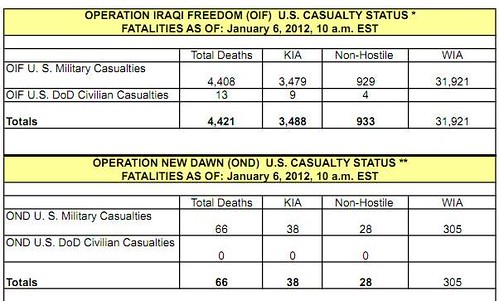
Last Sunday, the number of US military people killed in the Iraq War since the start of the illegal war was 4486. Tonight? PDF format warning, DoD lists the the number of Americans killed serving in Iraq at 4486. Here's the screen snap.

1812


Reuters notes today's violence includes a Mussayab car bombing which injured thirteen people, a Baghdad roadside bombing which injured three people, a Kirkuk bombing injured 1 husband and wife (the husband works for the Kirkuk University), a Kirkuk roadside bombing injured a father and son, a Saadiya roadside bombing left one official with the Kurdistan Communist Party injured and, dropping back to last night, an attack on a Falluja checkpoint claimed the lives of 3 people.


Isaiah's The World Today Just Nuts "Here's Lucy" went up earlier tonight. I'll change the time stamp on it so that it's at the top after this goes up. New content at Third:


Pru notes this editorial from Great Britain's Socialist Worker:

Imperialist war left a bitter legacy of hate and instability in Iraq

comment on article | email | print
Share: Facebook | Delicious | Digg | reddit | StumbleUpon |

After nine years of war and occupation US troops have pulled out of Iraq.

More than a million civilians died. Millions more were injured or became refugees. Iraq’s infrastructure lies in tatters.


The US still wants to shape the future of Iraq with its lucrative oil resources. It has built the biggest embassy in the world in Baghdad with thousands of staff and private security contractors.

Iraqis rightly cheered the US exit. Yet they are left with a legacy of poverty, instability—and the sectarian tensions stoked by attempts to divide the resistance.

But Iraq is not a victory for the West. The war was opposed across the world. Two million marched through London on the magnificent Stop the War Coalition demonstration in February 2003.

George Bush and Tony Blair will forever be associated with this bloody imperialist war and the lies about weapons of mass destruction that led to it.

They claimed they wanted to free Iraqis from a dictator. But imperialist war does not bring freedom whether in Iraq, Afghanistan or Libya.

Last year we saw the alternative. Popular revolutions of ordinary people showed they can overthrow dictatorships—and challenge imperialism.


© Socialist Worker (unless otherwise stated). You may republish if you include an active link to the original.


The e-mail address for this site is common_ills@yahoo.com.