| |||||||||||||||||||
| |||||||||||||||||||
| |||||||||||||||||||
| |||||||||||||||||||
| |||||||||||||||||||
| |||||||||||||||||||
| |||||||||||||||||||
| |||||||||||||||||||
| |||||||||||||||||||
| |||||||||||||||||||
|
| |||||||||||||||||||
| |||||||||||||||||||
| |||||||||||||||||||
| |||||||||||||||||||
| |||||||||||||||||||
| |||||||||||||||||||
| |||||||||||||||||||
| |||||||||||||||||||
| |||||||||||||||||||
| |||||||||||||||||||
|


Abolishing Police and Abolishing Militaries
https://worldbeyondwar.org/abolishing-police-and-abolishing-militaries/

By David Swanson, World BEYOND War, June 10, 2021
The similarities between the movement to abolish war and the movement to abolish police and prisons jump out at me anew when reading Mariame Kaba’s We Do This ‘Til We Free Us, which is about police and prison abolition. The book has a foreword by Naomi Murakawa that includes this:
“Police push millions of people into the criminal punishment system, where ant-Black death-dealing rises through each circle of hell. Black people comprise 13 percent of the U.S. population but roughly 30 percent of the arrested, 35 percent of the imprisoned, 42 percent of those on death row, and 56 percent of those serving life sentences. Inside the largest prison system on the planet, the Covid-19 death rate is five times that of the general population. The roughly eight hundred U.S. military bases the world over — like the nation’s birth in native dispossession and slavery — reinforce the lessons that Trump’s brand of white brothers know all too well: take by force and invent the racial enemy. We live in the age of human sacrifice, says Ruth Wilson Gilmore, and our prison and military machinery normalizes industrialized killing. We must abolish the prison-industrial complex . . . .”
That the military-industrial complex itself went missing from that last sentence reflects the fact that it isn’t the topic of the book. That it got mentioned in the preceding sentences is remarkable. Outside of anti-prison and antiracist activism, one is hard-pressed to find any advocate for anything good under the sun who mentions war abolition even in passing.
Prison-abolition has a similar problem. Opponents of sexual violence tend not to oppose the prisons in which a huge percentage of sexual assaults happen, just as opponents of environmental and climate destruction tend not to oppose the militaries that do so much of it (to take two examples of dozens for each of these two abolitionist movements).
Police and war abolition have a lot more in common, however, than the reluctance of well-funded respectable reform movements to support them. The two causes confront similar, dehumanizing, fear-driving myths and misunderstandings. Both have to help people outgrow their belief in the good war or the good prison sentence, and the fantasy of putting police to benevolent use or deploying the military to handle disaster relief. Both have to explain why reforms don’t help, and educate on what must replace the evil institutions that they are accused of wanting to simply tear down. Both must work on structural changes and cultural changes, tackling systems as deeply embedded in psyches as in public budgets. Both know the centrality of re-directing resources. Both are potential sources of massive funding for human and environmental needs if they can redirect it.
Both are taking on the worst actor in the U.S. government(s) and thus have the rest of the world to point to for big steps in the right direction — even as many other governments engage in their own awful policing and warring. Both are opposing institutions falsely imagined as affairs of adult males. Both institutions are, in fact, largely imaginary and false in people’s common pictures of them which consist of battlefields with ground “defense” forces, and lenient courts with “correctional” officers. Prison abolitionists must shatter concepts of idealized victims (and the debasement of non-perfect victims) while war abolitionists must point out the unwanted knowledge of what preceded the sacred assaults on innocent and pristine Pearl Harbor and the Pentagon/World Trade Center. Police largely create riots, and militaries largely create armed enemies. Prisons fuel recidivism, and U.S. wars are waged against U.S.-made weapons and dictators. Yet reality looks upside down to those who still need to be brought into the police and war abolition movements.
Something else connects these two movements. They’re up against, in many cases, the exact same people: the same profiteers, politicians, and pundits, as well as many of the same people “serving” as soldiers, police, and guards (in sequence and simultaneously). We Do This Till We Free Us describes a failed effort in Chicago to halt the creation of a new police academy by then-Mayor Rahm Emanuel, which of course did not completely fail as it did educational work in the process. Advocates for peace had been opponents of Emanuel for many years. Now, there’s something of a joining of efforts in opposing his nomination for ambassador to Japan, assisted by all the organizing that was done in Chicago when he was mayor.
And, of course, joining abolition efforts makes them stronger. If those seeking to abolish the MIC help out those seeking to abolish the PIC and vice versa, both gain — and so does the pot of funding they collectively strive to redirect into something useful. The https://WorldBeyondWar.org website that builds a case for war abolition could be tweaked to produce a World Beyond Police website, and could be improved by thinking through analogies from the insights of the latter. If either of these abolition movements ever becomes respectable in corporate media outlets and foundations there will be a tendency of course for it to shun the other, but I hope it will be resisted by those who understand the world we need to create, and I hope that in the meantime both movements can resist the temptation to imagine that they can know that their movement will be the one to succeed first. Nobody can be divided and conquered who doesn’t choose to be.
--
David Swanson is an author, activist, journalist, and radio host. He is executive director of WorldBeyondWar.org and campaign coordinator for RootsAction.org. Swanson's books include War Is A Lie. He blogs at DavidSwanson.org and WarIsACrime.org. He hosts Talk Nation Radio. He is a 2015, 2016, 2017, 2018, 2019 Nobel Peace Prize Nominee.
Follow him on Twitter: @davidcnswanson and FaceBook.
Help support DavidSwanson.org, WarIsACrime.org, and TalkNationRadio.org by clicking here: http://davidswanson.org/donate.
Bombs In Paradise: Missiles and Munitions Headed To Ewa Beach, Hawaii
By Brad Wolf, World BEYOND War, June 10, 2021
https://worldbeyondwar.org/bombs-in-paradise-missiles-and-munitions-headed-to-ewa-beach-hawaii/
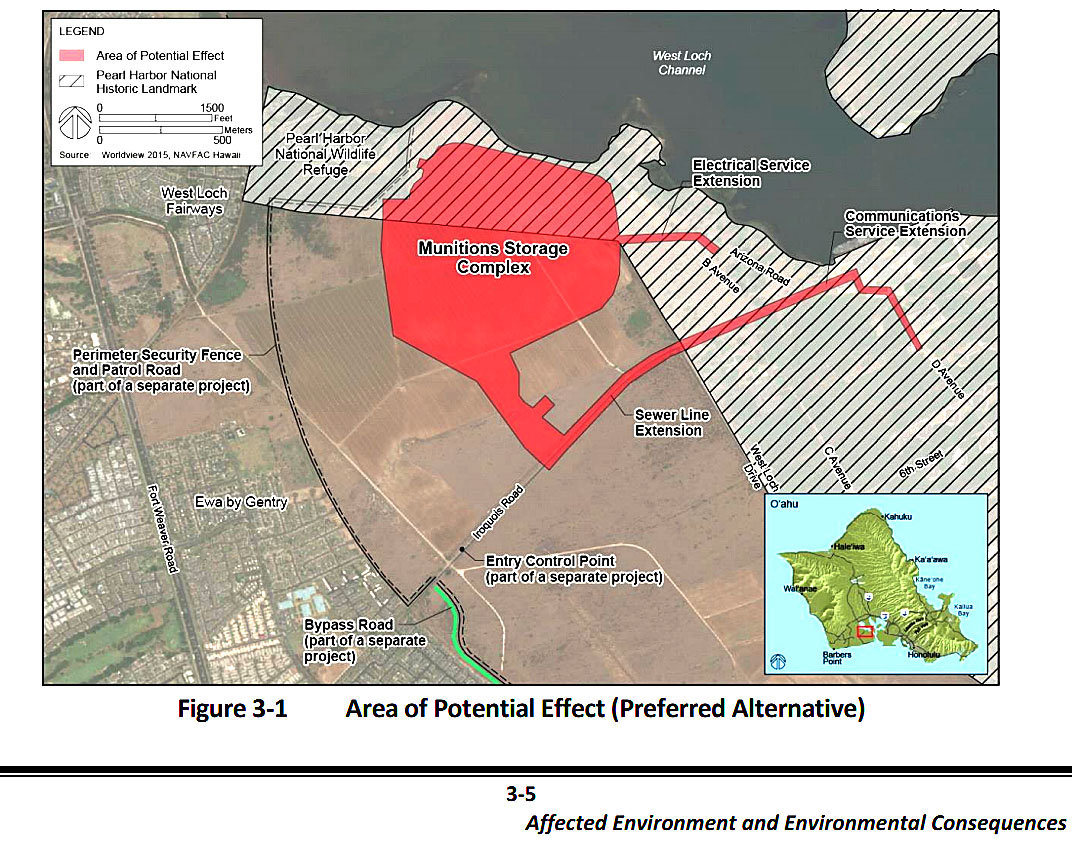
The United States Army plans to build an enormous weapons facility storing stockpiles of conventional warheads and explosives right next to the residential housing communities of Ewa Beach, Ewa Villages, West Loch Estates, and Ewa Gentry, as well as beside the Pearl Harbor National Wildlife Refuge in Hawaii. This Pacific island paradise already has the largest concentration of United States military bases and compounds in the country, making it one of the most militarized places on earth. Were it to secede from the Union, Hawaii would be a major military power on a global scale. And now, more weapons are on the way. A lot more.
The size, scope, and expense of this massive construction project must be considered, as well as the immediate danger placed on the residents of the surrounding communities. Equally important is whether the pre-positioning of such massive amounts of live warheads and munitions is in the interest and safety of the American public. Pre-positioning means ready to use. Locked and loaded. We’re off to war. This decreases the time for diplomacy and increases the likelihood of the weapons’ use. Do we really want to stockpile yet more weapons on this over-militarized island in preparation for the next big war? Is this a prudent strategy, or rash and perilous behavior?
In a 164 page report written by the Department of the Navy for the Army, titled “Finding Of No Significant Impact (FONSI) For The U.S. Army West Loch Ordnance Facilities At Joint Base Pearl Harbor-Hickman (JBPHH), Oahu, Hawaii,” the Navy states this project will include 27 new box type “D” magazines, eight modular storage magazines, administrative and operational facilities, accessory roads and concrete pads, utility service and distribution, site drainage, security features, and fire lines. For the record, a box type “D” magazine has an estimated footprint of 8,000 square feet. Again, there will be 27 of these. An 86,000 square-foot vehicle holding yard, a 50,000 square-foot vehicle inspection area, and a 20,000 square-foot residue storage warehouse are among the other larger items to be built.
Despite this massive construction project, the Navy asserts no significant direct, indirect, or cumulative environmental impact to the area. The Navy then doubles-down on the absurdity, stating the proposed facility would actually result in beneficial impacts to public health and safety, an interesting argument for the storage of millions of pounds of explosive materials not more than a half mile from a housing development.
The report continues in the same vein using language meant to be innocuous and reasonable, but which is deadly serious, by arguing the massive weapons complex will cause no impact to cultural resources, biological resources, socioeconomic conditions, and minimal impact to land use. The Department of the Interior even signed off on the environmental impact argument, thereby proving the obvious, that all branches of the government work for the Pentagon.
Explosive munitions would be on and off-loaded at this site from a variety of ships, trucked and forklifted to warehouses, and then carted back to other ships ready for war. An accidental explosion would be devastating to these residential communities, carrying the potential to kill and injure hundreds. Homes, businesses, parks and schools all would be in the blast zone, or the “explosion arc.”
Additionally, an accidental blast there could ignite even greater blasts at Pearl Harbor facilities and Hickam Field, a chain reaction of deadly explosions the Navy refers to as “sympathetic explosions.” The 1969 USS Enterprise fire near Pearl Harbor began when a Zuni rocket accidentally detonated under a plane’s wing and ignited additional munitions, blowing holes in the flight deck which allowed jet fuel to ignite the ship. Twenty-eight sailors were killed, 314 were injured, and 15 aircraft were destroyed at a cost of over $126 million. This accidental explosion occurred offshore and far away from residential neighborhoods. Such an explosion at this new facility would cause far greater loss of life and property.
Especially noteworthy about this new weapons facility is the shortened safety distance between the bomb storage buildings and the residential population, less than a half mile from the new Ewa Gentry North Park housing development. Other storage facilities such as Indian Island in Washington State and the Earle Ammunition Loading facility in New Jersey have far greater explosion arcs, while the Army MOTSU site in North Carolina has a 3.5 mile explosion arc. The recent accidental explosion in Beirut, Lebanon, though not of military munitions, left a blast zone of 6.2 miles. The data used to calculate these explosion arcs is, according to the Navy, classified. Additionally, the types of ammunition and exclusive amounts to be stored are also classified. And so, explosion arc is a term whose actual meaning is held in close confidence by the Navy. Trust us, they say.
At the end of their lengthy report, the Navy, not surprisingly, concludes there is no alternative but this. They have, so they argue, done their due diligence. Weapons must be brought here, a new facility must be built, there is no danger to the public or the environment. They are merely fulfilling their obligations under the law by planning, pre-positioning, and preparing for war. Rest assured, they seem to say, all is well. No reason to worry. You are in safe hands. The military is in control. Construction begins in 2022.
--
David Swanson is an author, activist, journalist, and radio host. He is executive director of WorldBeyondWar.org and campaign coordinator for RootsAction.org. Swanson's books include War Is A Lie. He blogs at DavidSwanson.org and WarIsACrime.org. He hosts Talk Nation Radio. He is a 2015, 2016, 2017, 2018, 2019 Nobel Peace Prize Nominee.
Follow him on Twitter: @davidcnswanson and FaceBook.
Help support DavidSwanson.org, WarIsACrime.org, and TalkNationRadio.org by clicking here: http://davidswanson.org/donate.


