The United States Department of Justice on Friday filed a motion urging a federal judge to immediately prohibit New Mexico officials from enforcing House Bill 9, the Immigrant Safety Act, saying the new state law is unconstitutional and would irreparably harm a New Mexico county.
The law prohibits public entities like counties from contracting with the U.S. Immigration and Customs Enforcement agency to hold immigrant detainees. The law has faced sustained pushback in Otero County, where county officials say the measure will result in the loss of up to 284 jobs and force the county to sell its immigrant detention facility, the Otero County Processing Center, at a loss.
The federal DOJ’s Civil Division and the United State’s Attorney’s Office in New Mexico filed the motion for a preliminary injunction Friday in federal court. The defendants are the State of New Mexico, including Gov. Michelle Lujan Grisham and Attorney General Raúl Torrez.
Their letter comes on the heels of new legislation introduced this week by Rep. Sydney Kamlager-Dove (D-Calif.) that would establish care standards for federally incarcerated pregnant people—including those jailed in ICE and Customs and Border Protection facilities. The bill builds on one that the House already passed in 2022, which only applied to those in Bureau of Prison’s custody.
It’s hard to know how many pregnant people are in federal custody, and what percentage of those are immigrants. In 2023, more than 700 incarcerated mothers gave birth in prison, according to the Prison Policy Initiative. Between January 1, 2025, and February 16, 2026, 363 pregnant, postpartum and nursing immigrants were deported, according to the Department of Homeland Security. Sixteen miscarriages were recorded during those six weeks. As of March, there were an estimated 126 pregnant women still being held in detention, according to the senators’ letter.
U.S. states can’t bar immigrant children – no matter their status – from attending public school. The Supreme Court said so in 1982.
A growing chorus of Republicans wants to overturn that decision. Bills in state legislatures over the past year have unsuccessfully aimed to collect data on immigrant students without legal status or charge them tuition. Passing that sort of legislation could put the issue back in front of the Supreme Court someday.
“It’s time for it to go,” Rep. Chip Roy, who’s also running in the Republican primary for Texas attorney general, said of the court ruling during a congressional hearing in March. “Any amount of illegal immigration in our hospitals, jails, schools, or elsewhere should not be tolerated. ... States should have the ability to curb it.”
As the death toll at immigrant detention centers across the country continues to rise, the Trump administration is kneecapping federal efforts to monitor allegations of abuse at these facilities.
Sites such as the Dilley Immigration Processing Center and Camp East Montana — both located in Texas and used to aid President Donald Trump’s racist anti-immigrant crackdown — have been decried by human rights advocates over reported deaths and alleged abuse.
You may have heard of Camp East Montana earlier this year, after a medical examiner determined that an immigrant who was being held there died by homicide via asphyxia, contradicting officials who said the man died after attempting suicide. Last month, NPR reported that the number of immigrants to have died in the custody of U.S. Immigration and Customs Enforcement has already hit a record annual high in the current fiscal year, which began in October. And CBS News reported that a record high for the calendar year is possible as well.
Meanwhile, the administration is undermining efforts to investigate unlawful and abusive behavior toward detained immigrants. HuffPost reported on an internal email, which MS NOW hasn’t independently seen, indicating that the Department of Homeland Security is closing an office tasked with investigating claims of abuse at immigration facilities.
The internal Department of Homeland Security office that oversees detention facilities and conditions is winding down its operations — even as the administration places more people in detention, and for longer stints.
Congress created the Office of Immigration Detention Ombudsman (OIDO) in 2019 to investigate detainee deaths, detainee access to medical care, and employee misconduct, among other issues.
In a statement to NPR, DHS said the office shut down because of the current funding lapse in Congress targeting immigration enforcement.
Congress last week finally ended the longest agency shutdown in U.S. history, agreeing to fund most parts of DHS — but excluding some immigration enforcement functions.
DHS said that it is Congress' fault. DHS who lies regularly to the American people and the American legal system. They're lying again.
Bustillo notes:
But the measure passed by Congress and signed by President Trump to fund most parts of DHS did not mandate the closing of the office.
Republicans are separately looking at a partisan process known as reconciliation to fund all of DHS, including ICE and Border Patrol, for the remainder of Trump's term without any Democratic support. It is not clear if OIDO would reopen if ICE and Border Patrol are funded.
Even before the shutdown, the Trump administration had been stripping down the office's functions and laying off staff in civil rights areas. That comes as the number of people who have died in immigration custody has reached an all-time high for the fiscal year.
While Melania ignored the mothers in need, American Friends Service Committee doesn't. They issued the following:
Mother’s Day is a time to celebrate the women who raised us—to honor their love, their sacrifice, their strength. But today, thousands of immigrant mothers are separated from their children and loved ones by detention. Across the U.S., mothers are locked up in immigration detention centers. Many more are left to care for their families alone after a loved one is detained or deported.
No one should be torn away from their loved ones. Families should never be separated by walls or borders. That’s why, with your support, AFSC is working alongside communities across the country to end detention for good.
This week, dozens of community members in San Diego, California, and Denver, Colorado, showed up for mothers in detention. We wanted everyone behind those walls to know that people outside stand in solidarity with them, that they are not forgotten.
In Colorado, community members gathered for a vigil outside the GEO Detention Center in Aurora. We held handmade signs and candles and delivered our messages through a megaphone so everyone inside could hear.
In San Diego, many community members came together to make Mother’s Day cards for people in detention. On Friday, we brought the cards and yellow flowers to Otay Mesa Detention Center, where we hoped they would be delivered to people inside.
These acts of solidarity are one part of a broader effort to support families facing detention. They also highlight the cruelty of our immigration system.
“Writing a Mother's Day card to someone who is currently being detained exemplifies the idea that everyday people are thinking about those who have been deprived of their freedom,” says Adriana Jasso, coordinator for AFSC’s U.S-Mexico Border Program. “We need to communicate to the public that immigration law and policies—as harmful as they are—don’t just impact mothers being held, but also their children and extended community. We have a responsibility to call out the inhumanity of a system that continues to take away people’s freedom and potentially their future.”
Since the start of the Trump administration, Immigration and Customs Enforcement (ICE) has vastly expanded detention and deportation. ICE has detained the parents of at least 50 U.S. citizen children per day, according to research by ProPublica. It has also deported four times as many mothers of U.S. citizen children per day as the previous administration did.
The people behind these numbers are mothers, children, and whole communities.
From California to New Jersey, AFSC provides direct support to families impacted by detention and deportation. That includes legal representation, social work, accompaniment, and other support.
In Florida, AFSC is part of the Miramar Circle of Protection. Since 2017, the group has offered mutual aid, information, and other resources to immigrants navigating the immigration system.
Every Wednesday, AFSC staff and volunteers set up across the street from the local ICE facility in Miramar. We offer water, coffee, homemade pasteles, clothing, Know Your Rights information, and legal referrals. When someone comes for an ICE appointment and gets detained, our team documents what they can and helps families locate their loved ones.
AFSC Campaigns Coordinator Maria Bilbao helped found the Circle of Protection. In recent months, she says the group has assisted mothers facing eviction, deportation, and family separation.
Gladis is a mother of two. Her youngest was just two weeks old when ICE detained her husband while he was walking to the neighborhood store. Without her husband’s income, Gladis couldn’t pay the rent or afford groceries or diapers. The Circle of Protection mobilized, helping raise funds from the community to cover her rent for three months and other expenses until she figured out her next steps.
Doris and her husband were both detained and facing deportation. Maria connected them with legal help to get their affairs in order. The parents made the difficult decision to return to Honduras with their young children. Maria helped Doris get passports for their children so they could make the journey together.
Ana* came to the Circle of Protection after her husband was deported during an ICE check-in at the facility. She didn’t know how she was going to support their family. The group provided her with some financial assistance. They brought toys for her kids. And they connected with a local immigrant services organization that could offer long-term support.
“We are not charity,” Maria says. “We are showing up. We are bearing witness. We are documenting everything we’re seeing. We are there every day to stand with immigrants facing detention and injustice.”
This is what community looks like—people choosing to show up for one another. None of this work happens without people who believe families belong together and that all people deserve to live in dignity.
Because of supporters like you, we can walk alongside mothers like Gladis, Dori, and Ana—offering care, resources, and solidarity in the hardest moments.
This Mother's Day, we stand with every mother harmed by detention and deportation. We stand with every family forced to navigate this inhumane system. And we will keep standing until every mother can spend this day where she belongs—with her children, her family, and her community.
Pope Leo XIV’s pick to lead West Virginia Catholics is a prelate who was at one time an undocumented immigrant. Evelio Menjivar-Ayala, who has served as an auxiliary bishop in the archdiocese of Washington D.C. since 2023 and has now been selected by the pontiff to become the new bishop of West Virginia, is a Central American immigrant who fled for his life hidden in the trunk of a car, The Guardian reports.
“Born on 14 August 1970, in Chalatenango, El Salvador, Menjivar-Ayala’s journey to the priesthood began in the violence of the Salvadorian civil war, where he and his family narrowly survived being fired upon by soldiers while fleeing their home, he previously told the Catholic Standard,” The Guardian said. “After two failed attempts to reach the US, hindered by deportation and a guide who deserted the migrant group, he finally succeeded on his third try, despite a brief imprisonment in Mexico and a grueling desert crossing.”
Menjivar-Ayala, who arrived in the U.S. with just an extra set of clothes as his only possessions, worked a series of essential jobs in construction and janitorial services while earning his GED before entering the priesthood, The Guardian noted.
During a press event announcing his elevation to bishop of West Virginia, Menjivar-Ayala pledged to stand by working people, including immigrants. Menjivar-Ayala has already asserted fierce support for immigrant communities as Washington’s auxiliary bishop, including penning an April 2025 National Catholic Reporter op-ed that rebuked the federal government’s mass deportation agenda and urged faithful to not be complicit in the targeting of their neighbors.
“To those of you who are silent or think this does not involve you, to those of you who are not troubled by this — or worse, who applaud it — particularly those who are Catholic, I ask you: Do you not see the suffering of your neighbors?” he wrote. “Do you not realize the pain and misery and very real fear and anxiety these unjust government operations and policies are causing? Is your conscience not disturbed? How can you stay quiet? In the final teaching of his public ministry, Jesus warned that we will be judged on how we respond to others in distress (Mt 25:41-46).”
This diversity reflects the diversity of the Church in America itself. Immigrants have of course always been a key Catholic demographic in the USA, since it is itself a nation of immigrants. However, over the past century their countries of origin have mostly shifted away from Europe.
Just in the first week of May this year, Leo XIV has appointed five bishops. On May 1, 2026, he made four episcopal appointments: two of them are immigrants, and a third will be the youngest bishop in the country. The fourth was a later vocation with a background in military service. Then, on May 6, he named the fifth, tapping a Jesuit priest to head the Diocese of Honolulu.
More than 200 people gathered May 6 at Sacred Heart Major Seminary in Detroit to discuss the Church’s prophetic witness regarding the debates surrounding immigration and the impact current federal policy has had on immigrant communities over the past two years.
Priests, bishops, parish leaders and immigration rights advocates from 10 dioceses participated in “Witness to Hope: Pastoral Care of Immigrant Communities,” a collaborative effort between the Archdiocese of Detroit, Catholic Charities of Southeast Michigan, the Hope Border Institute in El Paso, Texas, and the Center for Migration Studies of New York, to discuss what the Church can do at the parish and diocesan levels to accompany immigrant communities amidst the expansion of immigration enforcement initiatives taking place during President Donald Trump’s second administration.
This was the third daylong summit, following previous “Witness to Hope” gatherings in Providence, Rhode Island, and Phoenix, Arizona, in recent months.
“The goal here today is to get us energized to take the next steps as dioceses, parishes, religious congregations or as groups of Catholic organizations, because some of you might be doing pretty well in a lot of things,” said Fr. David Buersmeyer, a priest for the Archdiocese of Detroit and chaplain for Strangers No Longer, a Detroit-based, lay-led Catholic immigration rights advocacy group.
An Atlanta-based appeals court has struck down the Trump administration’s mandatory detention policy for immigrants in federal custody, clearing the way for more people to wait at home while their deportation cases wind through the court system.
In a 2-1 decision issued Wednesday by the 11th U.S. Circuit Court of Appeals, a three-judge panel ruled that the Department of Homeland Security can no longer deny bond hearings to people in immigration detention, including those who have been living in the U.S. for years with no criminal records.
Schiff:“…This regime is emerging more powerful, at least it feels it’s more powerful, more entrenched, more hard line, more of a threat to its own people. It’s the result of entering a war without thinking about the consequences and conducting it incompetently. And the fundamental weakness of this president.”
Washington, D.C. – U.S. Senator Adam Schiff (D-Calif.) joined MS NOW’s The Last Word with Lawrence O’Donnell to break down President Trump’s ineffective negotiations aimed at ending his illegal Iran war.
Last week, Senator Schiff led the sixth War Powers Resolution aimed at requiring the administration to end this illegal war. The procedural vote would have brought Senator Schiff’s resolution up for Senate consideration on the 60-day mark after the administration’s notification to Congress, coinciding with the War Powers Act’s statutory clock running out.
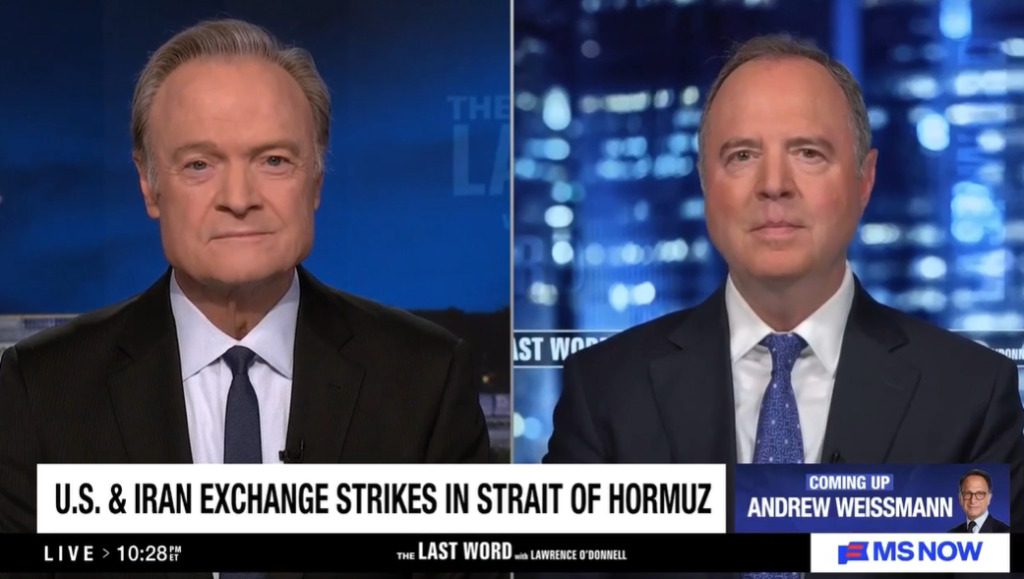
View the full interview here.
Key Excerpts:
On Americans paying the price of the Iran war:
[…] But Iran now feels empowered. It feels like the clock is ticking on its side. It feels the president is desperate for a deal. You hear the president talking about a deal basically, that sounds a lot like the deal that Barack Obama struck that he so ridiculed. And he wishes to distinguish it somehow by saying, no. No, this deal will be different, because this deal, in this deal, Iran promises not to develop a bomb. Well, I guess, I guess that’s really something we can now rely on. Iran’s word. So, we are just saying, as you said, the president having trapped himself growing weaker and weaker, and sadly, he has also trapped the country. And we’re paying for it. Prices are now 50% higher at the pump, and Donald Trump said today that if they went up another 50% and were paying double that, it would be worth it. Well, I don’t think the American people feel this is worth it at all.
On the weakness of President Trump:
[…] And unfortunately, even if we went back to the JCPOA, Iran now feels that it has the leverage, because it can shut down the strait, and any threat that it might shut down the strait. For example, if it doesn’t abide by any deal struck with President Trump in the future, and the president threatens to snap back sanctions. Which is basically the same mechanism as under the Obama JCPOA. Iran can threaten, well, if you snap back sanctions, we’re going to close the strait. And that now is a powerful threat that really wasn’t the case before this ill-considered and unlawful war. So tragically, I think this regime is emerging more powerful, at least it feels it’s more powerful, more entrenched, more hard line, more of a threat to its own people. It’s the result of entering a war without thinking about the consequences and conducting it incompetently. And the fundamental weakness of this president.
###


